Internet Safety

There are some basic rules to keep in mind when you are on the Internet:

  • NEVER put pictures of yourself online.
  • NEVER use your last name.
  • NEVER say where you live (street, city, area).
  • NEVER enter a chat room.
  • NEVER respond to threatening email or messages.
  • ALWAYS tell an adult (parent or teacher) about scary messages, chats, emails,or other communications.
  • TELL your parents about any ‘new’ friends you meet online.

Parents, there are some simple things you can do to help keep kids safe:

  • Monitor what your child is doing online. Keep your computer in a ‘high traffic’ area.
  • Have your child show you what they like to do online.
  • Sit with your child as they play games, chat, email, etc.
  • TALK constantly about online safety.
  • Install child safety software on computers, phones, iPads, iPods, tablets, etc.
  • Open communication at all times.

Great Resources:

Inspiration

I love it when I am in the middle of a lesson and I get a ‘brainstorm’. My students are so used to it at this point in the year. Today was another ‘brainstorm’ kind of day. We were just beginning a lesson on Geometry. Today was the review of 3-D shapes — sphere, cone, rectangular prism, pyramid, cube, and cylinder. So there I am ‘blah, blah, blahing’ away, when it hits me… Have the kids make ’em… Out of pipe cleaners and paper and whatever else! Brilliant! And of course I stop the lesson to write it down. Wouldn’t want to forget my own brillance!

When I am finally finished, sounding much like Charlie Brown’s teacher I’m sure, I share my idea with the students. Together — because most of my great ideas are just a base, and not fully formed — we worked out the specifics. So in the end, groups worked together on how to make the shape assigned, find out how many vertices, edges, and faces AND then make a short video. They did a great job. Here is a sample video.

And tomorrow I will try that whole flip the classroom thing again. Hope it goes better than last time.

Different ‘Sheets’ in Google Spreadsheet?

Yes, it is possible to to create several pages or ‘sheets’ in Google Spreadsheets. Many people avoid spreadsheets due to their complexities. However, they don’t have to be difficult. This is an example of a spreadsheet my site uses to keep track of AR goals.

You will notice that on the bottom left of the page, the months are listed

 You are seeing a view of March.

Simply click on the desired month and enter the data (student names in this case).

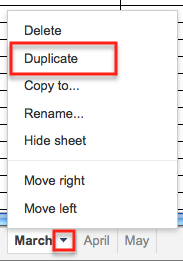
The ‘Sheets’ were easy to create. By simply creating the desired format (or template) you are then able to copy that to another sheet. For this example, I clicked the small arrow next to March. I then clicked Duplicate. The next sheet was created as ‘Copy of March’.

On ‘Copy of March’ I again clicked the arrow and chose Rename… I can then Rename it ‘June’ then ‘Move right’ to place the sheet in the desired location.


The ‘Flipped’ Classroom

I recently stumbled upon the concept of a ‘flipped classroom’ — Yes I know, it’s not THAT new. I have been fascinated with it for months now. Essentially a flipped classroom is where the ‘basic’ learning and lecturing is done outside the classroom — generally at home for ‘homework’. This allows students and teachers to arrive at school the next day ready to dive into deeper concepts, projects, and/or tasks. As I teach 3rd grade and not all students have access to a  computer (or internet) at home, I wasn’t (and still aren’t) sure how to accomplish this successfully. So today I ‘dabbled’ with flipping a classroom. We are fortunate to have a computer lab with 30 computers. We are also fortunate enough to have EnVision Math (Pearson) in our district for grades k-5. So the students were assigned certain learning videos. Then later in the day, we had our lesson. Was it a success? Not so much. I’m guessing it has more to do with the learning objectives than the process. You see, we are beginning ‘long division’. That wonderful task of dividing a 2-digit (or more) number by 1-digit. As it was a hard concept for 3rd graders, I will try ‘flipping’ the classroom again. Maybe with something a bit easier. I’m thinking I may have better luck with some Science concepts. I’ll keep you posted.

Please share any experiences you have with flipping a classroom. What worked? What didn’t?