The Organized Classroom Stream: Stop the Scroll and Help Students Find Their Work

“Where do I find that link?”
“I don’t see the assignment!”
“Where do I go?”

If you are a K-5 teacher, and likely beyond, you’ve likely heard these phrases on repeat. As an instructional coach and Tech TOSA, I see the “Digital Scroll of Doom” in half the classrooms I visit. If you identify with this, you’re not alone. I used to have this, too. It isn’t just a nuisance; it’s a drain on your most precious resource: Instructional Minutes. Every second a student spends hunting for a file is a second they aren’t engaged in the work. It’s time to move from a “Digital Dump” to a “Curated Workflow.” Here is how to dial in your Google Classroom for maximum efficiency.

Step 1: Silence the “Scroll of Doom”

By default, Google Classroom clutters your Stream with every assignment and material you post. This turns your communication hub into a chronologically messy place where important announcements get buried.

The Fix:
1. Go to your Classroom Settings (the gear icon).
2. Scroll to General.
3. Change “Classwork on the stream” to “Hide notifications.”

“But… how will they know what to do?”

This is the number one concern I hear. The answer is simple: The To-Do List. Whether an assignment has a due date or not, it automatically populates in the student’s personal To-Do dashboard. By silencing the Stream, you aren’t hiding work; you are teaching students to use their “Digital Planner.” This builds student agency and stops the habit of “hand-feeding” links every ten minutes. Students become self-sufficient.

Step 2: Choose a Consistent Topic Strategy

Once the Stream is clean, the Classwork tab needs a map. In K-5, there isn’t one “right” way, but there is a consistent way. Here are the two most effective structures I see in “Dialed In” classrooms:

  • The 5-Day Static Loop: Create topics for Monday, Tuesday, Wednesday, Thursday, and Friday. When you post a new assignment, put it under the corresponding day. Because Google Classroom places the newest post at the top, students develop muscle memory. They know exactly where the “fresh” work lives. Use color dots (e.g., πŸ”΄ Monday, πŸ”΅ ELA, etc.) to create visual anchors for younger readers and ELD students.
  • The Subject Specialist: Organize by Math, ELA, Science, etc. This helps students categorize their learning. Use Emojis (e.g., πŸ”’ Math, πŸ“– ELA) to create visual anchors for younger readers and ELD students.

Pro-Tip: The “Guest Teacher” Landing Zone
Create a permanent topic at the very top labeled “πŸ˜€ Guest Teacher / Coach.” When I walk into a room to guest-teach a lesson, we don’t waste 5 minutes navigating. I tell the students, “Go to the Guest Teacher topic,” and we start the math immediately. That is pure efficiency.

Step 3: The Quarterly Sweep

Efficiency requires maintenance. Even a static 5-day loop can become a mile long if it’s never pruned. That MathRep you did in September doesn’t need to be in the way of the work you’re doing in November.

The Strategy: At the end of every quarter or trimester, perform a 5-minute audit.

  1. Create a topic at the very bottom titled “πŸ“ Past Work [T1].”
  2. Drag old, completed assignments into this “Warehouse.”
  3. Delete any one-off materials or broken links that are no longer relevant.

If waiting until the end of the quarter or trimester doesn’t work for you, try the end of the month or every few weeks. The point is to create a system that works for you and is sustainable.

The Bottom Line: Instructional ROI

A clean digital classroom isn’t about being “neat” or “organized” for aesthetic reasons. It’s about Instructional ROI. When you flip the Stream switch and pick a consistent topic structure, you are reclaiming time for yourself and your students. Stop acting as a human search engine and start using those reclaimed minutes for what matters most: helping your students find success.

Google Classroom & Your Phone

Google Classroom

During class today, I assigned a quick summary of what we read together. It was at that point that I pulled a small group aside so that they would be successful and get small group instruction on specific skills.

While working with the small group, I noticed a few students who seemed to not be working. So I pulled out my phone! I quickly pulled up the Classroom App and went into select students’ work to monitor their progress. Needless to say, my observations proved correct. This allowed me to have a quick correction with those students and at the same time putting the rest of the class on notice. Just because I am working with a small group doesn’t mean I don’t know what you’re doing!

Ah, the wonders of modern technology. Used correctly, it can be a powerful tool.

Google Classroom – Personal Accounts

So I received this today in my inbox!

Screen Shot 2017-03-28 at 5.49.59 PMΒ A few days ago I wrote about Google Classroom andΒ Personal Accounts. I applied for early access and was granted it today! The nerd in me is super geeked.

This is a game changer for me. First of all, I enjoy sharing my knowledge of Google Classroom with the masses. Secondly, a friend and I thought about created classes that people could take to become more proficient in technology use in the classroom. THIS is the perfect tool to get that going.

I can’t wait to see what uses others come up with.

Google Classroom For All

Screen Shot 2017-03-22 at 6.35.50 PMOh. My. Goodness! I am so giddy, I can hardly contain myself. Google Classroom is open to everyone. Since Google rolled out Classroom (beta) in the summer of 2014, it has only been available to G Suite users (organizations): this included schools and non-profit organizations. Now, it is available on personal accounts.
One of the limitations of having it available to G Suite usersΒ was that you could only join a classroom if you had an account within the organization. Now that everyone has it, we can join each others’ classrooms. So why would a person want to create a classroom? Well, last summer a friend wanted to have book discussions and tried using another product. It just didn’t work very well. However, since Google Classroom has many features that educators and non-educators alike are familiar with, Classroom lends itself easily to book clubs. In addition, I was thinking of starting ‘how to’ tutorials that were more personalized. This will accomplish the task.

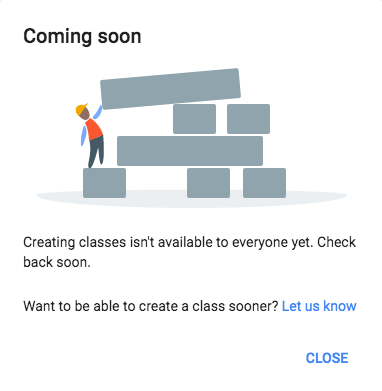
Screen Shot 2017-03-22 at 6.36.16 PMSeriously, I’m so excited! Check it out. Go to Classroom.Google.comΒ While you cannot currently set up or join a classroom, you can request early access. For more information on what Google Classroom can do check out my video series.

Google Classroom – Adding Materials

One feature that I really like in Google ClassroomΒ is the ability to add materials. My class is currently working on a project, with a digital text. I want them to be able to access the text at any point.

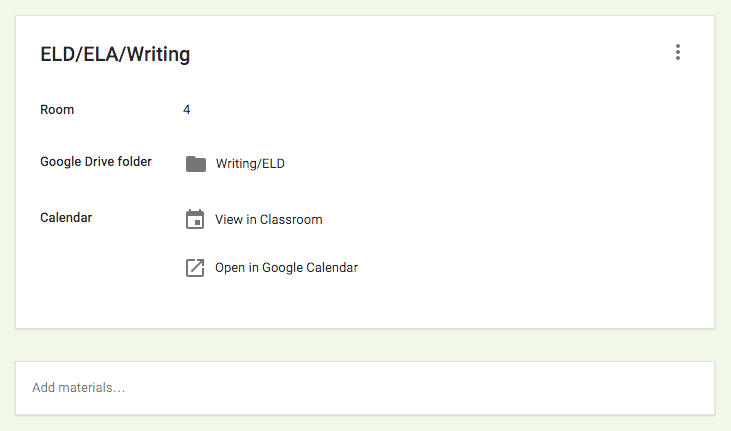
After logging into Google Classroom, I navigate to the classroom where I’d like to add materials. From the Stream page, I click on About.

Screen Shot 2016-03-13 at 8.01.06 PM

Now that I am on the ‘About’ page, I can add the desired materials. The first box on the page contains Course Information. The second box allows you to ‘Add Materials’.

Screen Shot 2016-03-13 at 8.06.48 PM

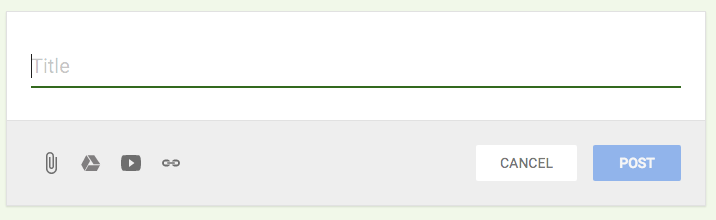
Simply by clicking on ‘Add materials’, the box changes to give you choices.

Screen Shot 2016-03-13 at 8.07.30 PM

You’ll notice that after adding a title to your materials, you have the option to add a file from your computer, Google Drive, YouTube, or a link. You have the ability to add as many as needed.

Screen Shot 2016-03-13 at 8.09.50 PM

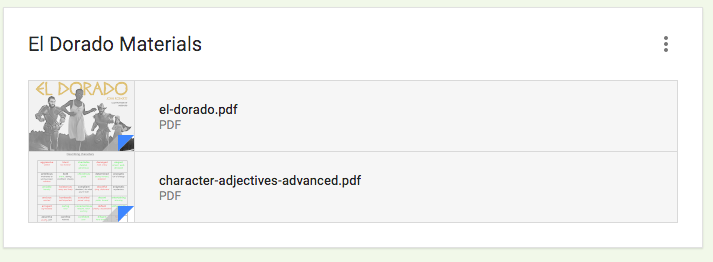
The three dots in the right corner allow you to edit or delete the materials.

This feature is a great way to keep all important materials in one place. In Writing, you can house all your rubrics. Math can house tutorials. The possibilities are endless, syllabus, study guides, videos, whatever you can think of!

Google Classroom: Drive Folder

One of the nice features of Google Classrooms is the folder that is automatically created in Google Drive. I like to use this when I am looking at student work. We have been working on our NaNoWriMo stories. We began polishing and editing our work last week (our first week back after break).

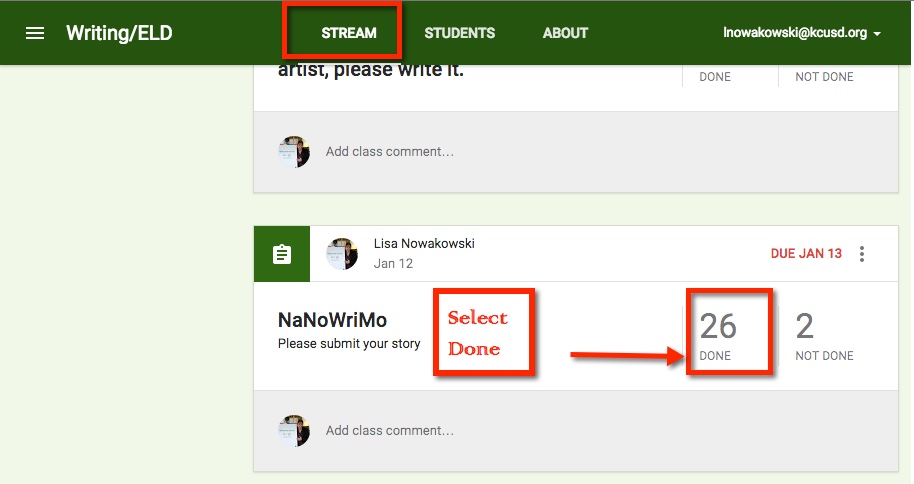
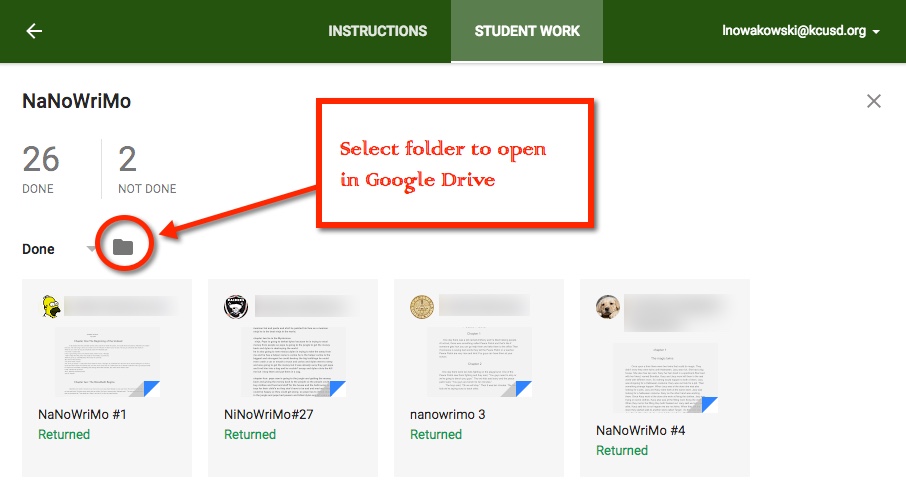
I created an assignment in Google Classroom, turn in their stories. Now that my students have turned them in, it’s easy to read them. While in Google Classroom, locate the assignment and select ‘Done’ (those students who have completed the assignment).

class folder 1Β This takes me to a new page within Classroom. Here, I see thumbnails for those students who have completed the assignment. However, just above the thumbnail is an icon of a folder. Click that to open a new tab, Google Drive.
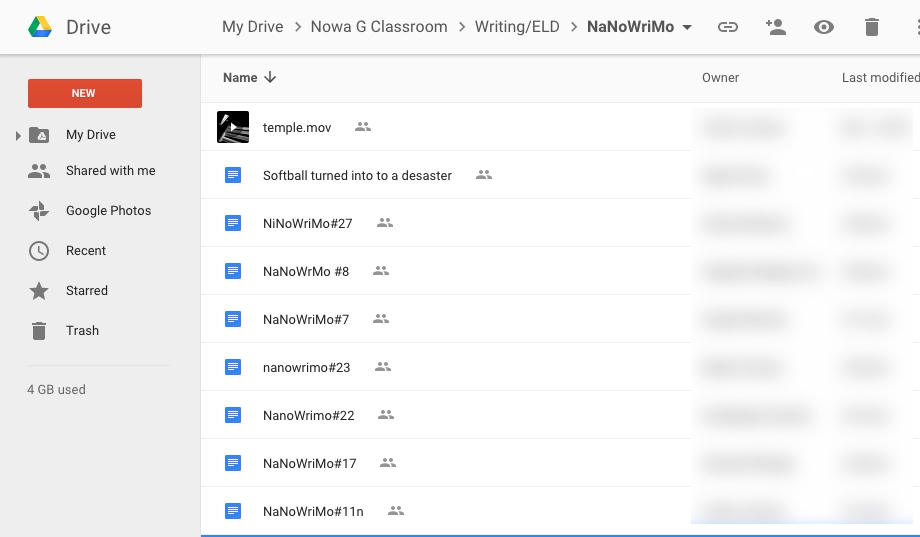
class folder 2Β Once the Google Drive tab opens, you can easily navigate your students’ work.
class folder 3

NOTE: This is just one of several ways to access the Drive Folder.

Google Classroom: Calendar Notifications

The integration of Google Calendar with Google Classroom has been helpful. Many schools require students to have a Planner [book]. This allows students to write assignments due dates, project deadlines, and tests. Google now assigns a Calendar with each Classroom you create. Then when you create an Assignment or Question, it automatically creates an event in the Calendar. However by default, there are no notifications reminding students of the Assignment or Question deadline. That can easily be changed. And by doing so, helping to create a digital Student Planner!

Navigate to your Google Calendar or Google Classroom – About Page.

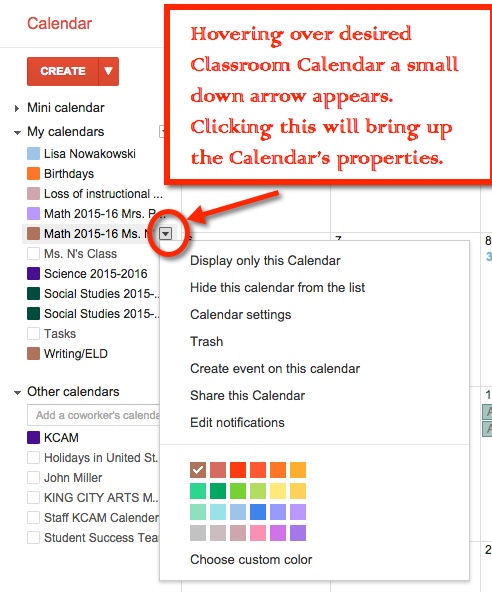
The left side lists all the Calendars. Each Classroom has it’s own. By hovering over the Classroom Calendar, a small down arrow appears. Choose it to set the properties. Choose Edit notifications.

Calendar 3

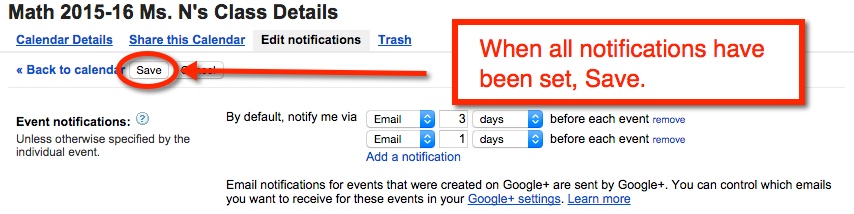
This will send you to a new page. There are a few options on this page. Event notifications is the first choice. This allows you to send emails or pop-up notifications to all attendees (students). You can send several if you choose. Say an Assignment is due on Friday, you may want to send a notification to students 3 days before it’s due AND the day before.

Calendar 5Calendar 6

You can add as many Notifications as necessary. When you are done, remember to Save.

Calendar 7


Google Classroom: Create Question

In Google Classroom, I like to ‘Create a Question’ for quick checks or exit tickets. They are easy to create and manage. Students can read each other’s posts, comment, and have quality discussions with ‘Questions’. This is an underused tool by many who use Google Classroom. It truly is a hidden gem in this tool.

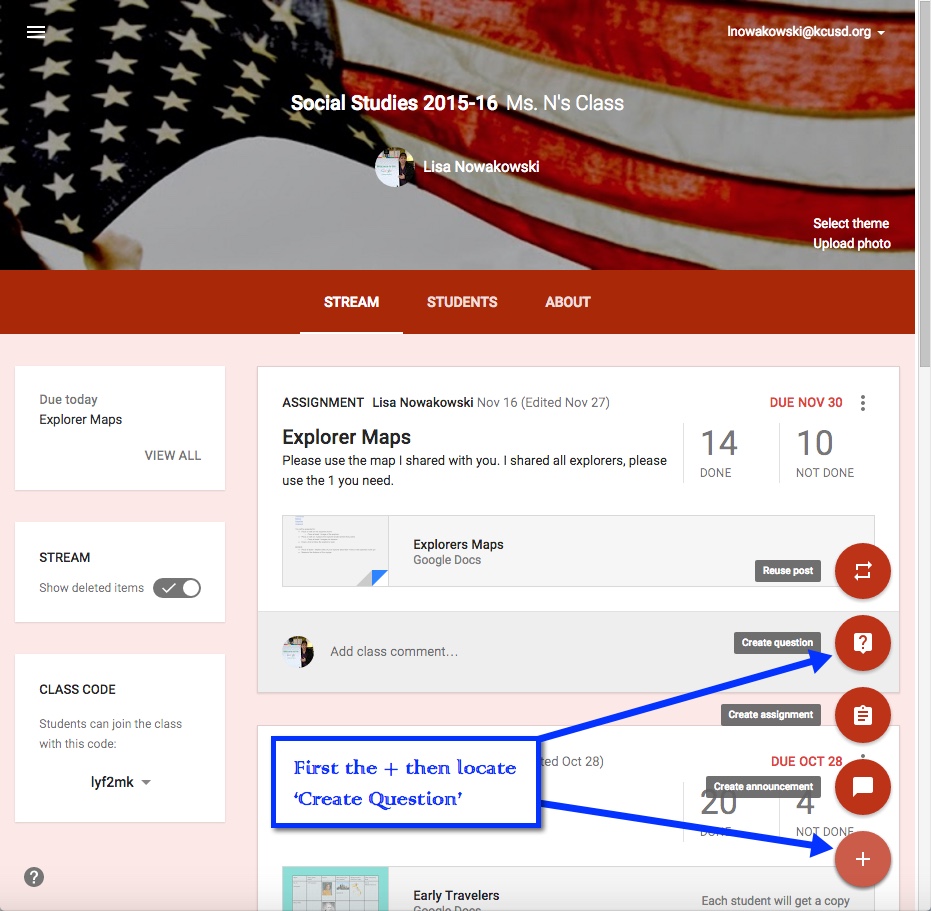
In order to create a Question, choose the + located in the bottom right corner of the ‘Stream’ section of your classroom.

Question 1

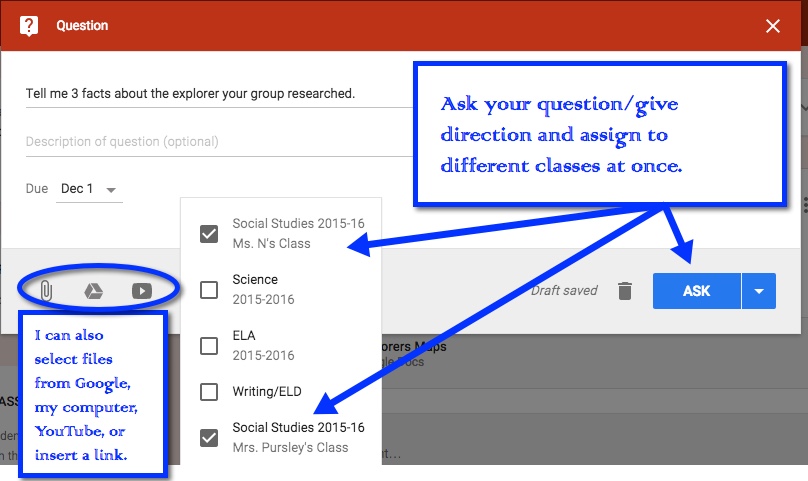
Now I can create my question. I can insert a file, something from my Google Drive, a YouTube video, and/or a link to a website. I can insert as many items as needed. Since I teach 2 classes of Social Studies, I can assign the question to both classes, with files and links, at the same time. I can even set a due date. When I have my preferences set, I choose the blue ‘ASK’ button.

Question 2

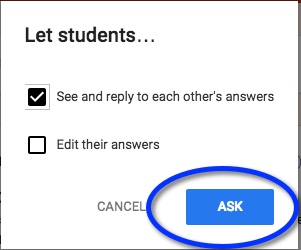
Next a pop-out window appears where I can allow students to view each other’s responses, or not. I can also allow students to edit their own responses. I like to allow students to comment on each other’s. This allows for discussion and opportunity for students to defend their positions. When I’m ready, I click the blue ‘ASK’ button.

Question 3

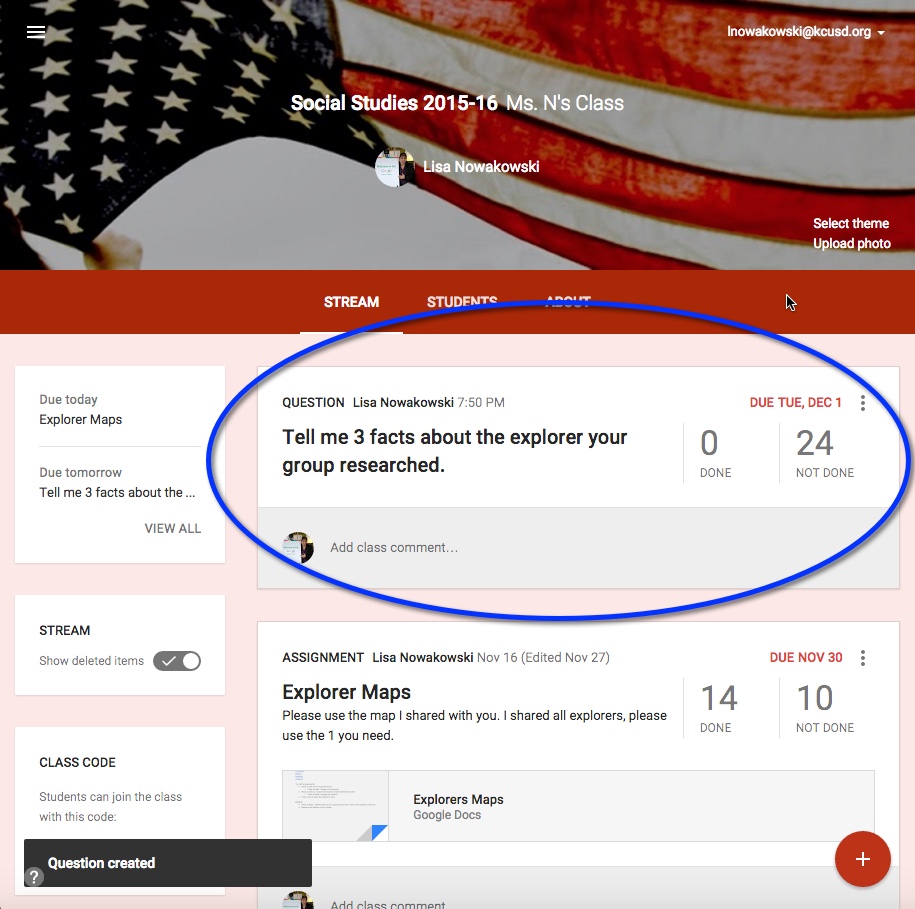
My question now appears at the top of the stream.

Question 4

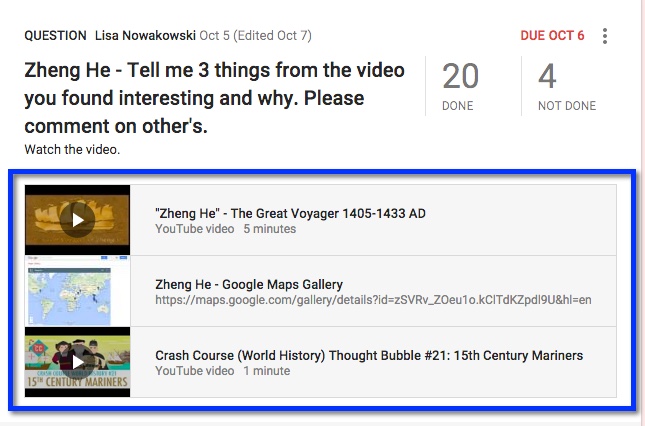
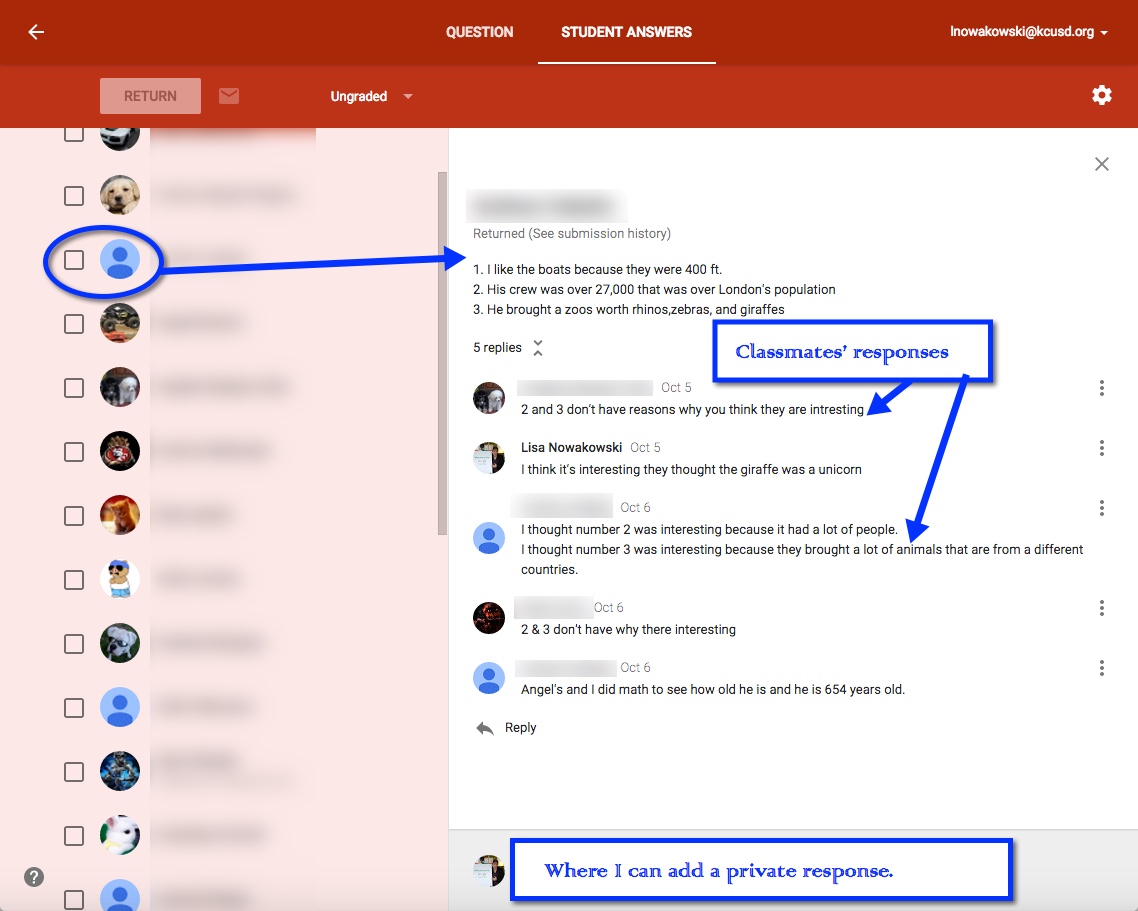
Here’s an example we did early this year. Once the students respond, I can then grade their answers if I choose to. On this particular example, I gave the students some material to review before answering. In order to encourage open dialog, I also asked them to comment on each other’s responses.

Question 5

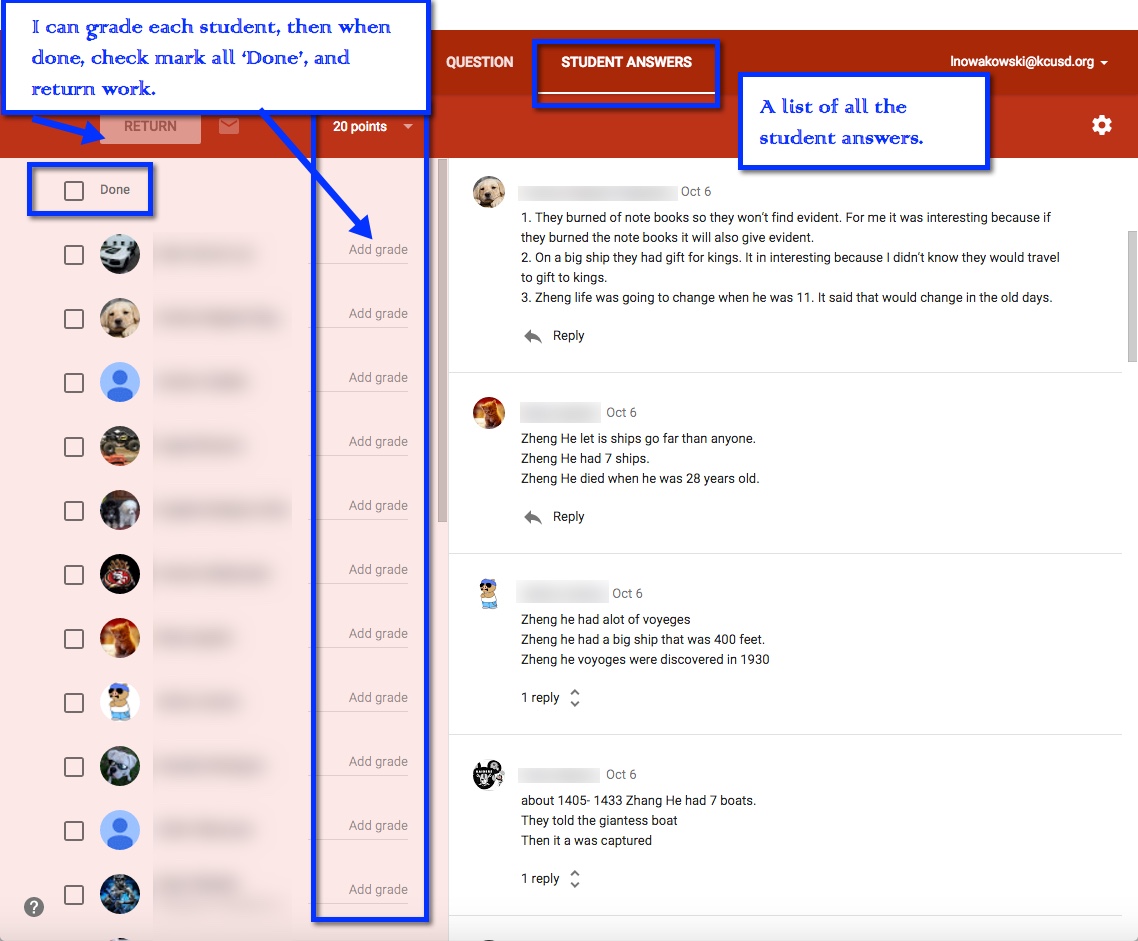
When I’m ready to view, I can click on ‘Done’ in the Question. This takes me to the Student Response page. All of their responses are listed along with the option to grade, comment, and return work.

Question 6

When I click on an individual student, I can see his/her answer and the classmates’ responses.

Question 7