In the sports world, athletes don’t spend the week before a championship learning new plays. They spend it “polishing”, perfecting their form, sharpening their reaction time, and ensuring their fundamentals are second nature. However, as a lifelong Detroit Lions fan, I’m not sure this analogy is always accurate. While I love my Lions, there have been plenty of games where it looked like they just learned the plays in the huddle! But all joking aside, as educators, we are preparing our students for life skills, not just a state test.
The Problem: The “Skill Blur”
When students are sitting at a computer, facing math problems one after another, cognitive overload is a real threat. The “how and when” of the four operations can easily get jumbled with fraction rules, and suddenly, all that geometry vocabulary becomes one big ole mess in their heads. This can be frustrating for both students and teachers.
It’s not that they didn’t learn the material; it’s that the retrieval is getting blocked by the sheer volume of information and tasks that need to be completed.
The Solution: MathReps as a Tactical Warm-Up
MathReps lower the affective filter by repeatedly practicing these core skills. I remember a year when my students didn’t just “do a unit” on decimals; we consistently spiraled decimal practice into our MathReps alongside other skills.
Because it was part of their regular routine, when they eventually faced a screen with decimal problems and tasks at the end of the year, they didn’t panic. The decimal didn’t throw them because it wasn’t a “guest star” in the curriculum; it was a familiar friend. By using MathReps as a 10-minute daily “Tactical Warm-Up,” we help students:
- Filter out the Format: They’ve seen the area model and the number line hundreds of times. The “test screen” is just another canvas for their existing skills.
- Sharpen the Fundamentals: We move from “manual labor” math to automaticity.
The 15-Day “Polishing” Routine
If you have 15 days left before the test, don’t reach for a packet. Reach for a Routine or EduProtocol.
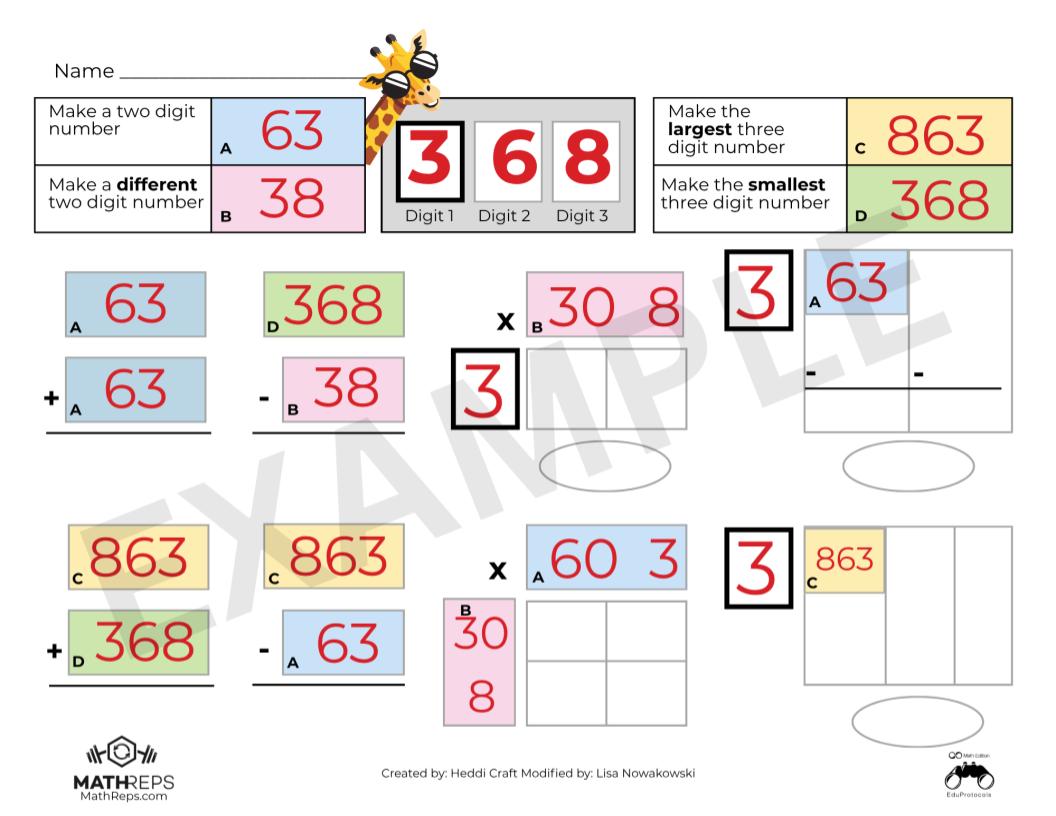
- The Selection: Pick the MathRep that addresses the skill your students find the weakest. If they are tripping over the arithmetic, use an Operations Frame (like the giraffe example below).
- The Routine: Use the same MathRep at the beginning of your math period for at least one week. Consistency beats variety here. On Day 1, they are reacquainting themselves with the procedures; by Day 5, they are mastering the logic.
- The Pivot: After 5 days, if you’re feeling good, move to another high-leverage frame. Or, cycle back to a different MathRep you used earlier in the year to keep those older skills from getting lost in the sauce.
The Bottom Line
We aren’t “cramming” for a test; we are clearing the fog. When we polish these skills through MathReps, we give students the confidence to show what they actually know, rather than getting lost in the “mess” of a testing interface and the information overload that bogs them down.
 Yes, I realize I’m waxing on about L and here’s why. L has run our school’s daily news all year – which is a news broadcast. She films, edits, and most recently, been in front of the camera. When I’m having issues with a computer/tablet she’s the first person I consult and she usually has the solution. She uses her phone as if it were a mini computer: downloading Google Classroom, working on assignments at home, using Raz-Kids, and other programs to help her succeed. She has helped her family to download and set up educational apps (on their phones) to help them be connected to Class Dojo and learn a new language. She ‘texts’ me via Google Hangouts (her school account) to ask school-related questions or just tell me that she’ll be out the next day.
 Slime. A craze that is still going strong in my classroom. While many teachers find it the bane of their existence; I do not. Okay, fidget spinners might be the new bane of our existence. I don’t ban the slime, or fidget spinners, mainly because my students seem to understand that each has a time and place. My students, for the most part, have found a balance between work and slime.
 One student kept the slime in her container, read, and simply played with it by dipping her finger in and out of the slime. She gets a bit nervous because she wants to do well. I believe it helped relieve some anxiety. I took a quick picture and texted it to her mom (our school’s secretary). We just giggled.
 Without a doubt! I have 16 days left in the school year and I need to finish 1 state test and START and complete 2 district ‘Benchmarks’. THEN if one of the district benchmarks is below a certain level I have to administer an additional assessment. Can we say, “Overkill”? If I’m feeling this way, I can’t image how over these assessments my students are.