Transcontinental ELD

A few years ago a friend of mine, Ruth,  contacted me with this crazy (BRILLIANT) idea – to have our students become pen pals. I know, you’re thinking, “That’s not crazy, in fact it’s not even a new idea.” Yeah, I know. You see, my friend lives, and teaches, in Spain – the Basque Country. Ah, now you see how cool this is.

  
http://en.wikipedia.org/wiki/Basque_Country_(greater_region)#mediaviewer/File:Euskal_Herria_Europa.png

Ruth had a group of ‘less than enthusiastic’ 6th graders. They had little desire to go to school let alone learn English. She thought if our classes became pen pals (yup, pretty much the old fashioned way), it would motivate them AND get them to practice reading and writing in English. She started it off with her students writing letters on a computer. We shared a Dropbox folder (I said pretty much the old fashioned way) to ‘deliver’ the letters. The result, it worked so well, the next year her students asked when they would get to write to kids in America.

Admittedly, Ruth and I thought it would be a one-off sort of thing that first year. However, last year when she asked if I was interested I couldn’t wait to get it going again. Last year we upped it to 50 students on my side and around 40 on hers. The students shared about themselves and figured out how to take photos on the computer to share on their letters.

This year…

Ruth and I upped our game! Okay, it was all Ruth. She is at a new school and she quickly reBeginning of Videoalized that writing to us in English would be a struggle. We had discussed the idea of videos before, but she was up against some rules preventing images of the students from appearing online. So this year, we are sending videos! We are sharing our videos privately. Yesterday, we received our first video from our pen pals. The students were FANTASTIC! Ruth relayed a story about a girl in her class who was so excited, went onto Google Translate to help her get started. The student did all this on her own time! What a great activity this is already turning out to be.
Her students hard work was noticed. My students were impressed with their efforts. They asked if the Basque students were reading from something, because they wanted to be able to read from their notes too. I think they realized how scary the whole thing can be. They were so excited to get started on making a video for them some didn’t even wait for their video to be over before they started asking me when we can start.

Many of my students speak Spanish at home and asked if they could speak Spanish in their video. I said that they absolutely could. I even challenged some of my non-Spanish speakers to learn a few things to say in Spanish. Upon hearing that, a few students went onto Google Translate, while others volunteered to help translate for students. So my students will introduce themselves, in English, and hopefully send an additional message along, in Spanish.

I’m excited to see where this leads.
Google Classroom Evolves

Google has listened to teachers’ feedback yet again. Since Classroom’s Beta rollout last summer, Google has continued to ask teachers what WE want, what would make their product better. We spoke, and they responded…again.

Today Google announced a few improvements based on OUR feedback.

1. Groups Integration

If you use Google Groups, you can now pre-populate classes with this newest iteration.

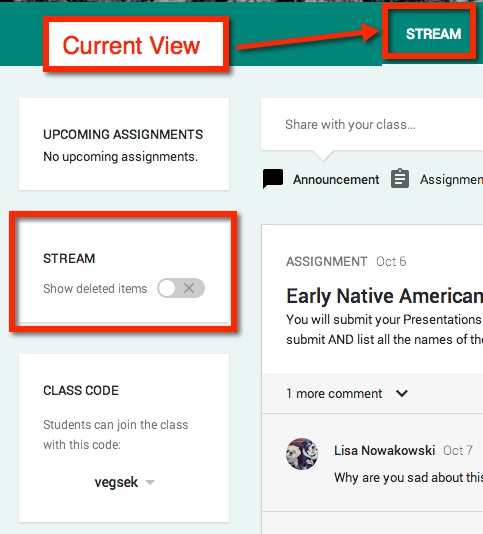
2. View Deleted Items

It’s a simple on/off toggle switch.

Classroom 1


3. Control Class Commenting Feature

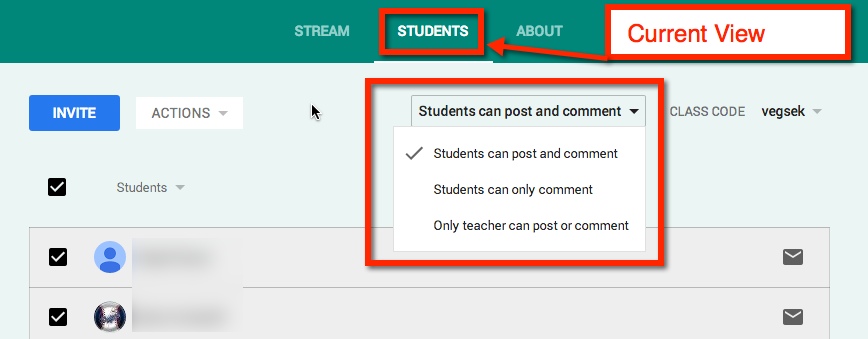
When in ‘Students’, you choose whether students can post, comment, or if the teacher is the only one with those rights. This feature will hold true for ALL students in the class. If you would like to control the ability for individuals to post/comment see below (number 4).

Classroom 2

 4. Mute Individual Students

Every now and then a student tests the waters, and drowns. You now have the option to Mute those individuals. Muted students will not be able to post or comment in the Classroom.

Classroom 10

5. Sort Students

Some teachers prefer to sort by last name, while others prefer first name. Google has given teachers the freedom to sort as we please.

Classroom 3

6. Downloading Grades

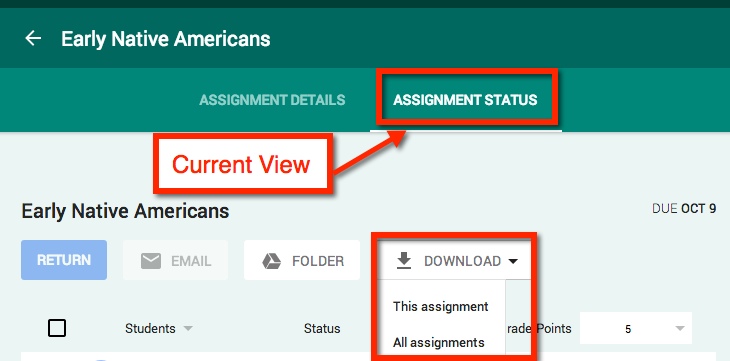
The ability to download ALL assignment grades at once (to CSV file) makes it easier to upload those grades into whatever grading program you or your district are using.

Classroom 4

7. Students Can Mark Assignments as ‘Done’

Recently I had my students working on a Presentation in groups. I posted the assignment, but only the owner of the Presentation needed (or had the rights) to ‘Turn In’ the assignment. This left 40 ‘Not Done’ assignments – which looked messy and inaccurate. Now those students can go into their Classroom, and mark the assignments as ‘Done’.

This feature is handy when assigning reading, viewing a video, or other tasks where nothing needs to be handed in.

Student View in their ‘Stream‘. It has marked the assignment as ‘Late’.

Classroom 5

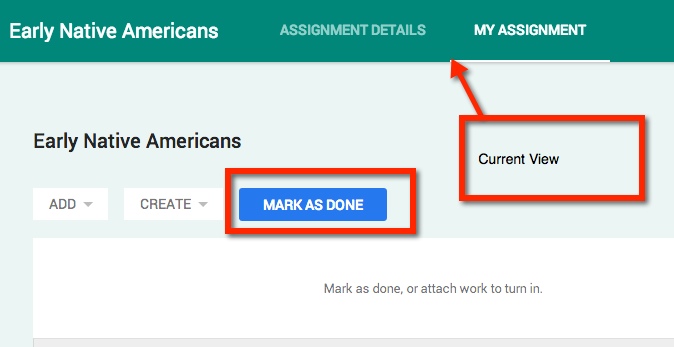
The student needs to ‘Open’ the assignment and ‘Mark As Done’.

Classroom 6

A pop-out window will appear asking if the student is sure this is the desired action. Notice the student can add a private message to the teacher.

Classroom 7


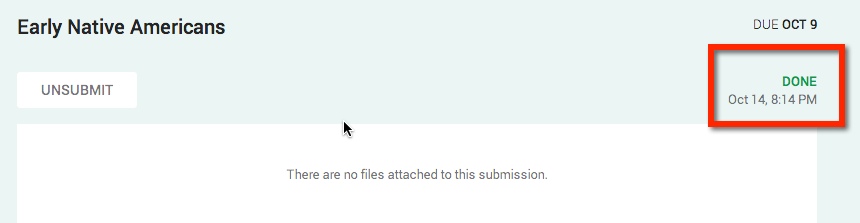
In their ‘My Assignments’ View the student has the option to ‘Unsubmit’. The completion of the assignment is noted in the right corner. It will also be reflected in their ‘Stream’ View.

Classroom 8


classroom 9

My First Dot Day

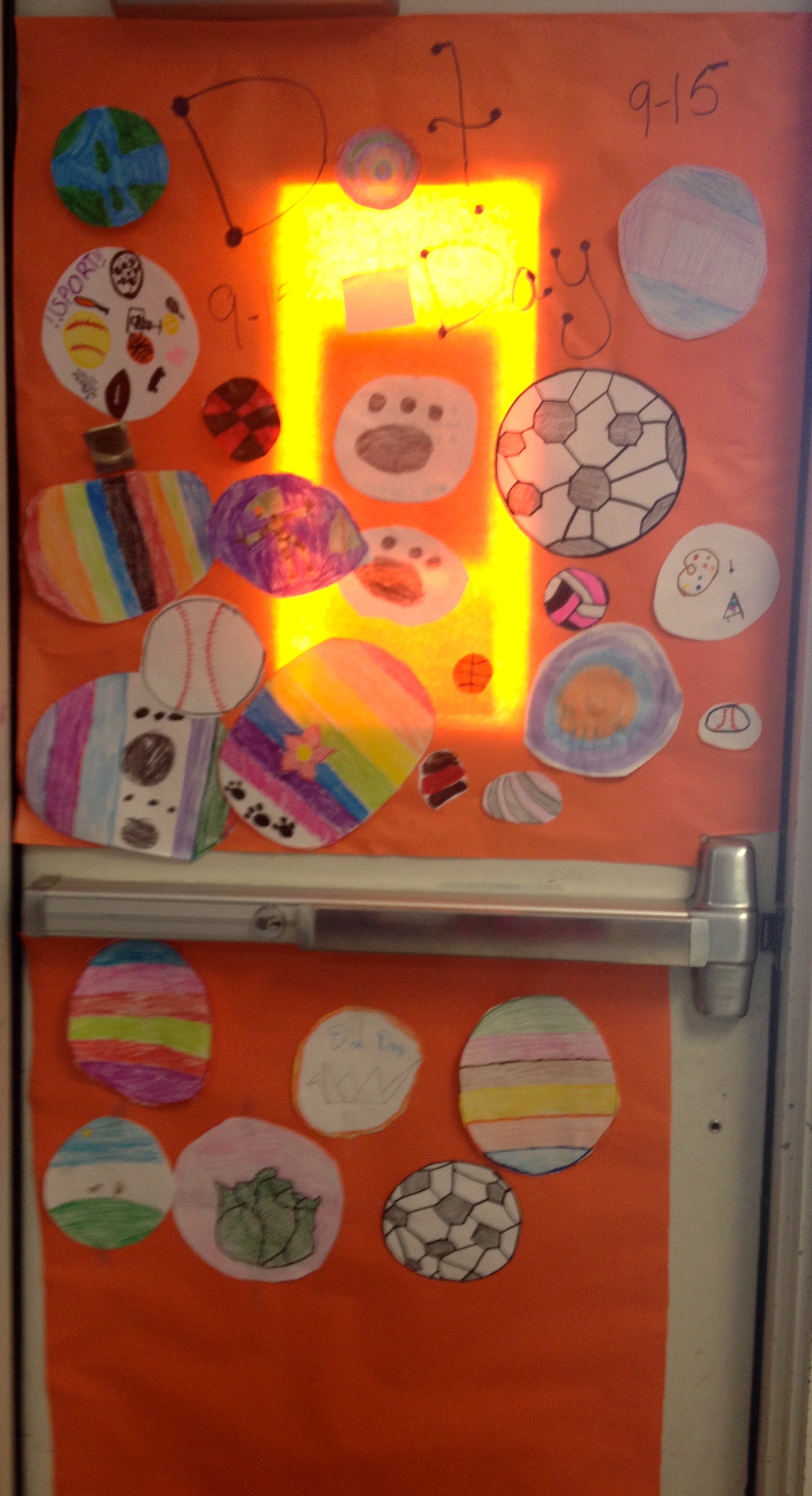
TOur Dot Day Doorhis was the first year that I have participated in International Dot Day. Boy am I glad we did! We first began by reading the book, The Dot, by Peter H Reynolds. It’s a story about a girl who begins to leave her mark, literally, on the world. In art class, she produces one single dot on a piece of paper. With the help of her teacher, she begins to create more and more dots. She explores and experiments with her ideas. And in turn, helps a boy – and us – learn to leave his mark.

After reading the book, we discussed what we could do to leave our mark on the world. Some wanted to open restaurants, others wanted to help animals, and still others wanted to help those in need. They cited helping those with illnesses and those less fortunate. One girl wants to help those who don’t have access to fresh fruits and vegetables, by creating urban gardens and wall gardens.

After our discussions, we were ready to ‘Make Our Mark’! The students eagerly began creating their dots to be placed on our door. This door has been ready for them for the past week.

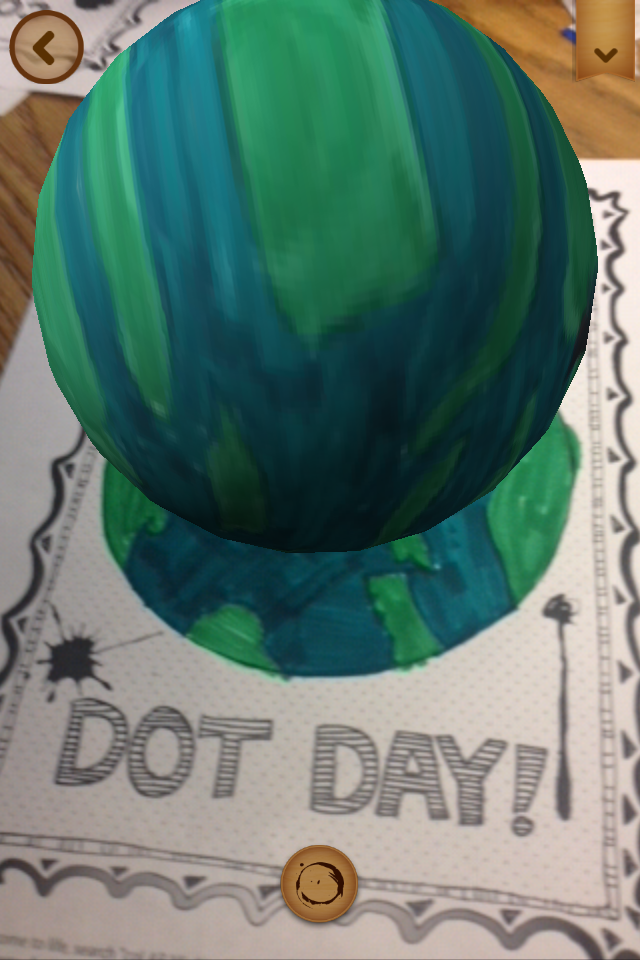
Dot Day AROriginally, I was only going to decorate the door, but then… I copied off the Dot Day paper by ColAR Mix. And again, I’m glad I did. I forgot the pure joy one has when experiencing Augmented Reality for the first time. So many of the students were taken by this, that they went home and downloaded the App for themselves. I had a few come in the next day to tell me all it.

I guess it’s safe to say that I ‘left my mark’ with my students this week.

Genius Hour AppSmashing

Let’s get a few things out of the way. You may be wondering what is Genius Hour? And what is AppSmashing? If you are familiar with these, then you can skip on down to the next paragraph. Genius Hour – Researching what YOU are interested in learning (you being a student). AppSmashing (See also: Jon Corippo) – creating a single project – photo, movie, etc. – using two or more apps.

So all last week, one of my students begged to take home one of the class iPods. He wanted to create movies using Lego Movie Maker (stop animation video creation). I applaud this student. He had NO clue how to use the app, wanted to try it out; and he ASKED if he could do extra work! He did what most kids do best – he played around with it! Were they the best movies ever? No, but each one got better and better. So on Friday, before we have Genius Hour, said student wasn’t sure what to do. I suggested AppSmashing. He was up for it. He imported 2 Lego Movies into iMovie on the iPod.

Now, I know little to nothing about iMovie on mobile devices. Give me a Mac and I’m good to go. I’ve used it a bit on the iPad, but never on the iPod. So needless to say, I was of no help. Note: The iPod version has many limitations (at least from what I could tell). Being the adult, I tried to teach him a bit and inevitably screwed everything up. So I wisely walked away and let him create. What he came up with wasn’t bad for a first try. He ‘imported’ is music by holding up his mobile device (where the music was stored) to the iPod. Here is his results:

Yeah, I think I’ll keep encouraging him to take risks and make movies.

Customize Google Forms

Recently Google updated their Themes in Forms. I, for one, was happy to see this. I use Forms for homework and try to change the Themes as often as I can. This being said, if you’ve been using forms, you know how limited the Themes were. Now however, my choices are endless! The first time I customized a Form, I put a picture of my dogs on it. The next day, I showed my partner teacher (our students do the same Form for homework), and she put a picture of her baby on it. We’ve decided to start taking silly selfies and use them on our Forms.

So this is how to customize your Forms:

Choose the ‘Customize’ feature on any form:

Choose the area in which you’d like to customize:

Class Dojo

Screen Shot 2014-09-14 at 9.34.44 AM I was introduced to Class Dojo by a Kinder teacher who gave our staff some Professional Development about it. I thought it was great for younger grades, but how would 5th graders respond? So, I let the idea go. Then I started hearing about middle school teachers who used it. That’s when I became intrigued. If middle school students liked it, then 5th graders might be more responsive than I thought.

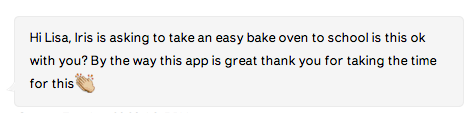
So here I am writing about how much my students, parents, and I LOVE Class Dojo! It took me a few years, but now I am a believer. I have students who check to see how many points they received. Others who see me get out my phone and get excited (or bummed if they’ve been off task) because they know points are coming. My students listen for the positive ‘ting’, change up their avatars (which are really cute), and expect to see the Class Dojo screen daily. Parents love the communication feature. Check out some of the messages I’ve received:

Class Dojo Parent Communication 1

Class Dojo Parent Communication 2And to make things interesting, students use their points to ‘buy’ prizes at a classroom auction. They bid on items with their points. They LOVE it.

Avatar 1I admit it, I was wrong. Class Dojo is great for any grade! This is why I’m sharing my #ClassDojoLove with everyone!


The Literacy Shed, ELD, and ELA

For a few years now I have been using The Literacy Shed, based in the UK, as a jumping off point for ELD lessons. These lessons blend seamlessly into ELA and writing. I was first introduced to the site by ELD specialist, Ana Alvarez. Unlike Ana, I was not consistent with its usage until this year.

The Literacy Shed is an amazing resource full of teaching ideas, videos, and in some cases, examples. What makes it so powerful for the ELL, is the simple fact that the videos are all non-verbal. This allows all students access to the idea, theme, and/or concept. The videos are of a high quality and visually pleasing. The site is broken up into ‘sheds’. The ‘sheds’ are “broadly thematic”. Some ‘sheds’ include: Inventor’s Shed, Thinking Shed, and Inspiration Shed.

As I’ve stated, it wasn’t until this year that I began using this site consistently. My partner teacher and I have been planning weekly lessons around one video or another. This week, we were in the ‘Inspiration Shed‘ and doing a lesson based on ‘The Windmill Farmer’ (second video on the page). We decided to have the students write a first person narrative based on the video. Before we let them loose on the writing, we did a lot of talking first. We viewed the video through once in its entirety, then talked about what we noticed. I was impressed when students noticed the music had changed with the seasons. We viewed it again stopping to talk at key points. We paid attention to the mood – based on music, visuals, and body language of the farmer. After viewing it one more time, without interruption, they split into groups of 2 to 3 students. They were to tell their story. As I circulated around, I was struck by how many had difficulty giving a first person perspective. We had discussed the pronouns to be used: I, me, and myself. While they were using the correct pronouns, they still weren’t putting themselves in the role of the farmer. I heard stories beginning with, “If I were the farmer and my windmills were destroyed…” With these groups I then began modeling what a first person narrative looked, and sounded, like.

When I was satisfied that the majority of the students had an understanding of what was expected, I invited students to share their stories with the class – thus further reinforcing what a first person narrative looks, and sounds, like. Their stories were rich with details. One student noted that the ‘chicken thing’ on top of the house “was going crazy”. At this point I did stop him to give a quick mini-lesson on weathervanes. I had front loaded vocabulary, but as it was a minor detail in the video, I didn’t pay much attention to it and failed to front load ‘weathervane’.

It was only after several periods that I allowed the students to begin their writing. This was such a successful lesson, that I am eager to see the results. They will finish their writings this week. Not only am I inspired to continue using The Literacy Shed, but I know that I WILL consistently use this resource for the rest of the year – and probably the rest of my career.

The lessons are not only inspiring, but align perfectly with the new ELD standards (California) and ELA Standards (CCSS). Even if you don’t teach ELL’s, this is a great resource.