Sometimes all it takes to transform a complex math standard is a fresh perspective and a small shift in approach.
Recently, I joined a 5th-grade class to model a strategy that lowers cognitive load during multi-digit division: pairing the partial quotient with a front-loaded division toolbox on a MathReps mat.
Multi-digit division can be taxing on working memory. Students must estimate, multiply, subtract, compare, and track place value all at once. By introducing a structured “Toolbox” before solving, we offload that mental friction so students can focus entirely on the division logic.
How the Division Toolbox Works
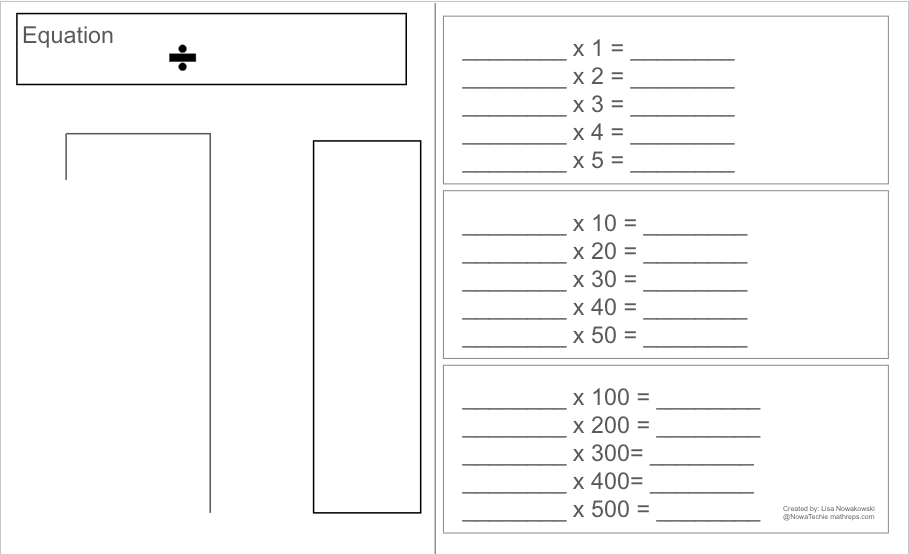
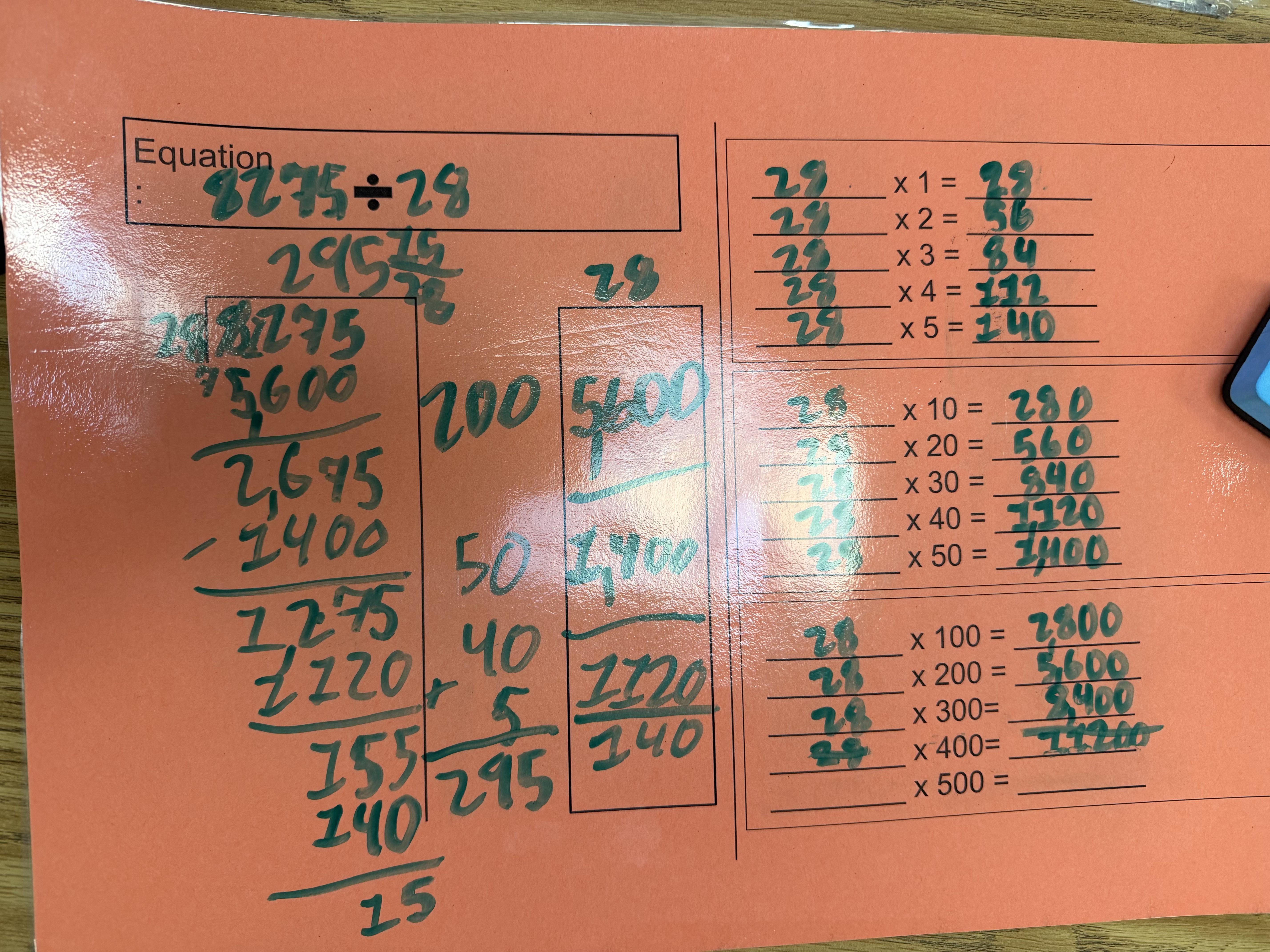
Before diving into the problem, for example, 8,275 ➗ 28, students fill out a pre-printed multiplication bank on the right side of their template:
- Basic facts: 28 x 1, 2, 3, 4, 5
- Tens place value: 28 x 10, 20, 30, 40, 50
- Hundreds place values: 28 x 100, 200, 300, 400, 500
Why Only Go Up to 5?
Capping the facts at 5 keeps setup quick and manageable while accomplishing several critical pedagogical goals:
- Reinforces Place Value Patterns: students instantly see that once they know 28 x 2 = 56, then 28 x 20 = 560, and 28 x 200 = 5600 simply involves shifting the place values by factors of 10 (thus reviewing a previously learned standard).
- Promotes Working Smarter: creating a bank of known facts up front eliminates mid-problem computational stalling.
- Encourages Flexibility: teachers often worry that students will be limited if facts only go to 5. In practice, students quickly notice when they can combine partial quotients! For example, if a student needs 90 groups of 28, they will pull 50 (1400) and 40 (1120) from their bank, eventually combining them into 90m (2520) as their efficiency grows.
Step-by-Step: Solving 8,275 ➗ 28
With the Tool Box ready, solving becomes a low-stress series of subtractions:
- First Chunk: Looking at 8,275, students reference their Tool Box and select 28 x 200 = 5,600. They subtract 5,600 from 8,275, leaving 2,675.
- Second Chunk: From 2,675, they select 28 x 50 = 1,400. Subtracting 1,400 leaves 1,275.
- Third Chunk: From 1,275, they select 28 x 40 = 1,120. Subtracting 1,120 leaves 155.
- Final Chunk: From 155, they select 28 x 5 = 140. Subtracting 140 leaves a remainder of 15.
- Summing Partial Quotients: Adding 200 + 50 + 40 + 5 yields 295, with a remainder of 15 (295 (r) 15/28).
Right beside the partial quotient work, the large rectangle represents the dividend (8,275). This dual layout lets students view the same mathematical decomposition through two distinct visual lenses at once.
Setting Up Future Success
The teacher and students were receptive to the routine.
Using partial quotients in 5th grade doesn’t just make division accessible today; it builds the conceptual foundation students need for 6th grade, when they transition to standard vertical algorithms with deep place value understanding rather than blind step memorization.
Here’s the FREE template
How do you help your student manage cognitive load during multi-step math routines? Have you tried building a ‘Toolbox” first? Share your thoughts in the comments below.