We have spent a lot of time discussing how essential it is, even in upper elementary, to introduce new concepts through concrete models and representational drawings before reaching abstract algorithms.
Take 5th-grade division, for example. Conceptually, division is about equal sharing and place value decomposition. Yet the traditional long-division algorithm – abstract and not officially introduced as a standard until 6th grade – remains the default in many classrooms.
This brings us to a sensitive, fundamental question: How can we expect teachers to facilitate Concrete-Representational-Abstract (CRA) math instruction if they were never taught math conceptually themselves?
Curiosity, Privilege, and the Luxury of Time
When state standards shifted years ago, I felt a deep, natural curiosity toward the “why” behind conceptual math. I spent countless hours searching online, watching instructional videos, and making it a priority to master these strategies.
But I also recognize that doing so was a luxury.
I had both the internal drive and the time, a rare commodity that many teachers simply do not have. Today’s educators are balancing relentless daily pacing, administrative demands, grading, and personal lives. Expecting time-strapped teachers to independently research, digest, and master complex conceptual math frameworks on their own time isn’t just unrealistic: it’s unfair.
Being Honest About the Learning Curve
Most adult educators grew up in a system dominated by procedural memorization. When faced with a new representation or conceptual strategy, it is completely natural to feel uncertain.
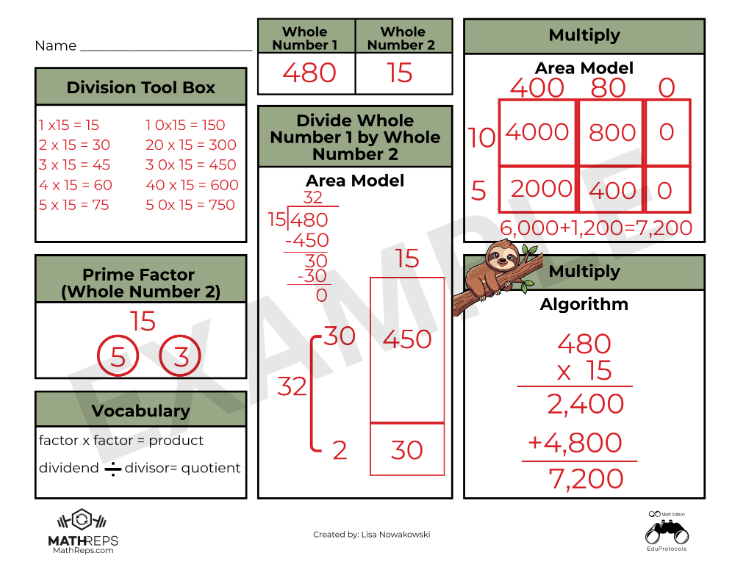
I’ll be the first to admit: using base-ten blocks for multi-digit division is still a struggle for me. Instead, I found my footing by bridging the Area Model directly alongside Partial Quotients. It wasn’t an instant shift for me, either. I embedded this exact bridge into my 5th-grade MathRep template, pairing Area Model and Partial Quotients with a “Division Tool Box” (multiplication facts) to give students multiple visual entry points.
Fourth-grade division also remained a struggle for many years. It wasn’t until I sat in a colleague’s classroom, watched her model the strategy with her students, and recorded the lesson that it truly clicked for me. (You can watch that pivotal classroom division lesson on YouTube!).
Overcoming Defense Mechanisms with Vulnerability
It can sometimes feel unsafe or uncomfortable for a teacher to admit, “I don’t understand how to teach this conceptually.” Instead, insecurity often manifests as understandable pushback: “This method is too confusing for students,” or “Why can’t we just teach them the standard algorithm?” While time and pacing concerns are real, we have to ask ourselves: Are we shortchanging our students’ future math understanding by skipping the concrete and representational foundations now? Short-circuiting the process might save ten minutes today, but it costs years of mathematical intuition down the road.
How We Move Forward: Actionable Steps for Leaders & Coaches
Building teacher capacity requires safety, embedded support, and visible leadership across all levels of a district:
- Low-Stakes Math Warm-Up Demos: Coaches and site leaders can facilitate short 10-minute conceptual warm-up demos during PLC meetings or staff gatherings. Experiencing these routines as adult learners demystifies the tools without putting anyone on the spot.
- Professional Development on Manipulative Literacy: We cannot hand classrooms new math tools without some explicit training on how to use them during contracted work hours. Professional development must focus on how physical tools connect directly to written representations.
- Admin Vulnerability: When administrators step up, sit alongside teachers in workshops, and openly express their own learning curves, it transforms the culture. Vulnerability at the top creates psychological safety in the classroom.
- Accepting the Limits of Coaching: As coaches, we offer support, model lessons, and provide resources. But real systemic change requires district and site leadership to champion these expectations alongside us.
Partnering with Parents: Demystifying “New Math”
Parents feel the exact same frustration when homework comes home looking vastly different from how they learned math. If we want parents as allies, we have to equip them with context:
- Share Worked Example Sheets: Send home completed MathRep sheets or visual guides that clearly label how strategies like the Area Model connect to basic multiplication facts.
- Leverage Short Video Clips: Many modern curricula include parent portal videos. Sharing short 1-minute video demonstrations (via newsletters or class communication apps) helps families understand the “why” behind visual models.
- Reframe the Goal: Help parents see that conceptual math isn’t about throwing away algorithms, it’s about giving their children an insurance policy so they never have to rely solely on blind memorization.
How did you shift your thinking toward conceptual math instruction? What strategies have helped your team build confidence with new models? Let’s keep the conversation going in the comments!


