Create Assignment in Google Classroom
Classroom Updates August 2015
Quick Overview
Reuse Post
Create Question
Google Docs – Speech Recognition
Have a student who has great ideas, but can’t get them written down? Google Docs has a great Add-On to help: Speech Recognition.
In a Google Doc, look for Add-Ons in the toolbar.
You will need to get the Add-On.

Now it’s ready to use. In the toolbar in your document, Speech Recognition is ready to use.

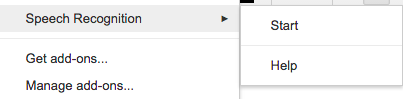
A sidebar will appear on the right side. Choose ‘Start’ and begin speaking.
When you finish speaking, press the ‘Stop’ and your text will appear in your document.
First Day
Start Off Positive
We’ve all heard this, but what does it really mean? Yes, we all greet our students at the door and welcome them with a smile on our faces. Many of us have ‘fun’ activities planned in order acclimate our new students to our ways, rules, expectations, and personality. How many of us bust out the technology on the first day? How many of us have students creating something meaningful the first day?
Here’s what we did
- Wrote out all expectations (learning goals, personal goals) on sticky notes and posted them around the classroom. As a group, we read them and talked about them. What I think I will do next year: write these expectations on a Google Form, take their answers and create a word cloud using abcya, wordle, tagxedo, or tagul (my personal favorite).
- Paper Bag 5 ‘W’s – I wish I could site this, as it wasn’t my idea. I read it online somewhere. The idea is to give each student a paper bag with 5 items in it (I put in a pencil, eraser, Hershey Hug, mini candy, and a Smartee). Students answer the 5 W questions (Who, What, When, Where, Why). They then take the bag home, put in 5 items that represent them, and present it in class the next day. A bonus was, I was able to see the quality of their writing in a low-risk setting.
- Students also worked together in the Marshmallow Challenge. I modified it to fit my needs. Students used spaghetti, mini marshmallows and 4 large marshmallows. I was able to see which groups/individuals communicated, collaborated, planned, thought out, and were innovative.
 Finally, each student created a Voki to tell me a little bit about themselves. This was a fun way for students to introduce themselves to me. They got to use technology, create something meaningful, and were able to view it online (and show their families). Here is my class and the other class (Mrs. Pursley).
This was a great way to begin the school year! We just finished our second week, and things are going GREAT. I am blessed with an amazing group of students. This may be the best year yet (and that’s saying something as this is my 20th year teaching).
Engage Students With Mangahigh
Making Homework Engaging
 A few years ago, I started to ponder how I could make my homework more engaging. I wanted students to be proud of their work and not just do it as fast as possible or not at all. I began giving less, but more thoughtful work. In other words, NO worksheets. Then last year I discovered Mangahigh. This was a game changer for me. You can read some of my initial thoughts about it here: Gamifying My Homework. As the year progressed, I liked it more and more. And so did my students.
When summer was upon me, I did what most teachers do: I reflected on the previous year. What worked, what didn’t, and what I was going to do for the next year. Continuing with Mangahigh was a no brainer. Last year I experimented with the Free version. This was good, but I wanted to up my game with the Premium Version. This will allow me to tailor a curriculum for each student.
Why Mangahigh
Last year, I used it as homework. The students were completely taken with it. They loved earning badges, points, and awards. One morning ‘K’ came in stating that she worked on a particular challenge (which is practice on a concept/standard) in order to pass ‘B’. What I was finding was that students were spending more time on the Challenges and Games than I assigned. I had students, who completed their homework, coming in early in the mornings in order to get more points, get to the next level, ‘beat’ a game or their friend, and win a ‘Fai-To!’. A Fai-To! is where one school challenges another school; the schools compete for a week. The competition is based on how many badges each school can get per day. My students LOVED this aspect.
What The Students Had To Say
They had a lot to say. Many quickly went through the challenges that I assigned. They pushed themselves to do more. They quickly became obsessed with certain games. Mangahigh has nearly 20 games, that resemble video games. They all focus on math (Common Core Standards) and are fun to play. Their favorites were PEMDAS Blaster (PEMDAS rules), Tangled Web (degrees of angles), and Pyramid Panic (Circumference and Diameter). Some of these concepts are above 5th grade. The beauty of this is that they were learning new concepts in a fun way. All they saw was a fun game, badges, and high scores.
Towards the end of the school year, my school purchased a (different) program. I decided to use it and have the students compare the two. They were both game based and web based. Very quickly my students started to complain. They all wanted to go back to using Mangahigh. I encouraged them to give the other program a chance. They did and were not impressed. When I encouraged them to have an open discussion on why they felt Mangahigh was better; it was eye opening for me. I was prepared to hear them say that the graphic and games were better. While this is valid, it’s superficial (in my opinion). I wanted well-thought reasons. To my pleasure, that’s exactly what I got. Yes, they appreciated the graphic of Mangahigh, but more importantly they appreciated the learning that occurred. They explained to me that when they got an answer wrong, or needed help, on the challenges; Mangahigh provided quality guidance that helped them understand their mistakes. The other program didn’t provide this and, therefore, was an inferior product in their eyes.
My Thoughts
Even though I used the Free version last year, I could still review some data. I was able to see who completed an assigned challenge, their score, percentage, and time spent on the challenge. This information was useful when I referred struggling students to our Student Study Team.
I watched struggling students gain confidence as they completed challenges. ‘C’ was one of my struggling students. She was one student who came in early in the mornings to complete challenges. While talking to her, she told me that she liked practicing and understand more. I watched her confidence grow as the year went on. She went from below grade level in the area of number sense to proficient. Her story was not the only one like it in my class.
Then in early July I received an email from a student that solidified my thoughts about Mangahigh. ‘J’ emailed me to tell me that she had finally completed PEMDAS Blast. Yes, students continued playing during the summer! You can read about it in Math In the Summer. If I wasn’t already convinced that this is a great way to help students, this email would have done it.

One Final Note
As I have committed to upping my game this year, and using the premium version, I plan to tailor the goals to each student’s needs. I have several students receiving additional help in math from a resource specialist. I will be able to give them different challenges than those students who require more advanced challenges. My principal and I are excited to see the growth and progress that each student makes using Mangahigh.
From my success last year, I can say that students spend more time reinforcing concepts through this type of homework than traditional homework. Even those students who aren’t really into video games enjoyed the gaming aspect and collecting badges. The Fai-to! challenges spurred many students to push themselves in order to beat the opposing school (and it doesn’t hurt that their teacher is competitive).
Finally, I’d like to point out that I work at a school where over 80% of the students qualify for free or reduced lunches. We are a Title 1 school. We are located in a rural, economically depressed area. Many of my students do not have internet access at home; yet found ways to complete their challenges daily. Some went to the local library, others stayed after school, many came to school early, or used a parent’s phone/tablet. It’s that type of motivation that has proven that Mangahigh IS engaging for all students.
Archive A Classroom
The new school year has just begun, and I have been asked by a few, “How do I delete all of my assignments from last year, and add this year’s class to Google Classroom?”
My answer: Archive the old and create a new classroom! It’s easy to do.
Navigate to your Google Classroom. Find the class you wish to archive. Click on the three (3) dots in the upper right corner. This will bring up a pop out menu. Here you have the choice to ‘Rename’ the class, or ‘Archive’ it.

No worries, you can always refer back to last year’s assignments in your archived classes:

Math In the Summer
Unexpected Email
This was waiting for me in my Inbox recently; along with the message:
Mrs.N LOOK !!!!!!!!!
Now, this may not look like a big deal, or that the student was playing a game and beat it, but when you look deeper; it’s a big deal. I received this email on June 28. Our last day of school was June 4. This particular game helps to reinforce the concept of the PEMDAS Rule. So this means that ‘J’ has been playing meaningful math games during her summer break! Oh, and that this game covers standards above 5th grade, is just the frosting on the cake.
The Power of Games
Back in November of 2014, I wrote about how I was Gamifying my math homework. I was using Mangahigh. Then in the spring, my school decided to purchase a different system (that had math included) for the entire school. So I switched my math homework to the new system (I was using the free version of Mangahigh). My students were NOT happy.
When I first asked them about their preference, they all agreed that Mangahigh was better. At first they went on about the games, but when I pressed further on the issue they disclosed an interesting revelation. Mangahigh showed them steps, processes, and most importantly, where their mistakes were. After one student explained, “I like Mangahigh better because it tells me why I got an answer wrong,” the rest of the class quickly agreed and expanded on the value learning from their mistakes.
Next Year
After listening to my students go on about Mangahigh, and seeing that students were STILL using it on their vacation, I asked my school to purchase 2 classes. Unfortunately, due to a very limited budget, it’s a no go. So now I’m on to trying to figure out how to finance this valuable tool. As I always say, “It’ll all work out in the end.”
Data Driven Vs. Numbers Driven
Are you Data Driven or Numbers Driven? What about your district? In order to answer this question, we need to understand the difference.
Data Driven
 The buzz word from the past 8 years or so. This is where teachers, schools, and/or districts collect data from students in order to guide instruction and progress. Most often this data comes in the form of formal and informal assessments. In my opinion, the most powerful assessments are the informal ones. The ones in which teachers observe students demonstrating understanding of a concept. Based on the information collected, the teacher knows best how to proceed with the students. In short, Data Driven is helpful, guiding, and reflective. It also focuses on the growth that students have made; it recognizes room for growth.
Numbers Driven
This one is a bit trickier. It masks as Data Drive but, in  fact, is not. Let me try to explain what I mean. It mainly uses the formal assessments that were mentioned above. I have experienced Numbers Driven with districts (and by extension, state and federal). Many districts give summative assessments – benchmarks. I have heard administrators claim that the information will be used to help guide teachers. See, sounds like Data Driven, but this is where it takes a turn. What is said, and the actions that are taken are two different things. This is because there are (still) Pacing Guides. So when a teacher has given the 1st benchmark, regardless of the outcome, they need to move on to the next item(s) on the Pacing Guide. There is no time to reteach confusing concepts (according to the assessments). The Numbers Driven game tends to be competitive, punitive, and unhelpful to the stakeholders – students and teachers. Its sole focus is on the final number; it’s very finite.
My Answer
I tend to be more Data Driven – based more on informal assessments. However, I get tangled in the web of Benchmark Assessments, from time to time. It’s easy to get sucked into the hype when you know you are being judged – and looked down upon – based on scores. Unfortunately, No Child Left Behind helped change the focus to Numbers Driven since that’s how money was/is allocated.
So let me ask my question again, are you Data Driven or Numbers Driven? What about your district?
To Ceremony Or Not
This week’s #youredustory question:
Why are, or aren’t, graduation and promotion ceremonies important?
Graduation Ceremonies
Yes, I do think these are important – maybe more so in some communities than others. It is a way for the rest of us to celebrate the accomplishment of those that have worked hard to meet a goal. That being said, I need to clarify that, for me, graduations are at the end of high school and college – be it a Bachelor’s, Master’s, or Doctorate’s. I am also a firm believer that ALL students should be recognized, by name.
Promotions
Not a fan of these. I had a whole rant written here but deleted it. Why? Because I would rather focus on what my school does.

The last day of school has a celebratory feel. In the morning, each classroom has their own traditions. Starting at lunch, the Luau begins. Each year, we BBQ hamburgers for the students and staff. Then teachers sign up for a game station (I do a wet sponge challenge each year. Students race with a wet sponge on their heads). Then about 30 minutes before school is dismissed, all grades K-4 form a tunnel, or aisle, for the departing 5th graders to go through. The tunnel ends at my classroom door, so the 5th graders file into their classroom to say their final goodbyes. As they all go through the tunnel, the rest of the students give the 5th graders high fives. I love this tradition.
Why do I like this so much? First of all, it’s understated and simple. Secondly, it still acknowledges the fact that these students will not be at our school next year, and that they are moving on to the next phase of their lives. Then there are the parents. Parents, siblings, and other family members often join us for the festivities. The parents love this tradition too. I talked to several, who don’t have 5th graders, who really like this.
So, we celebrate the 5th graders without going ‘over the top’.
Thank you to Maricela Cuevas, Vanessa Reyes, and Elizabeth Zuniga for the photos.
 Nowa Techie