Notes on Google Slides

Earlier this week my students started on a group project – Road to the Revolution. I had given them a Hyperdoc with the information on the French and Indian War. I gave them very specific guidelines and some questions to answer. The end product is an Animoto video. As I was walking around and helping, I noticed that a group of students had Google Slides open. I got worried. It took a long time for me to get my students out of the habit of wanting to create a slideshow for presentations. So I stopped and asked why Slides was open and “Please don’t tell me you’re creating a slideshow.” I was so relieved when one of the girls explained that they were using it to take notes! I didn’t even show them this trick. Yeah, proud teacher moment.
download One of the girls created and shared the slides with the rest of the group. Each person in the group had their own slide to take notes. I know this isn’t the first time this has been done, but I was really proud of my students for thinking of this. It is so much easier to take shared notes on Slides as opposed to Docs.

I LOVE it when students take learning into their own hands and make it work for them. Go Innovators!

Just another great example of what students will do when we give them the freedom to own their learning.
Google My Maps Part 4: Layers

Another feature on Google My Maps is the Layers. When we were studying the 13 Colonies, I was able to separate information into layers. There was a layer for the original 13 colonies, a layer for the colonial regions (New England, Middle, Southern), and the current geography of the 50 states. The students were able to click on and off layers in order to clearly see important information.

Google My Maps Part 3: Lines and Shapes

There are so many learning opportunities with the lines and shapes feature of My Maps. We are currently adding and subtracting fractions with unlike denominators. It gets really boring doing problems from a book. In the coming days, I plan to create a Hypermap with lines – making sure the distance will be a fraction. (NOTE: My Maps measures distance using decimals. This will be good practice for my 5th graders to convert). My Maps will also tell the area and perimeter of a shape, MORE math opportunities!

Tweet The Author

I recently wrote for the CUE Blog on how to own a premade curriculum. I spoke about taking it and tweaking it so that we, as teachers, feel the ownership instead of feeling like we have no say. Part of the way I take ownership in my math class is to use Andrew Stadel‘s Estimation 180 site. It’s a nice warm-up for the students and a great way to practice several of the 8 Mathematical Practices found in CCSS.

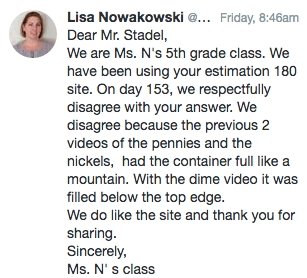
Most recently, we have been going through a series that has us estimate the value of coins in a container. It started with pennies, then progressed through until the day we estimated the value of dimes. We went through our normal routine – three minutes to discuss and find an estimate that is too low, too high, the actual estimate, and how they arrived at that estimate. Then, as normal, we viewed the video answer. Upon finding the answer, the RSP co-teacher got a discussion started. She disagreed with the answer. We left it at that so that the students could either agree or disagree. After they reviewed the previous two days’ answers and compared the answer to the dimes, the class determined that they too disagreed. Following the Mathematical Practices, they had to justify their reasoning, which they did. They reasoned that the pennies and nickels were mounding up to the point of almost spilling over, whereas the dimes didn’t quite reach the top of the container – same container.

Fortunately, with modern technology, we didn’t have to let the discussion die there. So, I got on my phone, hooked it up to the screen so the students could be active participants, jumped on Twitter, and sent Mr. Stadel a private message. This is what they wrote, well, told me to type:

screen-shot-2017-01-22-at-2-22-09-pm

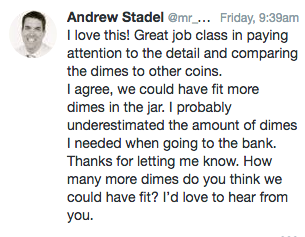
After they got over the initial shock that one could actually do this, they got excited. Now, I have only been a participant in a few of Mr. Stadel’s sessions at conferences but was fairly certain that he would be open to what we had to say and would most likely respond. And he didn’t disappoint! The kids were VERY excited that he did respond. Okay, I was pretty excited too. This was such a real and relevant experience.

screen-shot-2017-01-22-at-2-27-05-pm

We then talked about how many more dimes we thought could fit. They determined that 1/2 roll more – 25 dimes – would be needed.

THIS is why we, as educators, need to be connected. THIS is why we continuously grow our PLN.

I would like to thank Mr. Stadel and Ms. Luke (RSP teacher) for making this all possible.

Biggest, BEST Fail of the Day

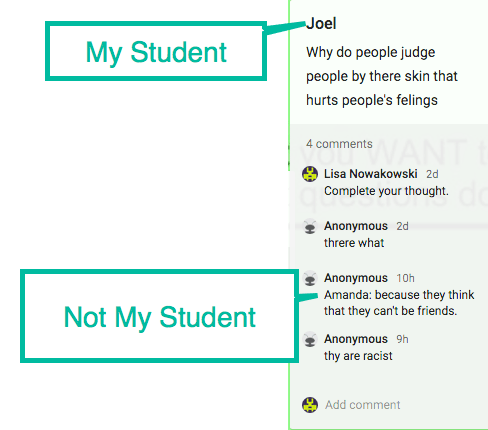
Yesterday I wrote about the MLK Hyperdoc my students are doing this week. Today we discovered that at least one other class is using it. While doing their work today, a student approached me asking, “Who are some of these people?” My student was on the MLK Padlet doing their assignment. I looked, and sure enough, there were names on it of students who weren’t in our classroom or school.

When I shared the Hyperdoc I forgot to unlink the padlet and make a note to create your own padlet. The other teacher must not have thought about it either.

padlet-1I got pretty excited about this. THIS makes their learning even more relevant. They now have a chance to talk with another class somewhere in the US. I encouraged my students to answer questions and check out what the other students had written. Some were silly (a string of letters) and my students were disturbed by this. Which I took as a compliment. This means they know what I expect from them and that that sort of Internet activity isn’t acceptable. My students then began answering questions and reading the information.

This was such a GREAT learning opportunity for them (and me). So yes, my Padlet is a ‘hot mess’, but a wonderful ‘hot mess’!