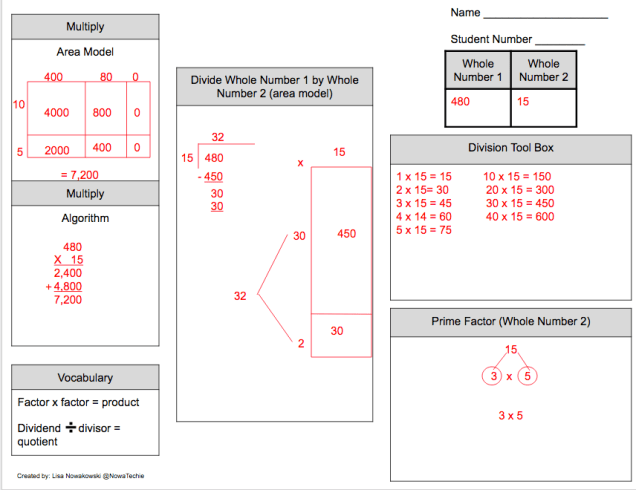
This year I began using ‘Classroom Economy’. The students have jobs, earn money, and rent or buy their desks. Students have several opportunities to earn extra money. This is important because their monthly paychecks are less than their rent ($1000).
One way they can earn extra money is to solve math problems. I post two problems for anyone in the class to solve. I will only take the first correct answer. One is generally more difficult than the other thus allowing students to challenge themselves. The harder problem will earn them $50 while the easier one will earn them $20.
I was able to snap this photo of a student, who NEVER passes up the opportunity to make extra money, practicing the skills that she has learned. Added bonus, we leave the process a student takes on the board for all to see and learn from.
So what’s the big deal with 92%? A lot when it comes to having 3 weeks off and the likelihood that none of my students practiced their multiplication facts.
Monday was our first day back after winter break. As we do every day, we practiced our math facts using the Fast & Curious Eduprotocol. I had an anticipated drop from our usual 96% – 98%. I predicted, to myself, it would drop to around 89%. I wasn’t too concerned as I knew that they could easily get it back up to our normal within a week.
Well, to my surprise, my class scored 92%. Seriously, I was happily surprised that they really didn’t lose as much as I had feared. YES! The continuous rep practice has worked. The facts are sticking.
I was so giddy, I needed to write this quick post to celebrate the success my class is finding. I was sold before, but now I’m a believer for life!
I will admit, I was reluctant to use any sort of ‘timed tests’ for math in my classroom. The research does not support it. However, my students were sorely lacking in their multiplication skills, a skill they should have mastered by now. At conferences in September, I spoke with each parent about the need to practice at home and easy ways they could help their child. After a month, there was little improvement. THEN, I had a conversation with Jon Corippo.
Jon suggested I use the Fast & Curious Eduprotocol with math facts. I knew he had convinced Cori Orlando to try this with her 3rd graders previously. She balked at first then became a believer. I still held out. He gave me the same spiel he gave Cori. I begrudgingly tried it. It felt too much like timed tests. At first, the kids loved it; it was something new. But then, they kept asking for it day after day. This lasted a while. Several months later, they STILL beg for it.
Does It Really Work?
Simply put, yes. The data speaks for itself. In the beginning, we were averaging around 56% as a class. That’s 56% correct on a 10 – 20 multiplication question quiz. As a class, we could only score 56% on a quiz. And some quizzes we were a bit lower (48%). YIKES! Within two months, as a class, we score between 96% and 98% no matter the quiz I give them. That doesn’t mean that I still don’t have kiddos who are struggling, I do. I still have kiddos who take an incredibly long period of time to complete it. Some day, I have to end the quiz before everyone can finish. But let’s face it, going from 56% – 96% is a drastic difference. I’ll take it!
I use Quizizz, a computerized gaming review system. It’s a mouthful but if you’re familiar with Kahoot, it’s very similar. I choose a multiplication quiz. No need to make your own, just do a search and you’ll find one. Set up the quiz in classic mode and have the students sign in. On day 1, we take the quiz twice. The first time is cold, we write down our score (Quizizz is great that it’ll average your class score for you), review the questions, then take it again. We keep our first score then we record our second score to see how much we’ve improved. For the rest of the week, we take the same quiz. If our score goes up, which it should, we erase the last high score and replace it with the newest score. We repeat this process with a different quiz the following week.
Because students can consistently score in the 90% range on the first go-around no matter the quiz, I only do the quiz once on Mondays. I have some added bonuses you can read about.
Cheating
I have teachers ask if students cheat: help each other, start the quiz over again, tell another student the answer. The answer is yes. But I don’t care. The kids who are getting the answers are clicking the correct answer and reinforcing it. Those that take it again are practicing twice as much as everyone else. It’s really a win-win.
I’m a Believer
Based on all that I have seen in my classroom, I am now a believer in this protocol. The kids still love it months later. The information is transferring. The data doesn’t lie. Even if you’re still reluctant, give it a try. I did and so did Cori!
I have been on a creative streak lately. I LOVE #EduProtocols by Marlena Hebern and Jon Corippo. I LOVE #MathReps which were inspired by Jon Corippo’s 8 p*ARTS of Speech (read the full story). As a result, I have been working on Math EduProtocols. My latest one, that is ready to share with the world and receive feedback, is Tic Tac Toe Math.
This is a sample I created for my class. My intent was to review some basic math concepts while having fun. The rules are simple:
Each player writes their name and chooses either X or O.
Player 1 chooses a square to complete. BOTH Player 1 and Player 2 independently work out the problem in the chosen square. If Player 1 is correct, Player 1 gets the square and circles their symbol (X or O)
IF Player 1 is incorrect, Player 2 has a chance to ‘steal’ the square. Player 2 MUST complete the problem correctly AND explain where Player 1 was incorrect.
Player 2 chooses a square, even if they stole Player 1’s square. BOTH players must work independently to solve the problem. If Player 2 is correct, Player 2 gets the square. If Player 2 is incorrect, Player 1 has a chance to ‘steal’ the square. Player 1 MUST complete the problem correctly AND explain where Player 2 was incorrect.
This continues until someone wins or all squares have been completed.
I tested it out on my students. They liked it and had some good feedback. Some wanted ALL algorithms. Some wanted harder problems. This was a fair statement as I purposefully chose easier problems. I wanted to hook them before going all in. Two students worked on the middle square together and decided that they both claimed it; that worked for me. Overall, it was something that they all enjoyed.
The set up of the problems was purposeful. The four corners are meant to be easier problems (DOK 1). This allows all students success. Those that are between the four corners are meant to be a bit harder. Finally, the center square is to be the hardest. A challenge problem. A player can still win without choosing the challenge problem. I did like the modification my students came up with for that middle square. It takes the pressure off one particular player and allows for collaboration, problem-solving, and communication between players in a friendly manner.
I have created a template with directions and the above sample. Feel free to copy and create your own. I would love to hear how you are using it and how your students feel about it. What modifications have you made? Please share!
Several years ago I created #MathReps (EduProtocols for math) for my classroom. The original idea was based on Jon Corippo‘s 8 p*ARTS of Speech. When I first designed it I was excited and blogged about it. Since then, the idea, and resources have grown. And being who I am, I constantly doubt myself and my creations. I constantly question whether I’m doing good or harm.
Yesterday, some of my doubts were cast aside and my creation was validated. Recently, I was talking to another 5th-grade teacher at my site. We were talking about some tasks that we have students do. She follows the curriculum to a T; I, however, do not. This is in NO way a slight towards her (she’s new and is doing as she is instructed). She shared that she pulled out a concept the students hadn’t seen in a few months (our curriculum doesn’t spiral. I have much more to say about it, but won’t do it here.). It was adding/subtracting with decimals. I thought THAT was a great idea, so I did the same. She reported her students having difficulty remembering to line up the decimals doing the task. As I gave my students a similar task, I observed that they instinctively lined up the decimals. I found this not only interesting but satisfying. My students had been exposed daily to almost 5 months of this concept on various #MathReps. Needless to say, I was elated and felt somewhat justified in doing what I do.
After completing the task I had a frank discussion with my class. I asked, even though I already knew the answer if they had any trouble adding the decimals. I asked about lining up the decimals. They all looked at me like I was crazy. Of course, they knew to line up the decimals….duh! I then shared WHY! I also shared that a class that doesn’t use #MathReps had trouble remembering that important piece of information. And that it was because we practiced these concepts DAILY that they had no trouble with that part. (They had trouble with the task but weren’t confused about how to perform the actual skill of adding decimals.) Because of the culture of our class, they focused on the fact that #MathReps actually do help them and not on the class that had trouble. It was so awesome to bring to light to them, and me, that this protocol really works. One student even remarked that while they may not like doing them it does help them to learn.
Just like with anything, if we don’t use newly acquired knowledge we lose it. In addition, John Hattie puts repetition at a 0.73 on the Hattie Check Scale. I would caution that there are different types of repetition and we need to make sure that our reps are meaningful.
I did share this with the other teacher. I assured her it was no slight on her, and she understood, rather it was a slight on the adopted curriculum.
I am so over our math program! It’s soooooo boring! And if I’m bored, the kids are too. So today we did ‘Cootie Catcher Math’ aka ‘Fortune Teller Math’. This was not completely my idea. The original paper came from Scholastic. I liked it, copied it, and added to it. So simple, so fun, so NOT boring!
I copied the Cootie Catcher from a book by Scholastic. This was interesting because my students aren’t really into them at the moment so neither of us knew how to fold them properly. After a brief refresher, we were on our way! This was a very simplistic one. We needed to practice subtracting fractions. This one had like denominators so it was perfect for the first go-around.
The students worked in pairs. They had 2 tasks to complete for each round. Round one had them answering a subtraction problem while round two had them answering a more difficult word problem. But, because I know how 5th-graders work, there had to be some accountability attached otherwise it would be a free for all.
Students were tasked with solving all problems on their whiteboards. Then they were to take a photo and insert it into a slideshow that I shared with them via Google Classroom. Essentially, the students had a 2 slides presentation to complete. Problem 1 and challenge went on one slide show while problem 2 and the attached challenge went on slide two.
It was a success! All students completed the task successfully. I plan to do it again! I’m feeling better and better about math as I stretch what can be done outside a textbook. Last week we did an Iron Chef, Math Style.
I hate monotony. I hate doing boring work. I hate workbooks. However, sometimes the simple fact is that kids need to do some of that boring work to get the process down. We have been working on multiplying decimals for a week now. They are getting it, but need more practice. If I suggested doing more work from their math books, I might have had a mutiny on my hands. So I tricked them!
I made copies of some of their math book pages. They were given partners and one problem to solve. In the end, they were to record their process. This was a great exercise for everyone. A few groups used physical manipulatives to show their thoughts while others chose to use the algorithm. I think my favorite was this group who tried to subtract before multiplying. During their group work, I was able to sit with them and help guide them after listening to their reasoning
I don’t use manipulatives enough in math. Over the past few years, I have used fewer manipulatives than ever before. I take partial responsibility for this. I should have incorporated more into my lessons. However, other factors contributed to this: my district not providing any manipulatives, adopting a half curriculum (half because the state doesn’t recognize it) that makes no mention of using any, and the pressure to keep moving along the curriculum/pacing guide. Well, this year I am making a conscious effort to do better.
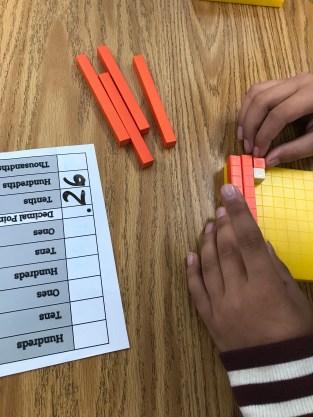
No more excuses. Last week my class explored decimals and multiples of ten. I didn’t think they were really understanding that they moved the numbers a column (base-10 number chart) because we have a base-10 number system. They could do it, but were they understanding the why? The answer was, no. So, I broke out the base-10 manipulatives (rods, flats, etc.) to illustrate this. THEY worked as a group (table groups) to prove that 0.26 x 10 = 2.6. Yeah, that lesson was a total failure! Each group created 10 groups of 0.26, but when they combined them they grabbed everything; including the unused manipulatives.
I did not want to give up the opportunity for them to make a connection. I regrouped after the failed lesson and reflected on what went wrong – management on my part. The next day we tried it again with greater success. Once they had their 10 groups of 0.14 I had them clean up the extra pieces (duh). They still weren’t completely making the connection, therefore, several conversations were had. Several finally saw the connection.
I’m not saying that this lesson hit it out of the park, obviously, it didn’t. I do need to make sure the students are getting more and more exposure to the manipulatives. With practice, we will all get better.
For as much as I write about my successes, I need to also write about my failures. This is a lesson that I am still thinking about nearly a week later. How can I make it better next time? Where did I go wrong? Any and all suggestions welcome.
About a year and a half ago I began imagining how Jon Corippo‘s 8 p*ARTS of Speech might look in a math classroom. That’s when I started on my journey of #MathReps. It was small, and originally just for me. I had no problem sharing it and did so freely. Since then, I have been encouraged to expand to other grades. Working with other teachers, I have begun creating and collecting #MathReps for grades K – 8. It is an ongoing process.
Feel free to share with others. All credits are given to those that helped. And to them, I thank you!
Last year I created some 5th-grade math protocols. Simple pages students could fill in to help solidify and keep up previously learned skills. This year, I decided to create grades K – 8. A friend and I got together this weekend and hammered out the beginning of 1st grade. And, we gamified it! The directions and gameboards are in Google Slides. This allows you to copy it and customize it.
I also created a video, based on the 1st-grade teacher’s recommendation. Thank you Cris McKee!
I’d love to hear how you use it. Have suggestions for other 1st-grade MathReps? I’d love to hear your thoughts.

 So what’s the big deal with 92%? A lot when it comes to having 3 weeks off and the likelihood that none of my students practiced their multiplication facts.
 This is a sample I created for my class. My intent was to review some basic math concepts while having fun. The rules are simple:


 I don’t use manipulatives enough in math. Over the past few years, I have used fewer manipulatives than ever before. I take partial responsibility for this. I should have incorporated more into my lessons. However, other factors contributed to this: my district not providing any manipulatives, adopting a half curriculum (half because the state doesn’t recognize it) that makes no mention of using any, and the pressure to keep moving along the curriculum/pacing guide. Well, this year I am making a conscious effort to do better.