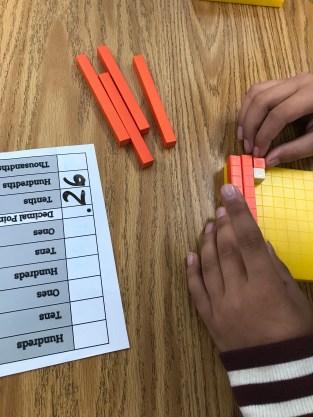
 I don’t use manipulatives enough in math. Over the past few years, I have used fewer manipulatives than ever before. I take partial responsibility for this. I should have incorporated more into my lessons. However, other factors contributed to this: my district not providing any manipulatives, adopting a half curriculum (half because the state doesn’t recognize it) that makes no mention of using any, and the pressure to keep moving along the curriculum/pacing guide. Well, this year I am making a conscious effort to do better.
No more excuses. Last week my class explored decimals and multiples of ten. I didn’t think they were really understanding that they moved the numbers a column (base-10 number chart) because we have a base-10 number system. They could do it, but were they understanding the why? The answer was, no. So, I broke out the base-10 manipulatives (rods, flats, etc.) to illustrate this. THEY worked as a group (table groups) to prove that 0.26 x 10 = 2.6. Yeah, that lesson was a total failure! Each group created 10 groups of 0.26, but when they combined them they grabbed everything; including the unused manipulatives.
I did not want to give up the opportunity for them to make a connection. I regrouped after the failed lesson and reflected on what went wrong – management on my part. The next day we tried it again with greater success. Once they had their 10 groups of 0.14 I had them clean up the extra pieces (duh). They still weren’t completely making the connection, therefore, several conversations were had. Several finally saw the connection.
I’m not saying that this lesson hit it out of the park, obviously, it didn’t. I do need to make sure the students are getting more and more exposure to the manipulatives. With practice, we will all get better.
For as much as I write about my successes, I need to also write about my failures. This is a lesson that I am still thinking about nearly a week later. How can I make it better next time? Where did I go wrong? Any and all suggestions welcome.


 I quickly realized while reading the first article with the class that it wasn’t going as planned. And for some insane reason, I powered on with the second article. What? Yeah, not sure what I was thinking (well, clearly I wasn’t thinking!). I did, however, extend the cat mini-report for a second day and scrap the dog report for next week. I also realized that I need to work up to two articles.


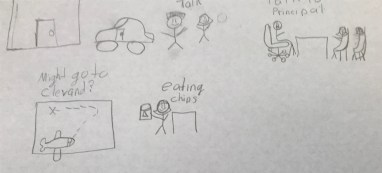
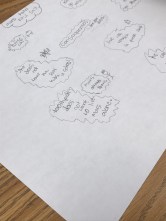 This is where I brought in sketchnoting. One complaint I hear over and over from teachers in my school/district is that the kids just don’t listen. I agree. The CELDT scores would also concur. By drawing the story, what they envision, they are forced to use different parts of their brain and listen. At first, a few students liked it but wanted to watch the episode. I explained that there wasn’t anything TO watch. They were not fans of this. However, by the end of the second episode, I didn’t hear any complaints. Some students had no problem drawing. Others listed the events in a note-taking style without any drawings. Others listed events and placed the notes in bubbles.
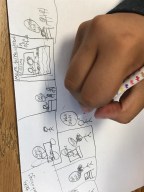 Mars Patel. I have to beg them not to listen on their own and go ahead. Others have settled on finding other podcasts they can listen to. I am thrilled, and excited, by their response and the possibilities. Next year, I plan to incorporate podcasts into my lessons more often.





 To the merchants – be they insurance, savings plans, ‘bookman’, or whoever –
  Nowa Techie