#MathReps Work!

Several years ago I created #MathReps (EduProtocols for math) for my classroom. The original idea was based on Jon Corippo‘s 8 p*ARTS of Speech. When I first designed it I was excited and blogged about it. Since then, the idea, and resources have grown. And being who I am, I constantly doubt myself and my creations. I constantly question whether I’m doing good or harm.

MathReps Logo

Yesterday, some of my doubts were cast aside and my creation was validated. Recently, I was talking to another 5th-grade teacher at my site. We were talking about some tasks that we have students do. She follows the curriculum to a T; I, however, do not. This is in NO way a slight towards her (she’s new and is doing as she is instructed). She shared that she pulled out a concept the students hadn’t seen in a few months (our curriculum doesn’t spiral. I have much more to say about it, but won’t do it here.). It was adding/subtracting with decimals. I thought THAT was a great idea, so I did the same. She reported her students having difficulty remembering to line up the decimals doing the task. As I gave my students a similar task, I observed that they instinctively lined up the decimals. I found this not only interesting but satisfying. My students had been exposed daily to almost 5 months of this concept on various #MathReps. Needless to say, I was elated and felt somewhat justified in doing what I do.

After completing the task I had a frank discussion with my class. I asked, even though I already knew the answer if they had any trouble adding the decimals. I asked about lining up the decimals. They all looked at me like I was crazy. Of course, they knew to line up the decimals….duh! I then shared WHY! I also shared that a class that doesn’t use #MathReps had trouble remembering that important piece of information. And that it was because we practiced these concepts DAILY that they had no trouble with that part. (They had trouble with the task but weren’t confused about how to perform the actual skill of adding decimals.) Because of the culture of our class, they focused on the fact that #MathReps actually do help them and not on the class that had trouble. It was so awesome to bring to light to them, and me, that this protocol really works. One student even remarked that while they may not like doing them it does help them to learn.

Just like with anything, if we don’t use newly acquired knowledge we lose it. In addition, John Hattie puts repetition at a 0.73 on the Hattie Check Scale. I would caution that there are different types of repetition and we need to make sure that our reps are meaningful.

I did share this with the other teacher. I assured her it was no slight on her, and she understood, rather it was a slight on the adopted curriculum.

Cootie Catcher Math

Playing with the Cootie Catcher

I am so over our math program! It’s soooooo boring! And if I’m bored, the kids are too. So today we did ‘Cootie Catcher Math’ aka ‘Fortune Teller Math’. This was not completely my idea. The original paper came from Scholastic. I liked it, copied it, and added to it. So simple, so fun, so NOT boring!

I copied the Cootie Catcher from a book by Scholastic. This was interesting because my students aren’t really into them at the moment so neither of us knew how to fold them properly. After a brief refresher, we were on our way! This was a very simplistic one. We needed to practice subtracting fractions. This one had like denominators so it was perfect for the first go-around.

The students worked in pairs. They had 2 tasks to complete for each round. Round one had them answering a subtraction problem while round two had them answering a more difficult word problem. But, because I know how 5th-graders work, there had to be some accountability attached otherwise it would be a free for all.

Students were tasked with solving all problems on their whiteboards. Then they were to take a photo and insert it into a slideshow that I shared with them via Google Classroom. Essentially, the students had a 2 slides presentation to complete. Problem 1 and challenge went on one slide show while problem 2 and the attached challenge went on slide two.

It was a success! All students completed the task successfully. I plan to do it again! I’m feeling better and better about math as I stretch what can be done outside a textbook. Last week we did an Iron Chef, Math Style.

Math Video Practice

I hate monotony. I hate doing boring work. I hate workbooks. However, sometimes the simple fact is that kids need to do some of that boring work to get the process down. We have been working on multiplying decimals for a week now. They are getting it, but need more practice. If I suggested doing more work from their math books, I might have had a mutiny on my hands.  So I tricked them!

I made copies of some of their math book pages. They were given partners and one problem to solve. In the end, they were to record their process. This was a great exercise for everyone. A few groups used physical manipulatives to show their thoughts while others chose to use the algorithm. I think my favorite was this group who tried to subtract before multiplying. During their group work, I was able to sit with them and help guide them after listening to their reasoning

Manipulate This!

img_2277I don’t use manipulatives enough in math. Over the past few years, I have used fewer manipulatives than ever before. I take partial responsibility for this. I should have incorporated more into my lessons. However, other factors contributed to this: my district not providing any manipulatives, adopting a half curriculum (half because the state doesn’t recognize it) that makes no mention of using any, and the pressure to keep moving along the curriculum/pacing guide. Well, this year I am making a conscious effort to do better.

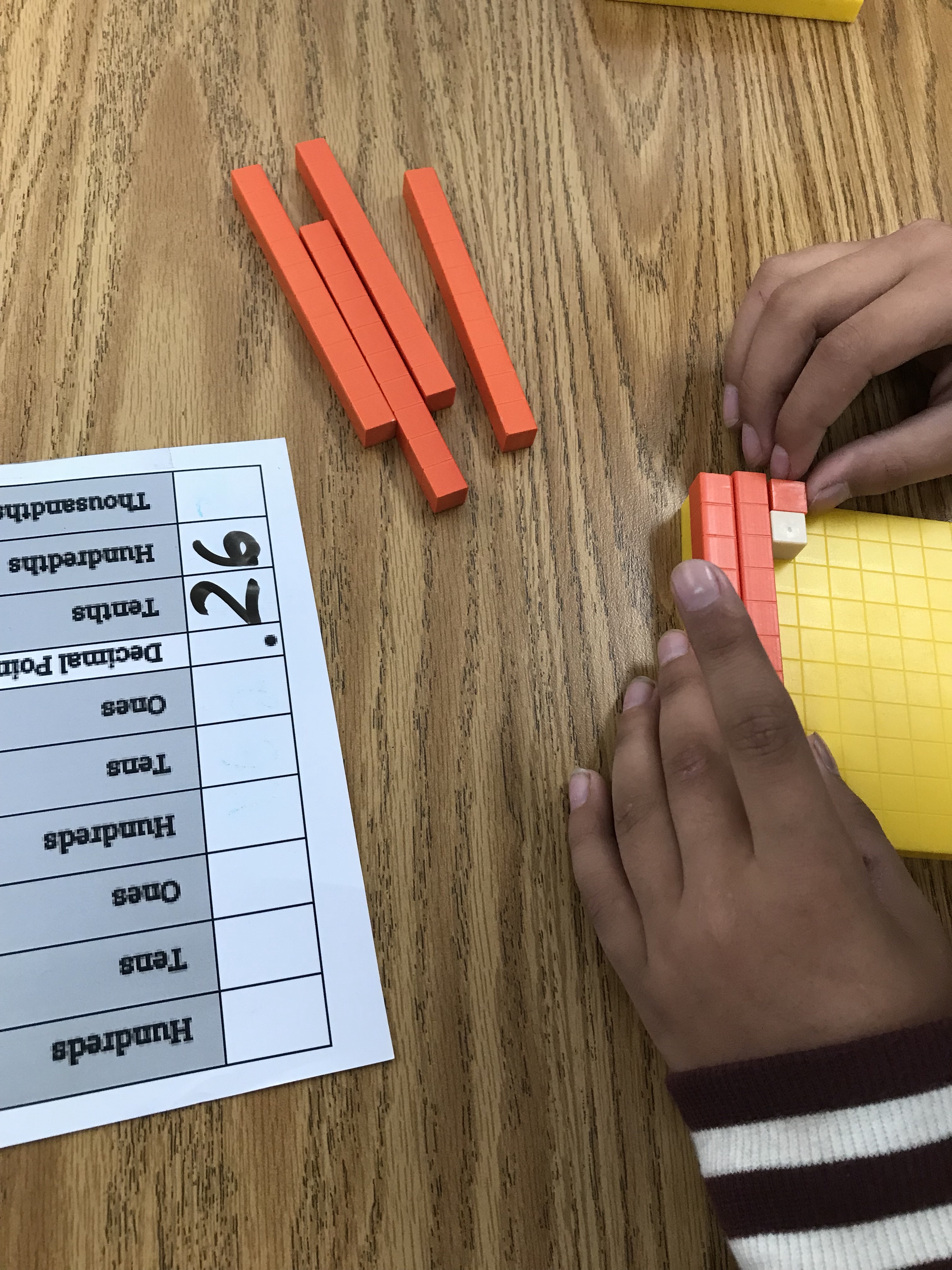
No more excuses. Last week my class explored decimals and multiples of ten. I didn’t think they were really understanding that they moved the numbers a column (base-10 number chart) because we have a base-10 number system. They could do it, but were they understanding the why? The answer was, no. So, I broke out the base-10 manipulatives (rods, flats, etc.) to illustrate this. THEY worked as a group  (table groups) to prove that 0.26 x 10 = 2.6. Yeah, that lesson was a total failure! Each group created 10 groups of 0.26, but when they combined them they grabbed everything; including the unused manipulatives.

I did not want to give up the opportunity for them to make a connection. I regrouped after the failed lesson and reflected on what went wrong – management on my part. The next day we tried it again with greater success. Once they had their 10 groups of 0.14 I had them clean up the extra pieces (duh). They still weren’t completely making the connection, therefore, several conversations were had. Several finally saw the connection.

I’m not saying that this lesson hit it out of the park, obviously, it didn’t. I do need to make sure the students are getting more and more exposure to the manipulatives. With practice, we will all get better.

For as much as I write about my successes, I need to also write about my failures. This is a lesson that I am still thinking about nearly a week later. How can I make it better next time? Where did I go wrong? Any and all suggestions welcome.

I Am a Lazy Teacher

Yes, you heard me correctly; I am a lazy teacher. Or so that’s how I feel. Being a 5th-grade self-inclusion teacher is hard. Now, I have nothing to compare this to, so I’m not saying that my job is harder than anyone else’s. I’m just saying that my job is hard. And I get lazy. I’m really hoping I’m not the only one.

So what do I mean by lazy? Well, there are days – more when it’s closer to a break – that I pull out the curriculum and do what’s next in the TE. I barely modify it, if at all. See, lazy. I hate this, but sometimes I’m tired and it takes a lot of energy to come up with engaging lessons for all areas of the day. I love Hyperdocs, Hypermaps, Breakouts, Ditch the Textbook philosophy, and all things engaging. But sometimes being an island in your own school/district is hard.

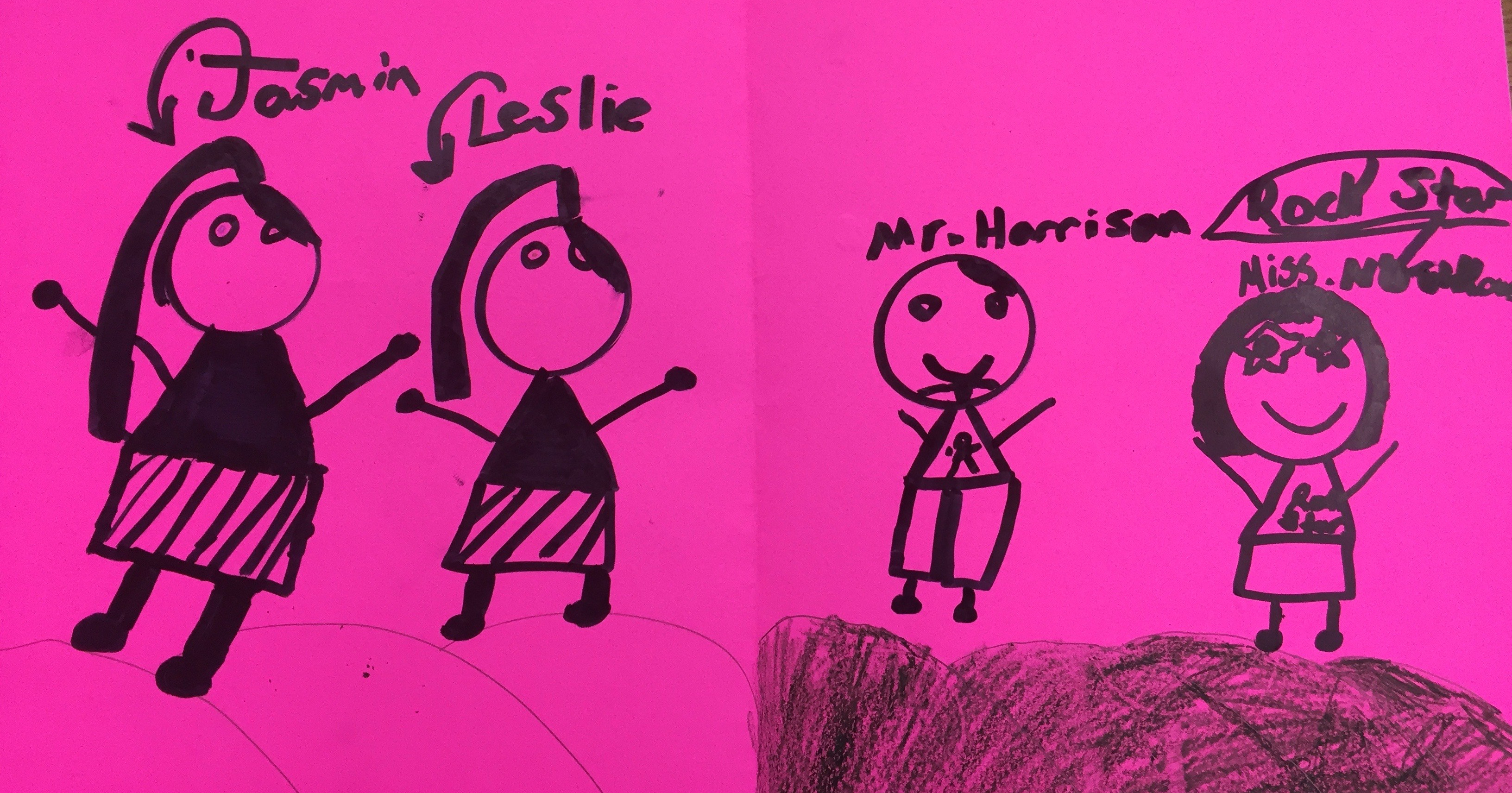
I want to BE the Rockstar my students think I am!

img_4891.jpg

So, this is why I am vowing to come back from break with more gusto, enthusiasm, and most importantly, engaging lessons for the students. They deserve it! I’m finally going to start that 50 states lesson I thought up last summer, we are going to read The Mouse & the Motorcycle by Beverly Clearly and the unit will include Flipgrid discussions. Science Camp is also scheduled for later in the week. And Math. I just received my copy of Jo Boaler’s new book: Mindset Mathematics Grade 5. It’s the perfect time to revisit certain concepts that they are struggling with.

No more lazy teacher! My students deserve better. I am capable of better. I will do better!

#MathReps

About a year and a half ago I began imagining how Jon Corippo‘s 8 p*ARTS of Speech might look in a math classroom. That’s when I started on my journey of #MathReps. It was small, and originally just for me. I had no problem sharing it and did so freely. Since then, I have been encouraged to expand to other grades. Working with other teachers, I have begun creating and collecting #MathReps for grades K – 8. It is an ongoing process.

#MathReps Example

Feel free to share with others. All credits are given to those that helped. And to them, I thank you!

MathReps: 1st Grade

Last year I created some 5th-grade math protocols. Simple pages students could fill in to help solidify and keep up previously learned skills. This year, I decided to create grades K – 8. A friend and I got together this weekend and hammered out the beginning of 1st grade. And, we gamified it! The directions and gameboards are in Google Slides. This allows you to copy it and customize it.

I also created a video, based on the 1st-grade teacher’s recommendation. Thank you Cris McKee!

I’d love to hear how you use it. Have suggestions for other 1st-grade MathReps? I’d love to hear your thoughts.


Mathematical Mindsets

Mathematical Mindsets book by Jo BoalerThis year, as a parting gift, my principal handed out this book to all returning and new staff members. We were invited to participate in a Summer Book Club. One in which we read, post thoughts, videos, questions, and ideas. This made me so happy! I had thought about buying the book earlier this year when my principal told me to hold off and that he was buying one for all of us. So for the last 2 weeks of school, I hounded him to let me take my copy. He wouldn’t give it to me until I signed out of my room. Tricky man! (NOTE: I NEVER ask to read a book. I have some reading disabilities that make ‘heavier’ readings difficult for me)

So a few of us have started the book and are making our notes/comments in the provided document; my principal created a shared doc in Google. I appreciate this way as I can read what others have written and get a general sense of what’s to come. The most recent chapter, Chapter 3, really caught my attention. In it, the author talks about how students view math vs. mathematicians view math. Students tend to view it as procedures, rules, and/or calculations. However, mathematicians tend to see it as creative, beautiful, and full of patterns. It was the sentiment that math is a study of patterns that made me take notice.

I have, for years, told my students that math was about patterns. That it was like a puzzle one needed to solve. I have always viewed math as a series of patterns and puzzles. I remember when I was in Kindergarten, a friend and I were talking. She was bragging how she could count to 100 while I could only count to 20. This irritated me. I wanted to count to 100 too. I remember going home and working this problem out in my room. Why I didn’t ask my mother is beyond me. But I was a stubborn kid (and for those of you who know me now, I’m still pretty stubborn). I remember looking at the numbers and ‘analyzing’ them. I thought, “If I can count to 20, then I can figure out how to count to 100.” And as I looked at the numbers, I saw a pattern. The numbers repeated. I began to realize that once the numbers in the one’s place (although I didn’t know place value at the time) were done, they started over again. And the numbers in the ten’s place began at 1, then went to 2 when all the numbers in the one’s place had been used. I had figured out the problem and went to school the next day bragging that I too, could count to 100.

Part of my success with math has come from A) a reading disability, so I gravitated towards math, and B) the fact that I was able to play and manipulate numbers on my own, okay and C) just being a plain old stubborn kid! We need to help students view math as patterns. We need to get over our own fear of math. We need to explore and allow conversations to happen in math. This is where the learning happens and a love of math will develop.

This is such a great book! Full of inspiration. I’m so glad we are reading it as a staff.

One final note: From grades 2 – 6 I was convinced I was going to grow up to be a mathematician. While that’s not my occupation, I’d say that I am one! We all are!

Coordinates Breakout

This year I have done a few Breakouts with my class. To say that they love them would be an understatement. So this week when we started coordinates in math, the wheels in our brains started turning. Seriously, there are so many things a person can do!

As we were walking to lunch one student suggested that we do a Breakout based on coordinates. I thought this was a GREAT idea and told him that I would search to see if there were any already made. However, by the end of the 45-minute lunch break, I had decided that making our own would be more fun!

I have been wanting to create my own Breakout for over a year. I have had a few ideas. One was an entire Breakout based in Google Maps. Another was based on directions and graphing. Unfortunately, I could never really get clues and ideas that I felt were good enough. Today was a different story. With the help of 28 other brains, we began creating an exciting Breakout – if I do say so myself.

IMG_5342I posed the idea to the class and they went for it. We decided which locks and accessories to use, created codes, and clue outlines. They even designed a distractor that should be used. They had some great ideas! We’re not done yet, but we will definitely share when we are done. I will have them create the clues and the story. I’m pretty excited for what they will come up with.
They know that I introduced this concept – BreakoutEDU – to the staff last week. They want to run their Breakout with the staff. I don’t think there’s time for that, but hopefully, we can run it with the other 5th-grade class.

Place Value Basics & Mult./Div.

Last year, I began using Jon Corippo‘s 8 p*ARTS . I saw great success with the repetition. As a result, I thought I’d like to do something along similar lines with Math. Now, I will admit, what I came up with isn’t nearly as fun. However, the repetition is there. This is for 5th grade and can easily be modified for other grades. Here’s what I came up with.

Place Value Basics

The plan:

  • Today’s Number – Have the student of the day decide on the day’s number anywhere from billion to thousandths place. However, the number must be at least to the tenths place.
  • 10 times greater – Take the original number and make it ten times greater.
  • 100 times greater – Take the original number and make it one hundred times greater.
  • 1,000 times greater – Yup, take the original number and make it one thousand times greater.
  • Add 10 times greater and 100 times greater – add the numbers.
  • Write a number that is GREATER – Have students change ONLY a digit that is AFTER the decimal.
  • 1/10 times less – Take the original number and make it ten times less.
  • 1/100 times less – Take the original number and make it one hundred times less.
  • Subtract 1/10 and 1/100 – subtract the numbers.
  • Write a number that is LESS – Have students change ONLY a digit that is AFTER the decimal.
  • Prime factors of the first 2 digits of the whole number – Only take the numbers in the ones and tens place and find the prime factors.

An example is given on the second slide. This should be done daily, with an assessment each week. The first week or two should be done as a group until the class understands what is expected. Once they ‘get the hang of it’ all that is needed is the number and the students can do this independently.

Update: Since the beginning of the year, I have added a new daily practice paper. Now that they can do the Mult/Div paper well, I switch back and forth. I will soon add a fractions practice paper to the mix.