Explain Your Answer

Shifts in Math

2000px-math-svgOne of the bigger shifts in math, aside from the building blocks in the CCSS Framework, is the ever dreaded ‘Explain your answer’. When this first came out, I wasn’t sure what they meant, the frameworks hadn’t been written yet. I had students explaining that they ‘added the ones then regrouped to get the answer.’ And while they were technically correct, there was a lot missing.

Better Understanding

Now, I have a better understanding of what is needed. The students need to break down each step and explain, using academic language, what their thought process is. I furthered my understanding when I went to a training on this. Honestly, it wasn’t the best training, but it got me thinking. I used some of the techniques to create a better lesson.

The Lesson

First, I created a template that the students were going to be using. Then, as a group, we walked through each part of the template and filled it in. There was  A LOT of guidance this first time. I’m hoping with practice, they will become more independent. Students worked in table groups to solve their table problem. Finally, they were to film their process of solving the problem. Using their ‘scripts’ students explained the process for division. Here’s an example:

sample

FAIL

Remember that Mult/Div math paper I was sooooo excited about the other day? Well, it was an EPIC fail. Monday morning I introduced the paper to the class. They freaked out. Okay, that’s normal. It was new and unexpected. We walked through each part together…slowly. Oh. So. Slowly. They could almost handle the paper until…division! Yup, that killed ’em. And here is where the fail occurred. I was so excited, I didn’t worry about the 2 numbers they would be dividing. BIG mistake!

failCreative Commons 3 – CC BY-SA 3.0 NY – http://www.thebluediamondgallery.com/scrabble/f/fail.html

I don’t remember what the numbers were, but it was a HOT mess! They were over it, I was over it, and they were super confused – it didn’t divide evenly and decimals were needed. For 5th graders who forgot how to divide in most cases, it was too much. So last night I reflected. I needed to choose the numbers (not let the kids) at least for now.

Today I went into class and discussed how that was an EPIC failure. I got jazz hands. Yes, we celebrate failure in my class. I told them what I thought and how I think it could be fixed. Then I asked what they thought. They agreed, the numbers needed to be smaller. So we went through the paper in a slightly different manner. We chose the whole number first. THEN, we went to the tool box and created equations. From here, we were able to find a decimal (first number box) that we knew would divide evenly. We had to manipulate the number (multiply 1/10 or multiply by 1/100) to get our desired decimal, but it worked. And hey, they are getting extra practice with place value!

I am happy to report that things went much more smoothly today. They kids were still a little perplexed as to how to confidently divide, but that’s why we’re in school; to learn. They got to see me fail, which is always a bonus. And they saw how the reflection and iteration are a part of the failure process.

Multiplication & Division Basics

In the beginning of the school year, I created Place Value Basics. This was meant as a daily review to get students thinking quickly about some of the basics we learn. It was a big hit! My students went from doing it in 40 minutes (I know, but they needed the time) to around 8 minutes. Pretty good, right!?

Well, they had been bugging me to change it up. THIS is a good sign. So I came up with Multiplication and Division Basics. As some were still having a bit of trouble with Prime Factors, I kept in on this version.

Each year I teach this before Winter Break. Then after this, we head into fractions. Fractions take up all of the 2nd Trimester and by the time 3rd Trimester and the State Test roll around, students have forgotten how to multiply and (deep sigh here) divide. The problem is they have a shaky footing on these concepts before hitting fractions. I know, I’m the teacher… I should go with what they know and base lessons around them. Yes, in an ideal world that is happening. However, the pressure to do Benchmark Assessments and my district’s pacing (don’t get me started on that), and prepping them for the next grade are all too much for me – and them I suspect.

I have seen a great success with my students and the Place Value Basics. I am hoping that they can have the same success with this. How long will it take us in the beginning? Ugh, I hope not the 40 minutes! It’ll take us a while the first week or so, but in time they will successfully complete it in 8 minutes or less! Again, I will start off doing this whole class.

Which One Doesn’t Belong

Last year I was introduced to a great website called Which One Doesn’t Belong by my friend, Nancy Minicozzi. The site is full of visuals in which students must decide which of the 4 images doesn’t belong.

Looking at the following, which would you say doesn’t belong?

screen-shot-2016-10-04-at-7-10-38-pm

Based on your perception you may have said the heart because it is the only one that is NOT a polygon. Or perhaps you thought the star for the lack of the red outline. Possibly you were drawn to the green arrow as it is comprised of two different shapes. Or maybe it was the last shape because it lacked a color on the inside. No matter what you thought, you were right.

This is a fantastic, low-risk activity for students to participate in. I have done it a few different ways. I have had students study the image and then move to different parts of the room. While gathered there, they talk about why they chose the image they did. Other times I have used tools like Padlet for them to record their thoughts. No matter what method I use, they enjoy the activity.

This year I have 1 non-English speaker. At first, he was reluctant to participate, but now he regularly raises his hand to explain why he chose the image he did. I also have students moving from table to table because they can see how the different images don’t belong.

In addition to the low-risk appeal, I am able to teach my students how to have conversations. We begin sentences with, “I agree with…. because…”, or “I disagree with… because…”, or even better, “In addition to what … said…” Quality language, thought process, and communication skills that are being utilized daily.

Mini BreakoutEDU Games

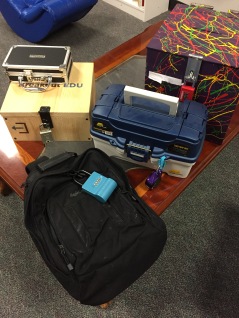
This week I wanted a fun review of the objectives that we have learned in Math thus far. So my ‘brilliant’ idea was to create 5 mini BreakoutEDU games for the students to rotate through. I have 5 tables groups, thus the 5 mini games. I went through our math program and copied some challenge problems for the students to solve. I gave them 5 minutes to complete each game.

img_4672Yes, one of the breakout boxes is a backpack! This was their first exposure to BreakoutEDU. At first, they thought it was going to be easy. A few decided that they would just ‘mess’ with the locks. They soon figured out, it wasn’t so easy!

So during the first round, only 1 of the 5 groups was successful. The other groups were disappointed that they didn’t succeed. I also think they thought it would be much easier than it was. The next round was a bit more successful: 2 groups succeeded. I even had one group that went 3-2 for games. All in all, 11 of the 25 games were successful. Not bad for our first try.

At one point, one of the groups that hadn’t cracked any locks asked if we were going to do it again on Monday. I was a bit nervous that the lack of success with this group (based on the kids in the group) was proving to be discouraging. However, when I answered no they were disappointed that they WEREN’T doing it again on Monday! They went on to tell me how much fun it was! This will be happening again this year.

Place Value Basics

Last year, I began using Jon Corippo‘s 8 p*ARTS . I saw great success with the repetition. As a result, I thought I’d like to do something along similar lines with Math. Now, I will admit, what I came up with isn’t nearly as fun. However, the repetition is there. This is for 5th grade and can easily be modified for other grades. Here’s what I came up with.

Place Value Basics

The plan:

  • Today’s Number – Have the student of the day decide on the day’s number anywhere from billion to thousandths place. However, the number must be at least to the tenths place.
  • 10 times greater – Take the original number and make it ten times greater.
  • 100 times greater – Take the original number and make it one hundred times greater.
  • 1,000 times greater – Yup, take the original number and make it one thousand times greater.
  • Add 10 times greater and 100 times greater – add the numbers.
  • Write a number that is GREATER – Have students change ONLY a digit that is AFTER the decimal.
  • 1/10 times less – Take the original number and make it ten times less.
  • 1/100 times less – Take the original number and make it one hundred times less.
  • Subtract 1/10 and 1/100 – subtract the numbers.
  • Write a number that is LESS – Have students change ONLY a digit that is AFTER the decimal.
  • Prime factors of the first 2 digits of the whole number – Only take the numbers in the ones and tens place and find the prime factors.

An example is given on the second slide. This should be done daily, with an assessment each week. The first week or two should be done as a group until the class understands what is expected. Once they ‘get the hang of it’ all that is needed is the number and the students can do this independently.

Today Was A Good Day

Yes, today was a good day. You know you’ve done something right when you tell the students that we are heading to the high school theater for a production and their reaction is, “What, we’re going to miss Math? I like math.” Yeah, that’s what they had to say. A few actually looked devastated to NOT have math.

math-is-fun-i-love-math-said-my-students-today-22815

Yes, they even said that Math is fun and that they love Math. What 5th graders says that?

Then later in the afternoon, during our regular break time, my students were so engrossed in their work, they missed their regular 2 pm break. What were they doing? Collecting information, doing research, writing notes, and creating videos about the Boston Tea Party. Yup, they were focused and engaged in HISTORY!

Now, this doesn’t happen often. Thus, me writing a blog post about my good day. We should celebrate the little things in life. Here’s to more days like today!

Mathbowl 2016

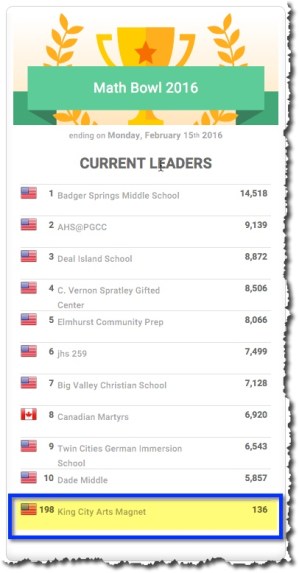
WMathbowl 1hile our school didn’t win, we had a lot of fun! I have never seen my students so focused and determined. One student asked if I could assign MORE challenges! Yes, MORE! How awesome is that?

In the midst of it all, we were challenged to participate in a Fai-To! This is where our school and another go head to head. Considering that our Internet went down twice in the past week, I was pleased to learn that we WON the last Fai-To!

There aren’t many classrooms at my school using Mangahigh, so to have 136 points is pretty big for us.

mathbowl 2

To top it all off, I had an IEP for a student on Friday. The parents commented how much the student, who struggles academically, enjoys Mangahigh. The student often asks to try, “Just one more time,” in order to achieve a higher score, beat another student, or gain another medal.

Just another reason to love this program! And to all the winners, congratulations!

Gamification: Here’s the Deal

And what a deal it is! I have written about my use of Mangahigh in my classroom in the past (Gamify My Homework, Math In the Summer, Engage Student With Mangahigh, and Online Homework). I really do like the tool!

Here’s an opportunity to check it out…for FREE (for a limited time). Not only do you get to check out all the features, your class/school can participate in an online challenge! Adding to the gamification fun. Go ahead, sign up for the challenge. What do you have to lose? It’s FREE.

10% Discount

And if you like it and decide to purchase…You can receive a 10% discount and a 30-day FREE trial. See, it just keeps getting better! Email Amber (amber@mangahigh.com) with the code: NOWATECHIE10.

Mangahigh

Challenge Details

The challenge will run from February 1st – 15th 2016 for all K-10 students at schools in the US and Canada. It’s completely free to participate and we encourage you to take advantage of this opportunity to explore Mangahigh and see the impact digital games-based solutions can have on students’ learning.


During the challenge, you will have full access to all of Mangahigh’s premium features, including 600+ activities aligned to Common Core and other state standards. You can assign specific challenges to support the topic you are currently teaching, or simply allow students to complete challenges independently.

What do we win?

The school that scores the most points during the competition will be crowned the Math Bowl Champion, winning a $500 Amazon voucher, $500 Mangahigh voucher, trophy plus medals and certificates for their top 10 students.

The 9 runners up with all receive a $100 Amazon voucher$200 Mangahigh vouchermedals, and certificates for their top 10 students.

Students with 200 points or more will receive a Mangahigh medal!

Who can enter?

The competition is open to all schools in the US and Canada for grades K-10 regardless of school size, location and previous experience with Mangahigh.com. You are welcome to enrol as many teachers and students as you like.

Who will join me?

I’ve already signed up. Who will join in the challenge?


Make It Ourselves!

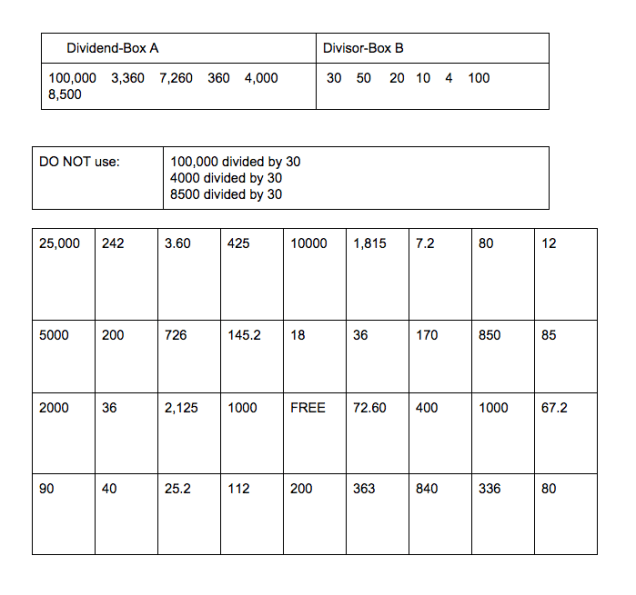
We have been working on division with and without decimals. To help my students gain experience with the computation, I found a game (Four in a Row) in Georgia Math. They enjoy the game, but you always have those few who get board because it’s too easy. And yes, I had some of those. However, these 3 boys didn’t complain. Instead, they asked if they could make their own.


Screen Shot 2015-12-14 at 5.22.42 PM
Credit: J-Jey, Julian, and Adan

The boys chose the numbers and did the division to fill in the boxes with the quotient. This week, the rest of the class was able to enjoy the fruits of their labor. It was a hit.

Now, this same group has decided to recreate another game. It was a multiplication board game, also found in Georgia Math. They are pretty excited.

Why was this so important? First of all, we talk about differentiation but aren’t alway great at it. This allowed my more proficient students to be challenged yet work on the same goals as the rest of the class. Secondly, and more importantly, my students took control over their learning and thought of a way to challenge themselves. What a powerful lesson for all.