MathReps on Wipebooks

August 8, 2023, marked the beginning of the school year for my district. As the school buzzed with energy and anticipation, it was a bit crazy but in the best kind of way. It felt good to be back, surrounded by familiar faces and the promise of a fresh start.

One of my primary tasks as a TOSA (teacher on special assignment) and coach is to coach teachers, assisting them in their professional development and helping them navigate the nuances of teaching and new pedagogy. Before that first day, amidst the flurry of preparations and moving classrooms, a teacher approached me with a spirited enthusiasm. She had recently decided to switch grade levels, seeking a new challenge and fresh perspectives in her teaching journey.

Eager to make the year a resounding success, she shared her latest plan with me. She had purchased MathReps, a comprehensive resource designed to enhance mathematical understanding and fluency, on Wipebooks.

With MathReps in her possession, she was eager to begin using them with her students. The versatility of Wipebooks, with their erasable surfaces, offered a tangible way for students to participate actively in their learning, fostering a sense of ownership and empowerment.

Off to a good start

The teacher had a great way to start her students on their learning journey by employing a technique that harnessed a low cognitive load. With the objective of introducing the concept of Numbers in Base-Ten (NBT) to her enthusiastic young learners, she began the lesson by carefully reviewing the NBT standards page.

She decided to ease her students into the topic to ensure a smooth and effective start by initially focusing on 2-digit numbers. By doing so, she created a comfortable and approachable learning environment, which allowed her students to grasp the fundamental format and expectations effortlessly.

With the teacher’s thoughtful approach and dedicated efforts, the classroom became a space where students actively participated, their confidence grew, and they developed a deep understanding of Numbers in Base-Ten. The teacher’s commitment to ensuring a low cognitive load at the outset proved to be an effective strategy that set her students up for success, fostering a positive and empowering learning experience for all.

This is where I come in

While the teacher was confident in all the tasks on the page, she did ask for a demonstration on how to round using the number line. On Friday, I went into the classroom to work with the class. They were amazing. They could easily explain many of the concepts being covered.

As we delved into the topic of rounding, I began by asking the students to think about a number line. We discussed how a number line can help us visualize and understand the process of rounding.

The students quickly caught on and started rounding with ease. It was truly inspiring to see their confidence grow as they mastered the concept of rounding using the number line.

Overall, it was a rewarding experience witnessing the students’ enthusiasm and progress in their mathematical journey. The classroom atmosphere was filled with excitement and a sense of accomplishment. I am confident that these young minds will continue to excel in their mathematical abilities, thanks to their dedication and eagerness to learn.

Notes From Their Grown-ups

My district holds Back to School Night the night before school starts, at least for the TK – 5 schools. I personally love this. No parents are asking about behaviors, assignments, etc. I get to meet them and get to know each family a bit. It also helps the kiddos see where to report to in the morning. I really enjoy this model.

This leads me to August 2019. Sometime during my classroom setup, I got the idea to post a giant poster in the room and invite parents to write little words of encouragement. This was the last year in elementary before they went off to middle school. I wanted to make it memorable. Little did any of us realize that the universe was most certainly going to make it a memorable school year!

Some notes touched on the importance of making mistakes, believing in yourself, and asking for help when needed. This poster stayed up in our room for a long time after school started. I referred to them from time to time reminding them of what their families wanted them to know.

We have many multilingual families and some monolingual families (non-English). They were invited to write in the language of their choice. Had a parent wanted something written for them, I certainly would have helped with that too. Their words mattered. Side note, as I sat to write this today, I realized I wrote about it in 2019 too. Funny how a great idea sticks with you.

I’m Totally Crying

So often as teachers, we hope to impact students’ lives for the better. As an elementary teacher, I oftentimes am unaware of what my impact may have been. But every now and then, I am fortunate enough to learn about my impact.

On one of my Socials, I posted a picture celebrating the number of years of service to my district (25!). A former parent saw it and commented. And yes, I have many former parents as mutuals on my Socials. I live in a small town and it’s not uncommon. She shared that her youngest, a former student of mine, was graduating this year and their plan is to study Computer Science in college and it was thanks to me. They are also graduating high school with a CSE sash. Which was all very nice to hear. THEN, she shared out a writing that the student did. I’m not sure what it was from but the focus was on an experience that the student had while in my class and the impact that experience had on their life.

Background:
For many years, the students participated in ‘Genius Hour‘. This is a time when students can explore their passion, learn something they are interested in, or explore subjects/concepts. There are rules and expectations that accompany this time. Part of the procedure has students reporting out to the class. Therefore, my students were giving weekly presentations. These presentations were then scored by the class. We focused on clarity, volume/eye contact, and overall presentation (did they slump, lean against things, stand tall, etc).

And for years, others side-eyed me and didn’t quite understand the power and impact this precious time held. From an outsider’s viewpoint, it looked like ‘free time’ or playing. To be fair, there was a good amount of slime and goo that was made through the years. I struggled with this for many years. I was hoping for more meaningful projects. Then, my good friend, Nancy Minicozzi, put it all in perspective for me. She said, “This is what they need and it’s okay. Let it go.” She was right. After all, there were many outstanding projects through the years. Techie Chicks were a group of girls who created a website of tech tools and tutorials. They even had their own Chrome Extension. There was another year, a group of girls got together to create a ‘business’. Well, it was more of a charity fundraiser. We had a student with health issues who was spending time in a Ronald McDonald house. This group created a website, sample products, and a Google Form all in an effort to raise money for the Ronald McDonald House. These 3rd-graders, raised around $300.

Back to the former student who will be studying CS. In an effort to help students explore subjects and projects they may have never thought of for themselves, I had some resources bookmarked for them to explore. The one resource that caught this student’s eye was Gamestar Mechanic. To say that the student was obsessed would be an understatement. This site allowed students to design their own video games. It was very basic pixelated images, but everyone enjoyed trying out the games this student created. The presentations grew more and more interesting as well. The student would invite another person up to play the newly created game while explaining how it was built and the skills needed to pass the level. It was so much fun watching this student dive into this newly found passion.

Fast forward 7 years. That student is now graduating and going on to study programming. Now, cue the waterworks. This was the reflection that was shared with me.

To this student and so many others, you are extremely gifted and, yes, here you are! You possess the drive and passion to build, create, solve problems, and make this world a better place. I can’t wait to see where you go and what you accomplish. I am so proud of you.

To educators and parents, allow students to explore new avenues. Allow them to spread their wings to try new things. Stand back and let them amaze you!

And yes, I’m tearing up again.

NOTE: I kept the pronouns neutral on purpose. It is nothing deeper than a habit to be neutral out of respect for others in the event they don’t want to be highlighted.

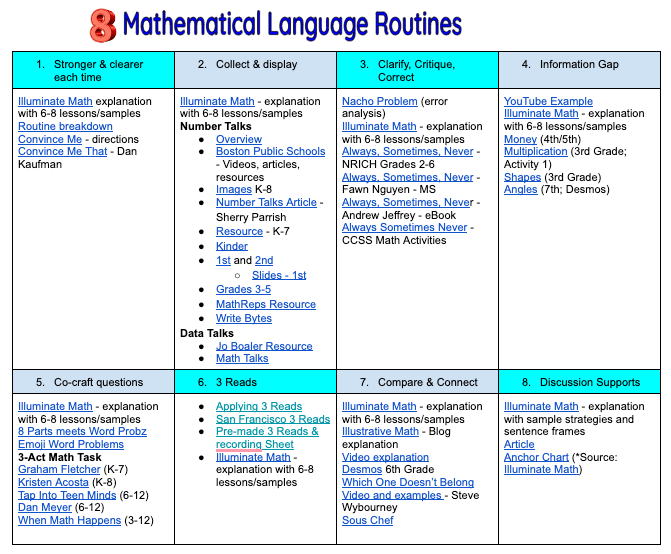
8 Mathematical Language Routines

I have been on a journey to educate myself on the 8 Mathematical Language Routines (MLRs). While they were designed with Multilanguage Learners in mind, I find that they are just good teaching. So what are they?

  • Stronger & clearer each time
  • Collect & display
  • Clarify, critique, and correct
  • Information Gap
  • Co-craft questions
  • 3 Reads
  • Compare & Connect
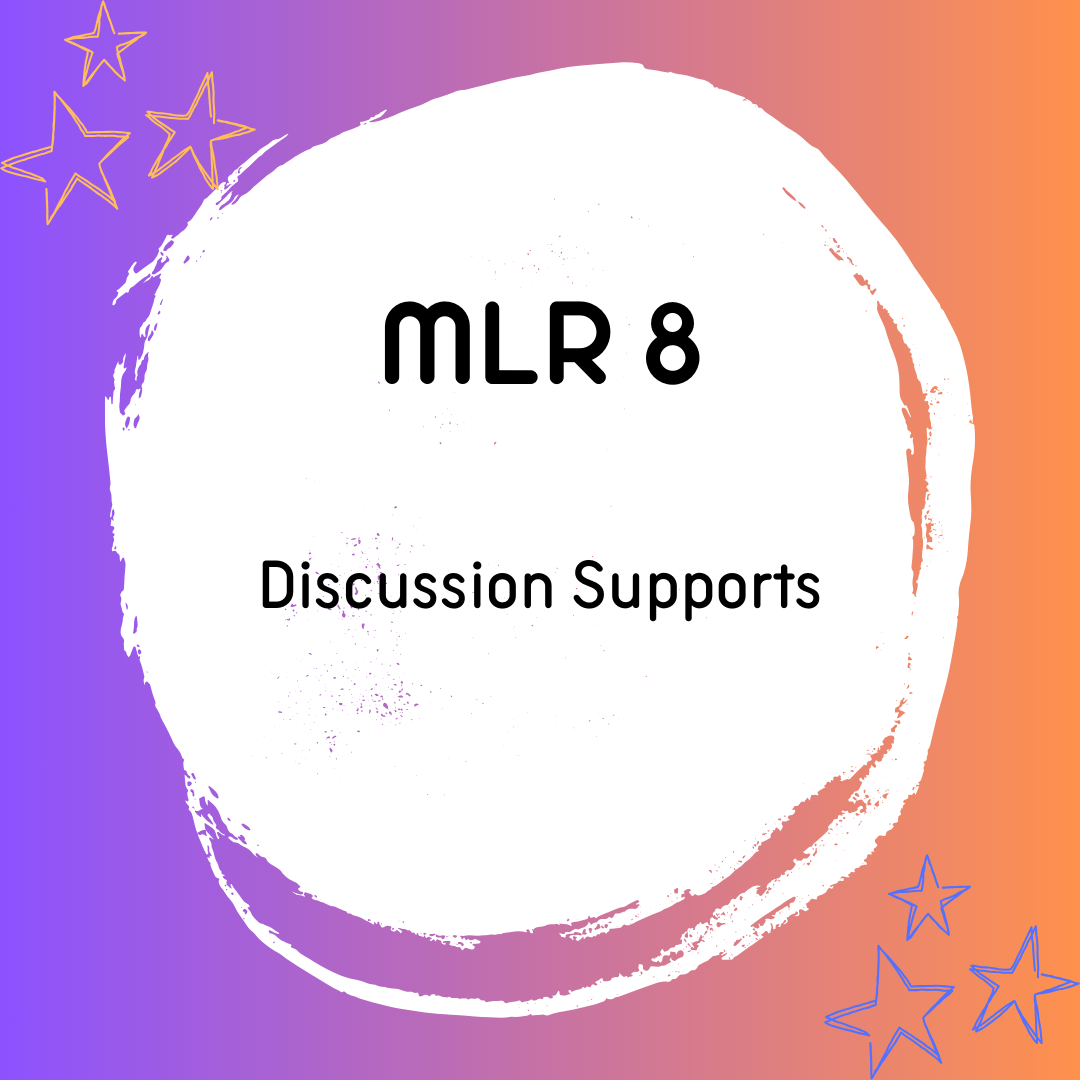
  • Discussion Supports

So what does each one entail? Well, rather than sit and explain, I’d rather give you a resource that does a far better job breaking it down. It’s also one of my favorite resources.

Part of my deep dive allowed me to align Math EduProtocols and these MLR’s. Doing this has my mind working on how to incorporate more MLR’s within Math EduProtocols.

With all this in mind, I have begun to curate some resources for teachers. I break down each MLR and give links to activities. It’s not a comprehensive list, so I will continue to add to it as I find more. If you have something that should be added to the document, let me know!

Inspirational Quotes

I have the honor to go into a 3rd-grade classroom in my district. Each time I am in there, the teacher has an inspirational quote posted. This isn’t your everyday quote. No, this teacher organically connects these quotes to social-emotional learning (SEL).

As you can see, the teacher is helping the students to have a healthy mindset about previously made choices. Not only does the teacher write these words, but demonstrates them to the students daily. The students are also reminded that mistakes are okay but in an authentic voice. It’s one thing to tell students, but it’s another thing to experience the compassion and encouragement to be gentle with oneself.

I have learned so much from this teacher. And hopefully, you learned a thing or two as well.

Accomplishing the Unthinkable

This post will be slightly different from most, but related to teaching nonetheless. Back in September 2022, a friend reminded me of a promise I made: I would run the Big Sur International 11-miler. In case you are wondering, yes, I run regularly. HOWEVER, I am slow and generally only run 5K races. I run most mornings, but no more than 2.5 miles. Getting up any earlier is way too difficult. So, being a person of my word, I signed up for the race. The race is held in April each year.

After signing up for it, in September, I vowed I would train to run this 11-mile race. I started off strong with a training routine. Then I purchased a new treadmill. This amped up my training. Along with the new treadmill, in early December, I started using a new app that accompanied this treadmill.

I realized I was a bit behind in training, but still had plenty of time to make it up. I was doing well until I wasn’t. You see, the time from January to mid-April just sort of flew by. I was still running, but not increasing my distance. Then, it was a week before the run and time had run out. So by this time, I was a bit worried. My running partner had told me since I signed up that we would mostly walk. Maybe that’s why I didn’t have a sense of urgency.

The night before, we went up to Monterey to easily catch the bus in the morning. While waiting for the race to start we decided to run all downhill grades. And that is exactly what we did. I’m not going to lie; by the time I got to mile 9, I was proud of how well I was doing and in a little pain. Yeah, I should have done a bit more training. Finally, near the end, I realized I could finish in under 3 hours. – Go ahead and laugh here; my dad did. – Anyway, I was very proud of myself, and we beat my running partner’s time by over 10 min.

My point behind all this is that I never, in a million years, thought I’d start running let alone do a (nearly) half marathon. And as I crossed the finish line, I thought to myself, “I really can accomplish the things that seem undoable. Mile by mile, step by step, no matter how difficult or daunting a task may seem, I can do it”

California Missions

I know that there are mixed feelings regarding creating California Missions. I’m going to focus on the positive. I work with a fourth-grade class in my district. The teacher went “old school’, her words, not mine. She had the students create physical models.

Now before anyone is concerned about equity, I assure you all student creations were created equally. How? Students created them in class with teacher-provided materials. She provided the cardboard, basic dimensions, paint, rulers, and scissors, while she hot-glued the walls together. Some students did bring in some extra decorations and happily shared them with others. Check out some of their work

Clearly, these were all student created. In order to get ready for this project, they did their research. The students began by learning about the colonization of California and the role Missions played in changing it. Then each student researched a mission: its history, founder, indigenous people, and its current use. They then produced a slideshow to present to the class. There was a lot of learning that occurred before this culminating activity.

All in all, I was blown away by their work. They did an amazing job and each student was proud of themself.

Eff Teachers

The opinion heard around the internet. On Meghan Trainor’s podcast, Workin’ on It, she spoke with Trisha Paytas. She and her guest began speaking about schools. Megan stated that she was homeschooling her children. They also brought up issues like school shootings. Then, things took a turn. Trisha began talking about bullying. This led to teachers bullying kids. Which led to Meghan saying, “Fuck teachers, dude.” Without hesitation, without stuttering, and with her whole chest.

Needless to say, this didn’t sit well with teachers. Look, we know that not every teacher is amazing. We recognize that we are human and have bad days. We acknowledge we have made mistakes. We also apologize, stand in front of bullets, buy food and supplies for our students. To be so easily and quickly dismissed was hurtful. What’s even more hurtful are the hundreds of people who also feel this way about teachers.

There was an apology. After the backlash, after the podcast was edited, after the podcast went through production. But an apology was given.

Why?

Photo by Image Hunter on Pexels.com

Why is it so easy to trash teachers? Why are teachers expected to be superhuman? Why is it encouraged to give students grace, which we should, but not extend that same grace to teachers? Why am I now expected to understand that being shot while teaching is a ‘hazard of the job’? ⬅️That one is absurd!

I know the answer to most of these questions is politically motivated. But can we PLEASE leave politics out this? We are all doing our best.

Back to Meghan

Dear Meghan,

We appreciate your apology. You say that you weren’t talking about all teachers, but felt good enough with what you said to keep it in the published podcast. You say you respect us. You say you fight for teachers. How? How do you fight for us? I’ll admit that you may and I just haven’t seen the reciepts. I’m open to seeing what you have done. Will you now take up inititives to fight for our, and our students’, safety? Many times, I have told my students, “If you are really sorry, your behavior will change.” Many teachers will be watching to see if your behavior changes, Meghan.

Nacho Problem

What’s a problem that’s not yours? Nacho Problem!

It’s that time of year, Test Prep time. Which makes me think about using EduProtocols for Test Prep. One great one that really promotes deeper thinking and understanding is Nacho Problem. This was created by Ligia Ayala-Rodriguez. It’s a fun way to do error analysis with your students. I have done this with students as young as 7.

One of the advantages is that you begin by telling the students the answer is wrong. This seemingly takes the pressure off. I like to have the students talk it out the first few times. I guide them along the way to help set the expectations. Just like in an ‘Analyze the Error’ on the test, students are expected to express their thoughts in writing. This can present an additional challenge if they haven’t exercised this skill. I’m not saying we should do this solely to prepare for the state test; the benefits of students being able to do this go far beyond that idea.

How to Get Started

As a class, they are presented with a Nacho Problem. We read and analyzed the problem together; starting with “What do you notice?” and “What do you wonder?” I explicitly tell them the answer is wrong and that we must find where I went wrong. I have found that looking at the question and working out the problem allows us to focus on the process (that the problem is asking us to solve) rather than the arduous task of finding a mistake. Once we work it out together, and later independently, students can then go back and compare their process with the original (wrong) process. It makes it more obvious where the original problem solver went wrong.

The written explanation can be the most difficult part. When I started doing problems like this, students would explain, in an addition problem, “I started in the ones and added 8+7. I left the 5 in the one’s place and regrouped the 1.” While technically that is true and we as teachers understand, that’s not showing an understanding. That is why practicing the structure of Claim, Evidence, and Reasoning (CER) is so important.

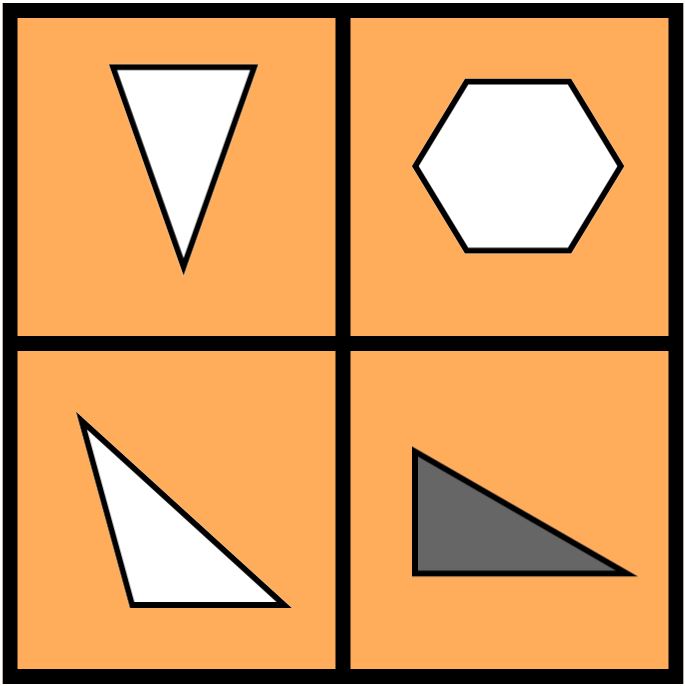
Claim: Ms. N. did not draw a quadrilateral.
Evidence: The student example with explanation.
Reasoning: Definition of a polygon and Ms. N’s error.

Finding Problems

One of the easiest ways to collect incorrect problems is from your class. Whether you use exit tickets or collect information from the day’s lesson, you have a plethora of options. When using student errors, it’s advisable to use a common mistake by many students. Done early, this can correct any misconceptions before they become habits. Ligia suggests using mathmistakes.org

Results

Teachers and students alike enjoy this math EduProtocol. Students find it ‘fun’ to find the mistakes. Teachers report that it takes little time to begin implementing in their classes. Doing this a few times a week can really improve understanding. Let’s face it, students LOVE to point out teachers’ mistakes.

If you use this, I would love to hear how it went. What changes did you make? How have your students improved with error analysis?

Free Bingo Cards

Recently I had a teacher ask me about some review games. Bingo is always a hit so I went on the search for a 3rd-grade Geometry Bingo game. Sadly, I couldn’t find what I wanted. Which then led to a search for Bingo card creators. I was not about to sit and recreate 25 Bingo cards. I like to use my time a bit more efficiently. And that’s when I found it! My Free Bingo Cards

This awesome sight creates simple Bingo Cards. They have several ready-to-go, broken down by categories. There is also the option to create your own. I opted to create my own. The process was simple. I plugged in all the words the students were to review. I then pressed one button for the program to create 30 unique Bingo cards. I did play around with it to see if I could insert images via copy/paste. No such luck. That was okay; I had a backup plan. The program also created a sheet for me to track which words were used and calling cards. I opted NOT to use the calling cards.

What did I use instead of the calling cards?

Instead of the calling cards I created a wheel on Wheel of Names. This was part of my backup plan: I used images. I could have also opted for the definitions, but I felt the images were more engaging and less repeating. This game was a big hit!

If you’re a 3rd-grade teacher and would like to play this here are the cards and here is the wheel.

If you’ve never used Wheel of Names before, you’re going to love it! There’s no need to guess where the spinner landed. The program tells you which one. Then you have the option to remove the selected item from the wheel to avoid mishaps.