Author: Admin
Literacy Shed #gafesummit 3-7-15
After-School Tutoring
The last few days, I’ve had students contacting me, at home online, to help them with their math homework. The first time, the student contacted me via email and we had a series of emails going back and forth. In class the next day, I mentioned how a student contacted me for help and how awesome that was.
The next day, I received a chat invite via Google Hangouts on my personal GMail account. My students know what the email is, but never (until now) use it. It’s used for web tools sites. She choose to contact me on this account as our district has disabled chat on the student domain. Here is a portion of our conversation:
How #awesomesauce is that? Next, I’m secretly (well not so secretly now) hoping that someone will figure out how to do the video chats and we’ll do a study group hangout.
This is what makes my job so awesome!
Becoming a Teacher
This week’s #youredustory topic is:
“What was the defining moment you decided to be a teacher?”

So imagine that you are sitting in a smoke filled, windowless back room working as a telemarketer for some shady company one summer. Now imagine that you have decided to change your major, yet again. This is the story of how I decided to become a teacher.
Most people have some really great story about becoming a teacher. They were inspired by a teacher in their youth, maybe they were inspired by a parent who happened to be a teacher, or it was a drive within them that they’ve had since childhood. Yeah, my story isn’t flowery or touching; in fact, my story is somewhat embarrassing/depressing, in a ‘I can’t believe that really happened’ kind of way.
One summer I had returned home from college waffling over my latest choice in majors. I began college declaring I was going to be a Physical Therapist when I grew up. Then I changed my mind and declared I would be a nurse. Needless to say, neither one of those worked out and I needed to make some decisions.
That summer I was taking classes at a University that was closer to home and needed a job to pay for expenses. It was at this job, that I HATED, that I made the life choice to become a teacher – in a most uninspiring way.
I was hired to do telemarketing for a shady company. They sold magazines, and I was charged with calling places like Kmart and Sears in locations like Florida. My first day on the job, one of the other workers warned me that the company won’t mail out W2’s so I should keep all my pay stubs in order to file taxes (I did as suggested, and no the company never mailed out W2’s). All the other telemarketers were in their late teens early 20’s. I just remember a lot of cigarette smoke, no windows, and having to shower once I got home because of the stench.
One day at lunch I decided I needed to sit down and look at what majors my University offered. I had put in a few years and didn’t want to lose credits by changing universities (this was back in Michigan). And I was lazy and didn’t really want to apply at another university – too much work involved. So I pulled out the paper that listed all the majors available. I went through the list and thought, “Shit, nothing appeals to me”. I then decided to go through the list again – I was seriously NOT changing schools – and thought, “Okay, it will go on ‘the list’ [of possibilities] if I can even remotely see myself doing it”. I got to the E’s and found Elementary Education. I sighed and thought to myself that yeah, I can imagine doing this, but I’m only in the E’s there’ll be something else that catches my eye. I wasn’t all THAT thrilled. AND… I got to the end of the listed majors; Elementary Education was the only thing on my list of possibilities. So the next week, I went to my University and officially changed majors, again.
I told you it wasn’t the most inspiring story, but makes a great story to tell others. I clearly enjoyed the classes and my choice. Otherwise, I would have gone through that list and changed majors yet again.
I can honestly say that I have never regretted my decision. My journey to becoming the teacher I am today may have started off in a smoke filled, windowless room; it has taken me to amazing heights, down passion-filled roads, and connected me with inspiring educators. This is my story, and I’m sticking to it!
Why Do I Do What I Do?
This week’s #youredustory prompt:
“People don’t buy WHAT you do, they buy WHY you do it” Simon Sinek – Why do you do what you do?
My first thought was, “My therapist would have a field day with this one [and me].”
https://www.flickr.com/photos/colinkinner/2200500024/
Someone once asked me how I could stay at the same job year after year and not get bored. Quite simply, it’s NOT the same job day after day, let alone year after year.
I do what I do because education is an ever changing entity. Theories, methods, and technology keep the classroom fresh and exciting. I am a person who loves to learn new things; I think most educators are the same way. Before teaching 5th grade, I taught 3rd for about 10 years. I never once taught the same lesson, exactly the same way, twice. I was constantly reflecting, and changing how I taught.
Change: it’s the beauty of our job. When we choose to continue to accept the positive changes, learn new techniques, and view each day as a learning experience, we can’t help but be fulfilled with “What We Do”.
So I do what I do, in part, because I’m selfish. I’m easily bored and need new challenges. Teaching affords me that luxury. Another reason I teach is because I get to inspire a love of learning through innovative and interesting ways. I get to show children how fun, and cool, fractions, technology, editing, creating, history, writing, and so much more can be!
I do what I do because it is inspiring!
Why I Love My Partner Teacher
In the beginning of the 2013-14 school year, a new 5th grade teacher was brought in. I’ll admit I was excited yet skeptical. I’ve worked with lots of teachers at my grade level and generally have gotten along with them, but never truly ‘clicked’ with another teacher. Until Mrs. Pursley came along.
And here is why I love (working with) her – in no particular order:
- I can talk her into doing almost anything in a classroom, no matter how crazy it is. Within 2 months she was doing Genius Hour with me.
- We both have a student-centered classroom.
- I get random texts from her saying things like, “You complete me <3”
- When asked if we do A.R. (Accelerated Reader) we both respond no (in a disgusted tone) and she adds ‘Cuz AR sucks’.
- She calls me a Dork, when I’m being one.
- I get to call her a Dork when she’s being one.
- She will text me at random moments just to say something smarmy.
- We share random 80’s aerobics videos back and forth – and we both secretly love them!
- We generally have the same mentality (age) – that of a 12 year old.
- We constantly laugh, mainly cuz of the mentality issue.
Seriously though, she’s awesome and just felt like sharing her awesomeness with the world.
Oh, and she’s one hell of a great teacher!
Student Choice
Recently I began a unit on the Reasons for the Revolutionary War. It’s all gamified and I am usually 1 step ahead of the kids. Last week, I was about an hour ahead of the students. I had a group getting ready to start creating their Boston Tea Party movie that afternoon. At lunch I had the thought, “Hm, I should probably have them create a storyboard”.
I then began looking up storyboards, and stumbled upon Storyboard That. It had several great examples of simple storyboards on the Boston Tea Party. I only meant to give my students some example so they could either draw theirs on paper or on Google Draw. My lack of direction and the group’s internal fearlessness, lead to better than expected results. Instead of my students taking the easy way out, they dove right into the new tool.
The students came came to me after 15 minutes and asked for my login. I told them that I didn’t have one for the site, and asked why they needed it. They then showed me their work. Yeah, they started creating their own story board, and the site prompted them to save it.
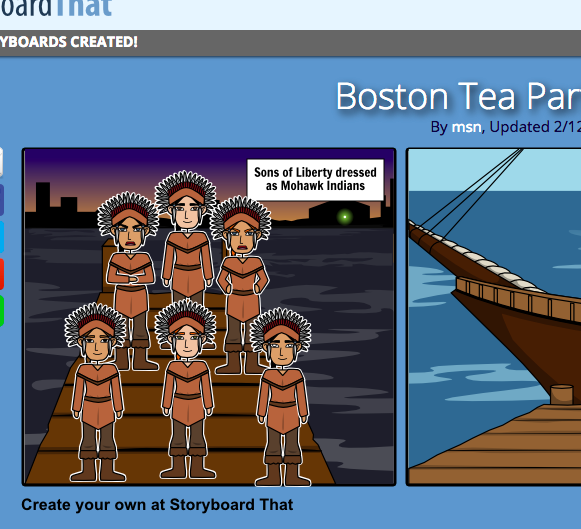
So I did what anyone else would do. I created an account on the spot! Glad I did, too. The students are being creative and showing me what they learned.
Beginning Bloggers
Today I had the pleasure of assisting a few teachers with Class Blogs. And truth be told, we took a side trip down ‘GMail Lane’. I was so pleased to see that some of those ‘non-techies’ (self proclaimed) were willing to jump in and give it a try. Since it was a small group, we were able to do it #CUERockStar Style. The teachers each set up a Class Blog on Kidblogs. We also had enough time for them to post their own blog post, with an image (yup, they were responsible digital citizens and used ‘Free to Use Images‘)!  These ladies ROCKED! I can’t wait to read what their students write.
Learning Is…
Define “learning” in 100 words or less.
This prompt made me think; 100 words or 1000 words ,I’m not sure I could ever articulate learning. But, here it goes.

Learning is…
- messy
- fun
- ever-changing
- diverse
- hands-on
- cerebral
- loud
- focused
- collaborative
- filled with tangents
- revolutionary
- intrinsic
- playful
- innovative
- exploration
- social
- creative
- in a classroom
- thinking
- trying new things
- outdoors
- everywhere
- different for everyone
Learning is what you make it. I hope you’re making the most of your experiences. (Check me out, I’ve got words to spare!)
Supporting the Beginner
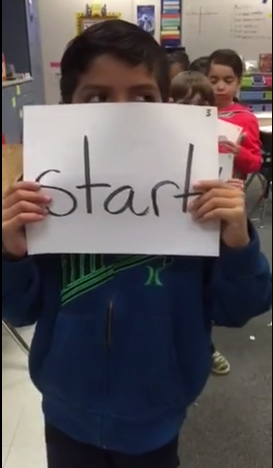 A few weeks ago I got together with a first grade teacher at my site. We decided to video tape her students holding high frequency words. The idea was to create a fun way her students could practice their words, at school and home. Needless to say, it has been a big success. The students love it, and the parents love seeing it on our school’s FaceBook Page.
So today when I stopped by to see if she needed another taping session, I was sad to find that she was a little down about the project. She had been so excited about this idea and how well it went, that she shared it with others – in hopes that they would find it as inspiring as she had. This is where she became disappointed. Unfortunately, some that she shared this with, immediately disregarded the idea saying that it would never work [for them].
And this is when I realized that those ‘new’ to technology in the classroom can be fragile. Fragile in the sense that this great new ‘thing’ that they are excited about and finding success with, which is then quickly disregarded by others, can easily break one’s spirit. She was truly disappointed that others had not wanted to try this. However, I quickly reminded her that 2 other teachers were inspired by her and had also taped their students.
It is stories like this, that encourage me to be the cheerleader for those who are willing to try. It is because of this teacher, who is now thinking of other ways to incorporate tech into her classroom, I will do what I can to support all those who dare to try something new. It’s not easy being the ‘Lone Nut’ [Jon Corippo & CUERockStar reference] in your grade level, on your campus, or in your district. But when a bunch of ‘Lone Nuts’ get together, amazing things begin to happen! And for this reason, I am looking forward to working with her with all the crazy ideas we can dream up!
Oh, and did I mention that she is a self proclaimed ‘non-techie’? Yeah, she’s THAT crazy – willing to dive into tech even when it’s outside her comfort zone. Mrs. Bolger, you inspire me!
Check out her kiddos:

