On paper, a MathRep might look exactly like a worksheet. I don’t fight that semantic battle with adult critics because the magic isn’t in the photocopy: it’s in the underlying pedagogy.
Traditional math curricula are inherently topical. They are designed as a fast-paced sprint, checking off one complex skill before immediately jumping to the next. This structure puts students at a massive disadvantage. It forces them to constantly use finite cognitive energy to decode new layouts, instructions, and isolated procedures, leaving little bandwidth to actually master the skills, spot the patterns, and make deep mathematical connections.
If we want students to truly own the math, we have to activate the Mastery Loop. And one of the most powerful ways to do that is by looking at the deliberate design, frontloading strategies, and classroom culture that drive true mathematical fluency.
The Anatomy of a Rep: Moving from Silos to Connections
Traditional worksheets treat math concepts like isolated islands. A student might practice “decimals on a number line” on Monday, but if they don’t see a visual area model or a place value chart alongside it, that knowledge stays siloed. When the format inevitably changes, the student gets stuck because the conceptual bridge was never built.
A MathRep completely flips this dynamic by grouping several interconnected standards onto a single page. By keeping multiple formats of a concept alive simultaneously, you shift the cognitive environment from rote memorization to relational thinking.
This design acts as a real-time diagnostic tool for teachers. Because concrete, pictoral, and abstract representations exist side-by-side, you can immediately spot where a student’s understanding breaks down: Can they partition the area model perfectly, but lose the logic when converting it to the abstract numbers of a standard algorithm? The layout reveals the gap instantly, allowing for precision intervention right in the moment.
The Prior-Grade On-Ramp (Frontloading)
This interconnected design makes MathReps the ultimate engine for frontloading upcoming units. Think about what happens when a fourth-grade teacher hits multi-digit multiplication and more complex division. If students don’t firmly grasp the core meaning of those operations, they get entirely lost in the steps.
Instead of diving straight into a frustrating textbook lesson, you can spend one to two weeks activating their prior knowledge with a past-grade protocol to jog the brain:
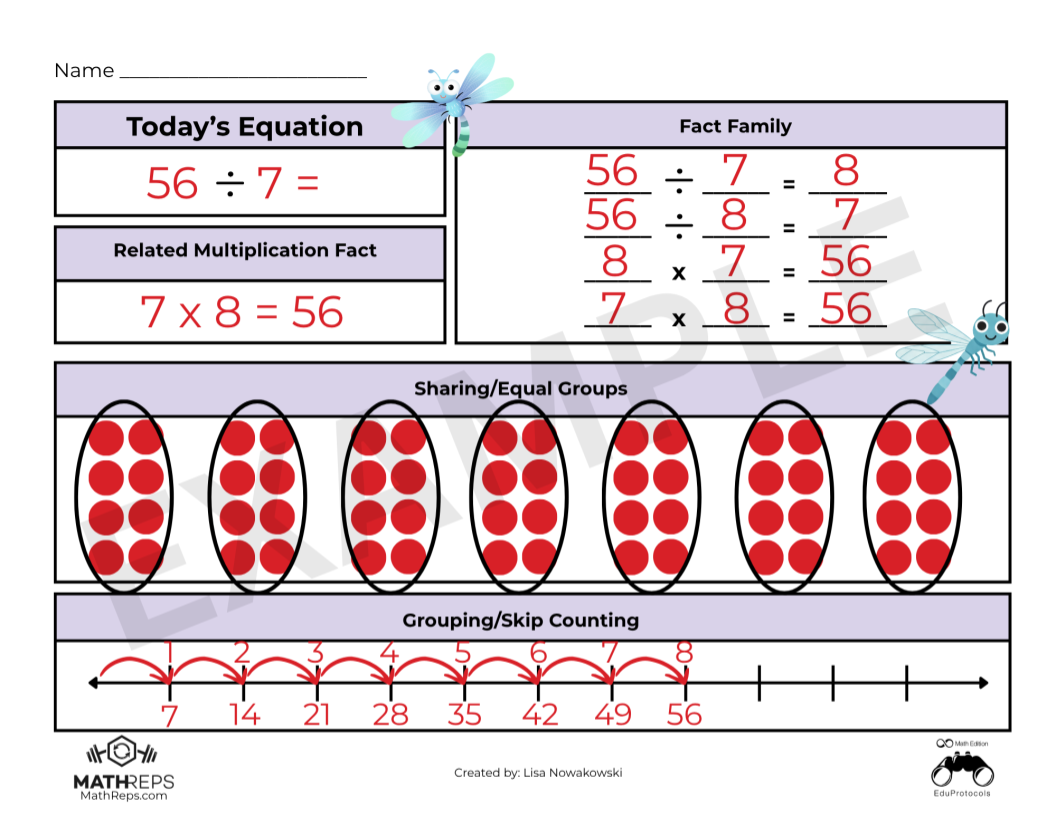
- The Reminders (3rd Grade): Before opening the current grade-level curriculum, pull a basic third-grade MathRep. For ten minutes a day, students interact with a single, simple equation—mapping out fact families, creating equal groups visually, and skip-counting on a number line. It gently reinforces the core foundation: division is sharing, and multiplication is grouping.
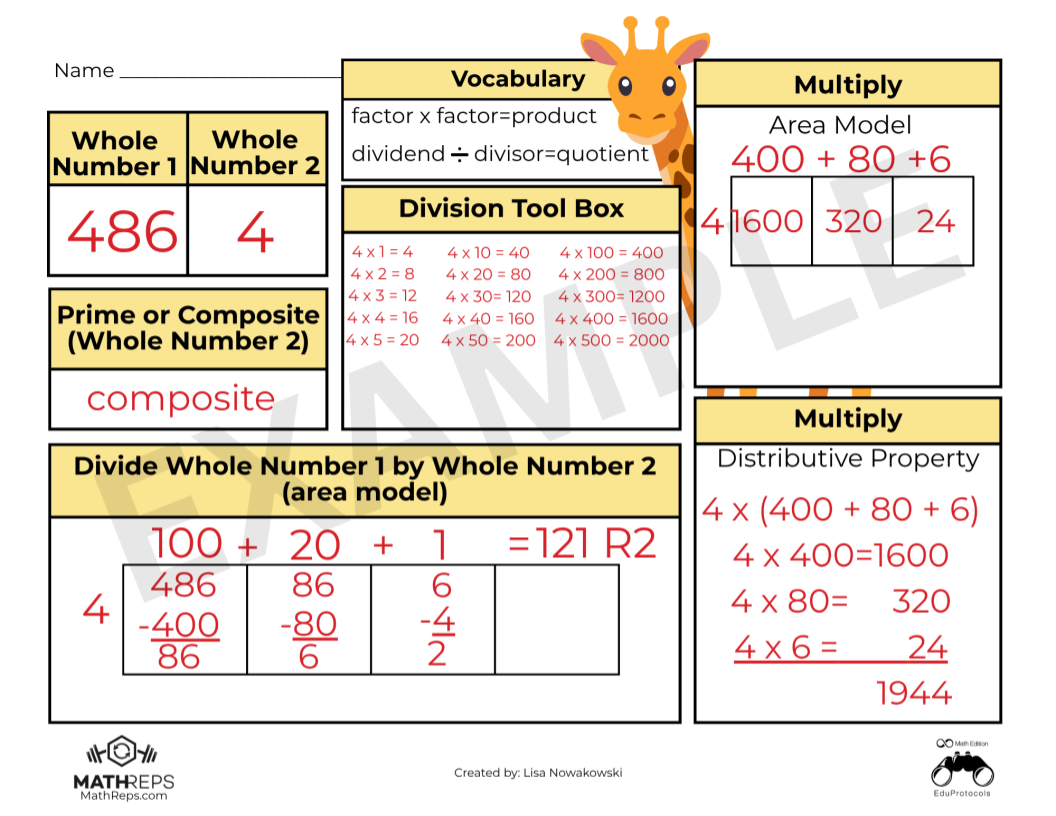
- The Transition (4th Grade): Once that foundation is secure, you introduce the fourth-grade MathReps. Because the heavy cognitive lifting of understanding “sharing and grouping” was already handled, their working memory is entirely free to tackle the next layer of complexity: the area model, the distributive property, or tape diagrams.
By utilizing a past-grade protocol, you prove to students that they aren’t starting at zero. You lower their anxiety and provide an active, scaffolded on-ramp to novel standards.
The In-Class Daily Glue vs. The Homework Silo
For this strategy to work, it is critical to note a fundamental rule: MathReps must be done in class. Sending them home for traditional homework completely defeats the purpose.
Traditional math homework is sent home into a feedback vacuum, often forcing students back into the “silo trap” of practicing a single procedure 30 times over. If they have a misconception, they spend half an hour reinforcing a bad habit before an adult can catch it.
MathReps acts as the daily glue because it thrives on a live classroom ecosystem built around immediate feedback. When you establish this routine as a daily norm from day one of the school year, you completely re-engineer the classroom culture:
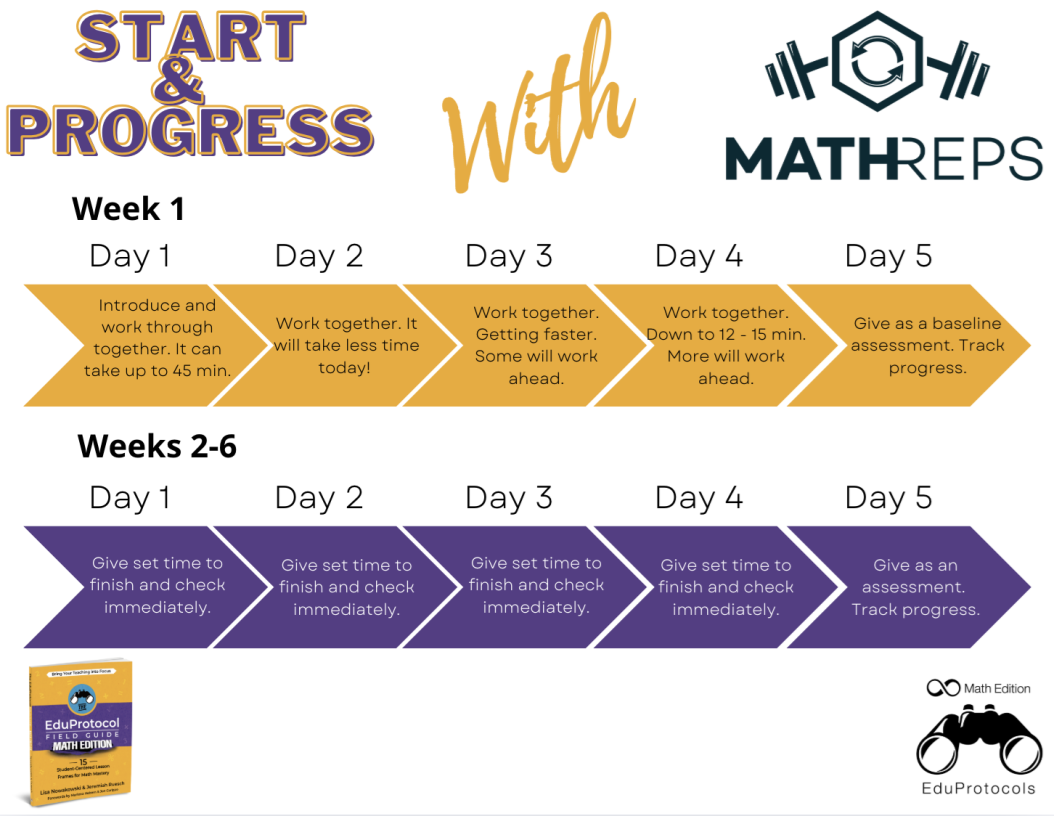
- Week 1 (The On-Ramp): On Day 1, the routine might take up to 45 minutes because you are teaching the layout and reducing the extraneous cognitive load together. By Days 2–4, the time drops dramatically (down to 12–15 minutes) as the format becomes predictable. Day 5 serves as a low-stakes baseline assessment.
- Weeks 2–6 (The Sustainable Machine): Days 1–4 become a predictable rhythm: a set time to work, followed by an immediate check. By Day 5, the weekly assessment is just a natural, stress-free extension of what they’ve already mastered.
Starting every math block with this routine sets a predictable, accessible tone. It warms up their “math brain,” lowers anxiety, and allows them to see the big picture.
Of course, when you move daily practice entirely into the classroom, the inevitable pushback arises: “Then what do teachers give for homework?” The answer lies in moving away from compliance-driven worksheets and toward non-traditional, meaningful alternatives like choice boards. Homework shouldn’t copy what happens in the room; it should extend a student’s vision outward. Instead of solving identical equations at a kitchen table, let them apply their mathematical flexibility to the real world, tracking geometric shapes in local architecture, finding the volume of buildings, or calculating the dimensions of a swimming pool.
Shifting the Ownership Loop
When the daily in-class routine is predictable and the layout never surprises them, you can finally pass the wheel to the students.
If a teacher doesn’t want to spend time curating a “Today’s Number” or “Today’s Equation,” you don’t have to. Assign a different student to choose the mathematical focus each day. When you hand over that marker, the routine stops being an exercise dictated by an adult and becomes a space owned entirely by the kids. They track the patterns, they navigate the constraints, and they build the schemas.
I have watched students actively use a visual representation they completely understand, like an area model in multiplication, to independently check their own work and guide themselves through a complex standard algorithm. They didn’t need a teacher telling them they were right or wrong; the interconnected page allowed them to be guided on their own.
Every time we step back and allow them to navigate the page independently, we honor the core truth of the learning process: The person who is doing the work is the one doing the learning.


