In my last blog post, I shared a story about coaching alongside a third-grade team that includes one of my former 5th-grade students.
Beyond our fun Skippyjon Jones read-aloud moment, my primary focus with this team has been elevating student writing. To help students become stronger, more intentional writers, the team wanted to introduce a classic EduProtocol: Parts of Speech.
To kick things off, I modeled demo lessons in each of their classrooms. By last week, the teachers were ready to take the reins and lead the protocol independently.
From Nervous Energy to Classroom Excitement
While heading over to visit my former student’s classroom, I ran into another third-grade team member. She was equal parts excited and nervous, mentioning she was planning to run her first solo Parts of Speech lesson later that afternoon. I promised to stop by.
When I popped into her room, the magic was already happening.
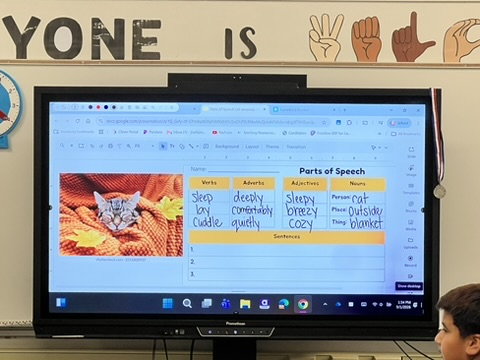
She was projecting a visual prompt on the display (an image of a sleeping kitten cozy in a blanket) alongside a collaborative word bank grid. The students were completely hooked and actively engaged.
How She Structured the Lesson
Her instructional execution was a textbook example of scaffolded support:
- Whole-Group Brainstorming: Together as a class, they generated targeted word banks across four columns based on the image: nouns, adjectives, verbs, adverbs.
- Guided Modeling (Sentence #1): She walked the class through constructing the first sentence together on the board, demonstrating how to pull words directly from their generated lists into a coherent, grammatically correct thought.
- Independent Application (Sentences #2 & #3): Once the structure was clear, she released the students to craft their own unique sentences for slots two and three, with the requirement that they pull from their shared vocabulary bank and use the parts of speech correctly.
Teacher Insights and Next Steps with Snorkl
The third-grade team is already noticing positive gains. Students are identifying parts of speech much faster, though the team noted that distinguishing between adjectives and adverbs still requires ongoing practice. Because EduProtocols rely on repetition and familiar frameworks, they will continue to refine these concepts in upcoming sessions.
Their next iteration? Tech integration via Snorkl.
The team plans to have students dictate their finished sentences into Snorkl, combining oral language practice, immediate feedback, and sentence construction into one seamless routine.
Seeing teachers move from watching a demo lesson to confidently leading high-engagement writing protocols in their own rooms is what coaching is all about. I’ll keep you posted on how their Snorkl dictation integration goes!
How do you help your students bridge the gap between isolated grammar practice and active sentence writing? Let me know in the comments below!