Mastering Elementary Math: The Power of MathReps and Math EduProtocols Pt. 3 Benefits

MathReps offers several clear advantages for students:

  1. Consistent Format: Unlike many curriculums, MathReps provides a consistent format for practice. This ensures that students know what to expect and can focus on mastering the skills without being distracted by changing formats.
  2. Repetition and Practice: Just like any new skill, math requires time and practice to master. MathReps offers repeated daily practice of multiple connecting skills, allowing students to spend sufficient time on each concept and develop a strong foundation.
  3. Reduced Anxiety: The combination of consistent format and ample practice time provided by MathReps helps to alleviate anxiety around math. With regular exposure to the material and opportunities for reinforcement, students become more confident in their abilities and feel less overwhelmed by math challenges.

MathReps offers a consistent and effective approach to math practice, allowing students to confidently develop their skills and reduce anxiety. It is important to note that MathReps is not a curriculum but an enhancement to any curriculum being used. This means it complements and supplements existing math curricula, providing additional resources and support to further strengthen students’ understanding and mastery of mathematical concepts. By incorporating MathReps into the learning environment, educators can optimize the educational experience and empower students to excel in mathematics.

Proof
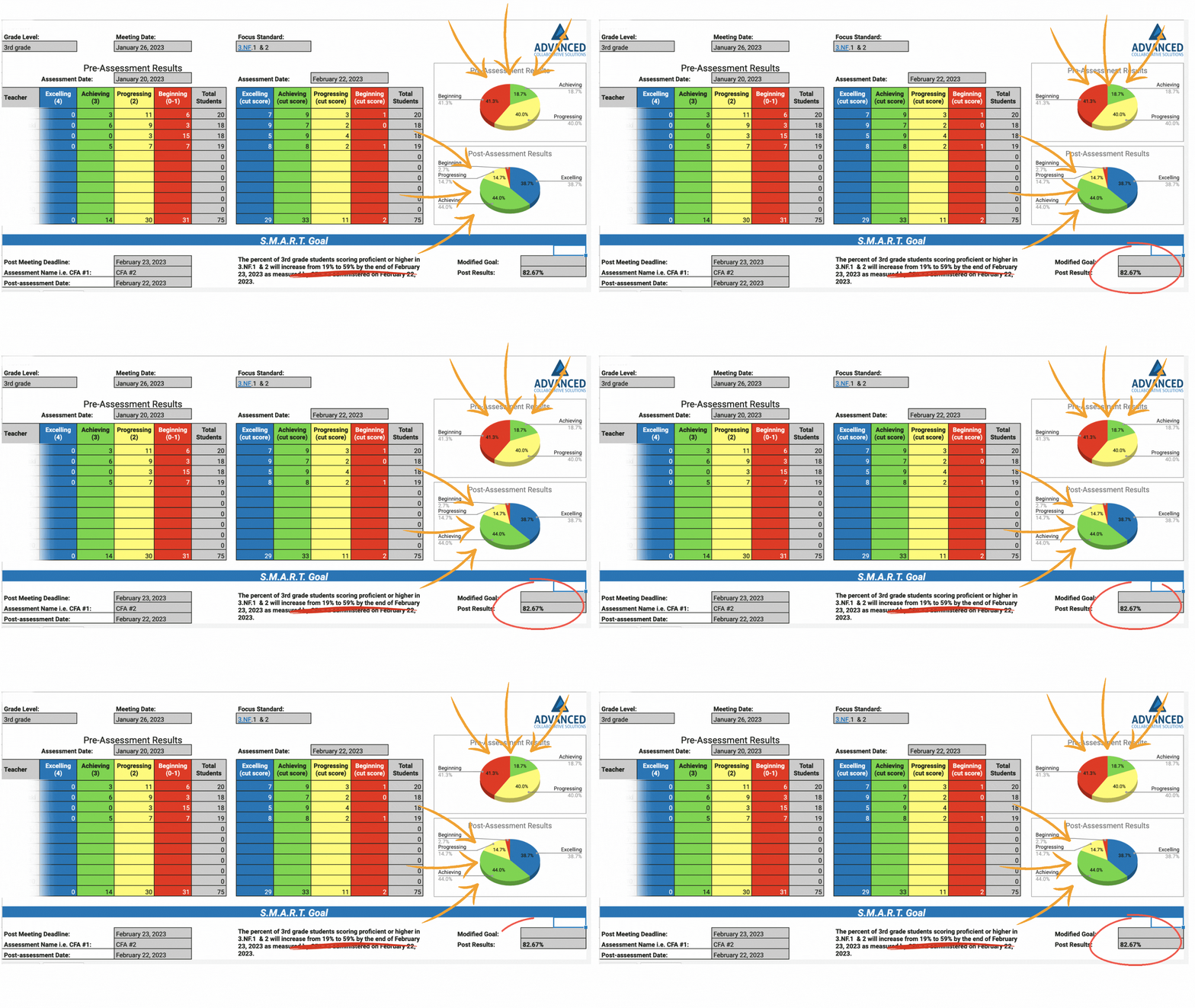
MathReps has proven to be incredibly beneficial for teachers and students alike. One 3rd-grade team saw a remarkable improvement in their students’ proficiency in fractions, increasing from 19% to an impressive 82.67%. This success was so significant that they decided to continue incorporating MathReps into their routine the following year. In their first focused cycle on multiplication strategies, they observed substantial growth, going from 23% to 70.59%. The teachers plan to continue using MathReps throughout the year because they recognize its contribution to their students’ growth. MathReps is an easy-to-implement tool that offers significant improvement rates, making it an invaluable asset in the classroom.

Mastering Elementary Math: The Power of MathReps and Math Eduprotocols Pt. 2 Understanding MathReps

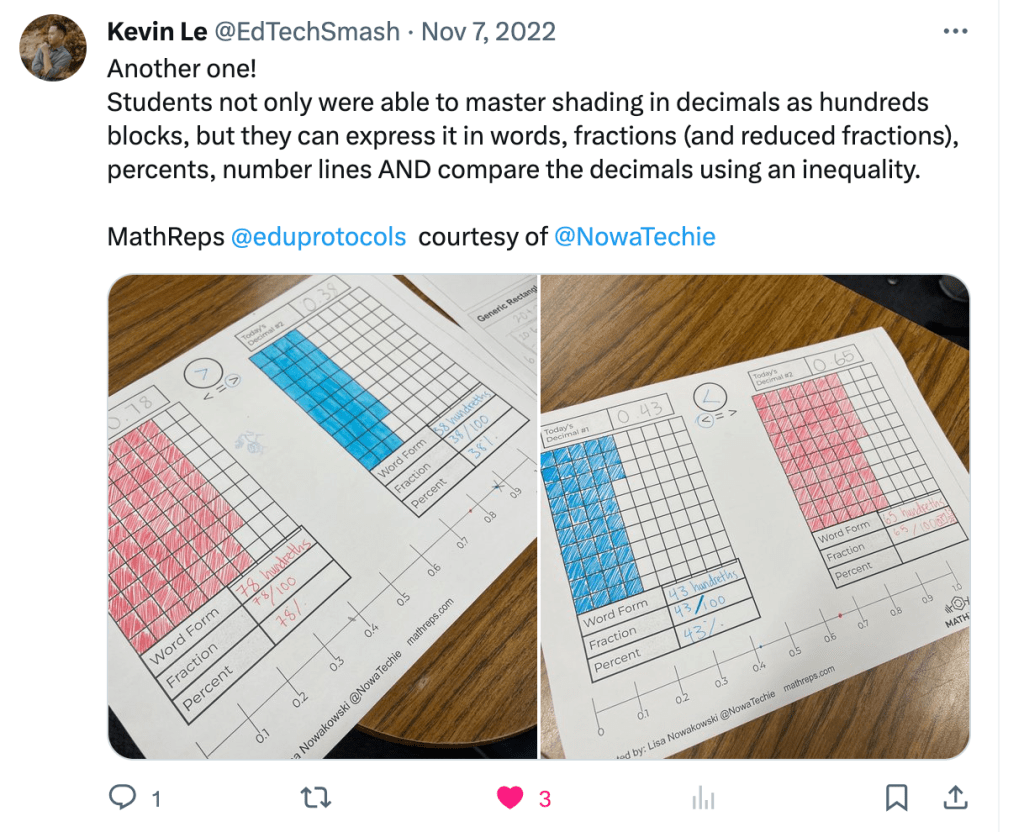
MathReps are thoughtfully designed templates teachers use for strategic and targeted math practices. These templates incorporate multiple related math skills and aim to help students make connections and bridge new concepts and strategies with previously learned ones. With MathReps, students can strengthen their understanding of mathematics in a structured and effective way.

MathReps is a powerful classroom tool that enhances learning. It offers ready-made templates, allowing teachers to focus on specific skills in order to gain mastery. One of the key benefits of MathReps is the immediate feedback it provides. In the classroom, teachers can give individual feedback as they move around, evaluate progress as a whole group, or employ a combination of both methods. Another advantage is the flexibility of MathReps, as it can be used with various platforms, ranging from simple paper and pencil or Wipebook to more advanced tools like Desmos, Nearpod, Pear Deck, or Figjam. It is recommended to use MathReps for at least three days a week to achieve the best results.

A Few Examples

Incorporating mathreps into a daily routine can be incredibly valuable for teachers. These short exercises provide repetitive practice and reinforcement for students, ensuring that concepts are deeply rooted in their minds. This approach helps to solidify connections between different mathematical concepts and builds fluency and flexibility in problem-solving.

Let’s take a closer look at the examples mentioned:

  • Second-grade counting money template: By using a template that incorporates word form and flexibility in handling money, students can develop a strong understanding of the concept of money in both dollars and cents. This repetitive practice allows them to become comfortable and confident in working with money.
  • Fifth-grade area model, partial products, and partial quotients: By combining these different techniques, students can see the connections between them and develop a more comprehensive understanding of the underlying mathematical principles. This approach encourages critical thinking and problem-solving skills.
  • Eighth-grade equations and expressions: Through repetitive practice, students can become proficient in solving various equations and working with different expressions. This builds their confidence and competence in tackling more complex mathematical problems.
  • High school trigonometry example: Running through several procedures in trigonometry enables students to make connections between different concepts and techniques. This helps them develop a deeper understanding of trigonometry and its applications.

Incorporating mathreps into the daily routine can ultimately enhance student learning by strengthening their mathematical foundation, connecting concepts, and fostering competence and confidence in problem-solving. It is an effective teaching strategy that greatly benefits teachers and students.

You can find the full collection at MathReps.com

What others are saying

Mastering Elementary Math: The Power of MathReps and Math Eduprotocols Pt. 1

According to (California) Mathematics Framework Chapter 3: Number Sense (2023), “To develop fluency, students need to have opportunities to explicitly connect their conceptual understanding with facts and procedures (including standard algorithms) in ways that make sense to them.” So what does all this mean?

To develop fluency, students need to have opportunities to explicitly connect their conceptual understanding with facts and procedures (including standard algorithms) in ways that make sense to them.

(California) Mathematics Framework Chapter 3: Number Sense (2023)

Building upon basic math concepts in early elementary is crucial for laying a strong foundation for future math concepts and overall academic success. By introducing and reinforcing fundamental mathematical skills, students develop essential problem-solving abilities, logical reasoning, critical thinking, and analytical skills.

When children acquire a strong understanding of basic math concepts, they are better equipped to tackle more complex mathematical ideas in later grades. By gradually introducing new concepts and building upon prior knowledge, students can gradually develop their mathematical proficiency. This progressive learning approach optimizes their chances of grasping and mastering higher-level math topics.

Moreover, the repeated practice of these basic math concepts is essential for long-term retention and automaticity. MathReps and Math EduProtocols provide valuable support in this process. Through systematic and repeated practice, students reinforce their understanding of basic math skills and improve their fluency.

Furthermore, the early development of strong math skills has a significant impact beyond the classroom. The critical thinking and problem-solving abilities fostered through the study of math are transferrable skills that have real-world applications. Proficiency in math opens doors to careers in various fields such as science, technology, engineering, finance, and even art, where mathematical reasoning plays a vital role.

In conclusion, building upon basic math concepts in early elementary is crucial for a child’s future academic success. By laying a strong foundation, students develop essential skills and pave the way for a deeper understanding of more complex mathematical concepts. MathReps and Math EduProtocols contribute to this process by providing systematic, repeated practice to reinforce these fundamental skills and promote mathematical fluency.

This captivating series explores the immense power of MathReps and Math EduProtocols, revealing their transformative impact on student success. Embark on a journey filled with insights, practical benefits, and step-by-step implementation strategies. Delve into inspiring examples and hear firsthand testimonials that will leave you motivated and ready to empower your students for a future of achievement. Don’t miss out, follow along and unlock your students’ true potential.

3 Reads Protocol

The “3 Reads Protocols” is a highly effective technique among the 8 Mathematical Language Routines. This strategy encourages a comprehensive understanding of word problems through a structured approach. In this activity, the problem is read three times, but it entails more than simple repetition. During the first read, the focus lies on comprehending the problem’s narrative. To aid in this process, teachers often conceal quantities and questions, enabling students to concentrate on comprehension rather than immediately diving into mathematical calculations. In the second read, teachers reveal the hidden quantities, redirecting students’ attention towards analyzing these values and their associated units, consequently deepening their grasp of the problem’s context. The final read diverges into two possible paths. If a question is provided, it is read aloud, and students formulate a strategic plan to tackle it. Alternatively, if no question is given, students are prompted to generate a list of inquiries themselves. Personally, I advocate for the latter approach, as it not only boosts student engagement but also fosters natural differentiation. In this scenario, students select a question from the generated list to solve. Remarkably, I have seldom witnessed students opting for an easy way out; rather, they frequently rise to the challenge by choosing appropriately challenging questions for themselves.

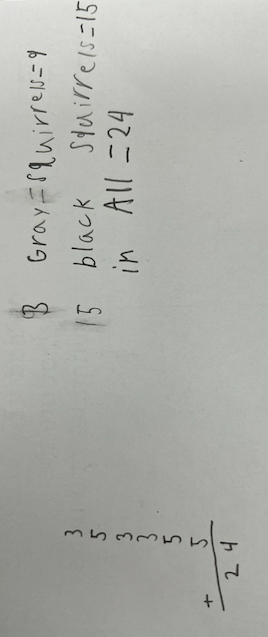
Today I was able to visit a 3rd-grade classroom in which the teacher was practicing this routine with their students. The teacher began by accessing the students’ prior knowledge about squirrels. The teacher then read the story (minus quantities) to the students. With partners, they discussed what the story was about. This can be hard for some students in the beginning. They know it’s math and naturally start looking for problems to solve. The students went through the steps and enjoyed themselves. After generating a list of questions, the group decided to answer the same question: How many acorns did each squirrel carry to get the pile of 24 acorns?

The struggle began as the teacher and I observed the students grappling with the task. We decided to give them some time to develop their own strategies before intervening. Many of them struggled to find a clear direction. Some counted the number of acorns squirrels can carry, reaching a total of 10. However, they seemed unsure about what to do next. Sensing the need for guidance, we asked the students to explain their thinking process. It was at that moment when a student appeared to have a promising approach. We asked him to elaborate on his reasoning. With a little clarification, he successfully explained that the black squirrel carried 15 acorns, while the gray squirrel carried 9 acorns. Surprisingly, the student didn’t mention the brown squirrel; technically, it carried 0 acorns. Another student followed suit and broke it down in a slightly different manner:

BrownBlackGray
253
253
121
Taking it one trip at a time

Doing it this way, the student was able to organize their thoughts and solve the problem in smaller chunks. At this point, we stopped the class to celebrate some early successes. With permission from the students, we shared each strategy pointing out how they are different yet correctly answered the question. By having the students explain their thoughts and showcasing some strategies this allowed struggling students to begin making sense of how to begin to tackle solving the problem. While some students still struggled others found similar strategies and were able to begin solving the problem.

The students agreed that this task was difficult, but fun. From our perspective, the students were engaged. As this was not the first time that students had experienced this, we can see small gains being made in the area of word problems. This is a protocol that the teacher plans to continue to use throughout the year.

Notes From Grown-Ups Update

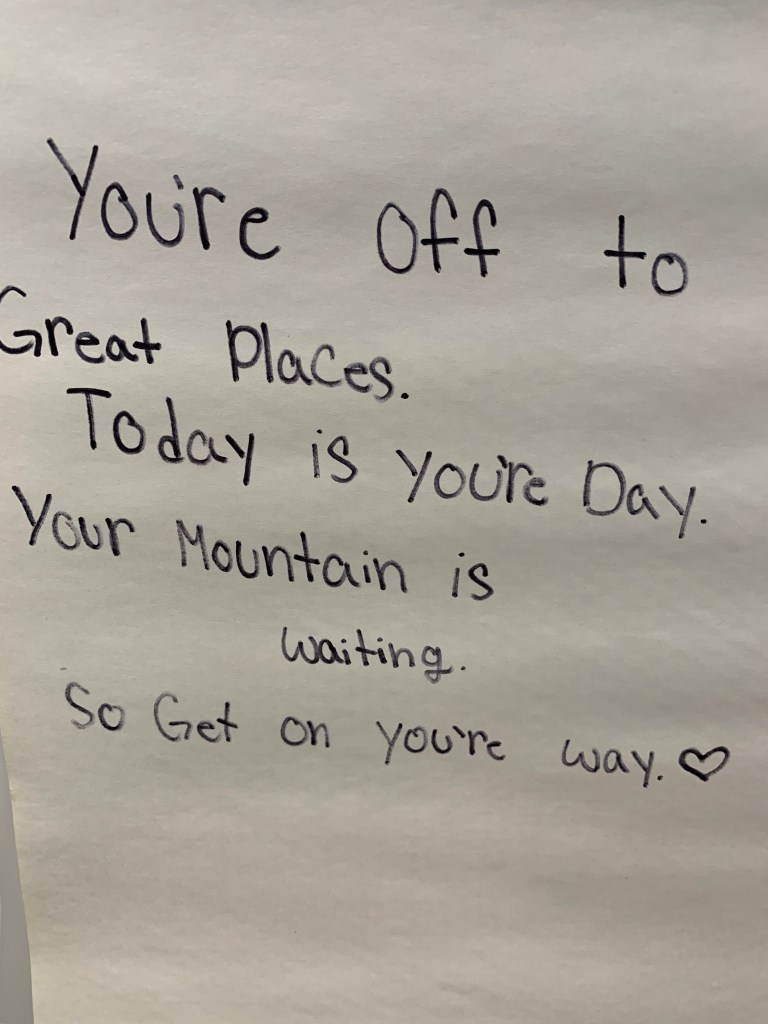
Back in 2019, I was blown away by the incredible energy and enthusiasm that filled the air during Back to School Night! The atmosphere was simply electric as students eagerly walked around their new room. Their grown-ups also had a job to do: write messages to the students. The results were fantastic and I couldn’t help but be captivated by the sheer brilliance and boundless positivity that jumped off the poster. These messages were like shimmering gems, glistening with love and inspiration, ready to guide and uplift the students throughout their entire journey. It was an absolute adrenaline rush of joy and motivation, leaving everyone buzzing with excitement for the amazing year ahead! If you want to relive that thrilling and heartwarming moment, head over to this link to read more about it!

What began as a humble idea in my classroom, born from a fleeting moment of inspiration in 2019, has blossomed into something truly remarkable. The joy that this concept brings has now spread far beyond the walls of my own classroom, reaching other classes, schools, districts, and even states. The impact of this simple idea has been truly astounding.

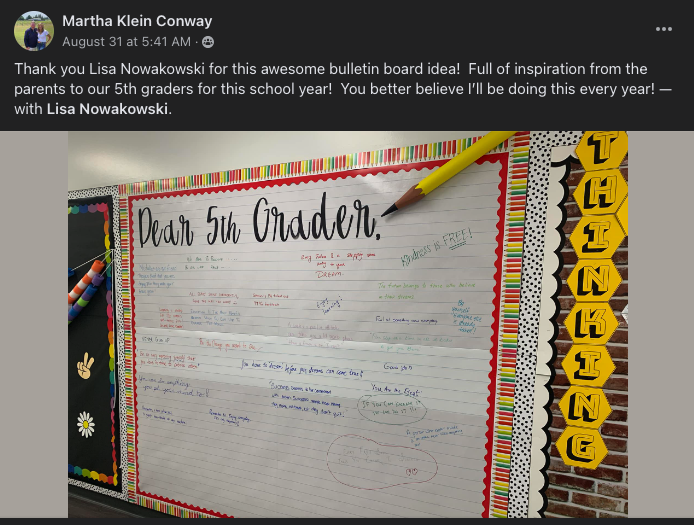
Allow me to share with you one particularly heartwarming story that exemplifies the reach and power of this concept. Martha Klein Conway, a dedicated educator and member of the EduProtocols Community Facebook Group, decided to implement this activity for the parents of her 5th-grade students. Recognizing the profound impact it could have on fostering a sense of connection and engagement, she eagerly created a space to share messages. The response from both parents and students was overwhelmingly positive, and it served as a testament to the transformative power of this idea.

Message board from parents

MathReps on Wipebooks

August 8, 2023, marked the beginning of the school year for my district. As the school buzzed with energy and anticipation, it was a bit crazy but in the best kind of way. It felt good to be back, surrounded by familiar faces and the promise of a fresh start.

One of my primary tasks as a TOSA (teacher on special assignment) and coach is to coach teachers, assisting them in their professional development and helping them navigate the nuances of teaching and new pedagogy. Before that first day, amidst the flurry of preparations and moving classrooms, a teacher approached me with a spirited enthusiasm. She had recently decided to switch grade levels, seeking a new challenge and fresh perspectives in her teaching journey.

Eager to make the year a resounding success, she shared her latest plan with me. She had purchased MathReps, a comprehensive resource designed to enhance mathematical understanding and fluency, on Wipebooks.

With MathReps in her possession, she was eager to begin using them with her students. The versatility of Wipebooks, with their erasable surfaces, offered a tangible way for students to participate actively in their learning, fostering a sense of ownership and empowerment.

Off to a good start

The teacher had a great way to start her students on their learning journey by employing a technique that harnessed a low cognitive load. With the objective of introducing the concept of Numbers in Base-Ten (NBT) to her enthusiastic young learners, she began the lesson by carefully reviewing the NBT standards page.

She decided to ease her students into the topic to ensure a smooth and effective start by initially focusing on 2-digit numbers. By doing so, she created a comfortable and approachable learning environment, which allowed her students to grasp the fundamental format and expectations effortlessly.

With the teacher’s thoughtful approach and dedicated efforts, the classroom became a space where students actively participated, their confidence grew, and they developed a deep understanding of Numbers in Base-Ten. The teacher’s commitment to ensuring a low cognitive load at the outset proved to be an effective strategy that set her students up for success, fostering a positive and empowering learning experience for all.

This is where I come in

While the teacher was confident in all the tasks on the page, she did ask for a demonstration on how to round using the number line. On Friday, I went into the classroom to work with the class. They were amazing. They could easily explain many of the concepts being covered.

As we delved into the topic of rounding, I began by asking the students to think about a number line. We discussed how a number line can help us visualize and understand the process of rounding.

The students quickly caught on and started rounding with ease. It was truly inspiring to see their confidence grow as they mastered the concept of rounding using the number line.

Overall, it was a rewarding experience witnessing the students’ enthusiasm and progress in their mathematical journey. The classroom atmosphere was filled with excitement and a sense of accomplishment. I am confident that these young minds will continue to excel in their mathematical abilities, thanks to their dedication and eagerness to learn.

Notes From Their Grown-ups

My district holds Back to School Night the night before school starts, at least for the TK – 5 schools. I personally love this. No parents are asking about behaviors, assignments, etc. I get to meet them and get to know each family a bit. It also helps the kiddos see where to report to in the morning. I really enjoy this model.

This leads me to August 2019. Sometime during my classroom setup, I got the idea to post a giant poster in the room and invite parents to write little words of encouragement. This was the last year in elementary before they went off to middle school. I wanted to make it memorable. Little did any of us realize that the universe was most certainly going to make it a memorable school year!

Some notes touched on the importance of making mistakes, believing in yourself, and asking for help when needed. This poster stayed up in our room for a long time after school started. I referred to them from time to time reminding them of what their families wanted them to know.

We have many multilingual families and some monolingual families (non-English). They were invited to write in the language of their choice. Had a parent wanted something written for them, I certainly would have helped with that too. Their words mattered. Side note, as I sat to write this today, I realized I wrote about it in 2019 too. Funny how a great idea sticks with you.

I’m Totally Crying

So often as teachers, we hope to impact students’ lives for the better. As an elementary teacher, I oftentimes am unaware of what my impact may have been. But every now and then, I am fortunate enough to learn about my impact.

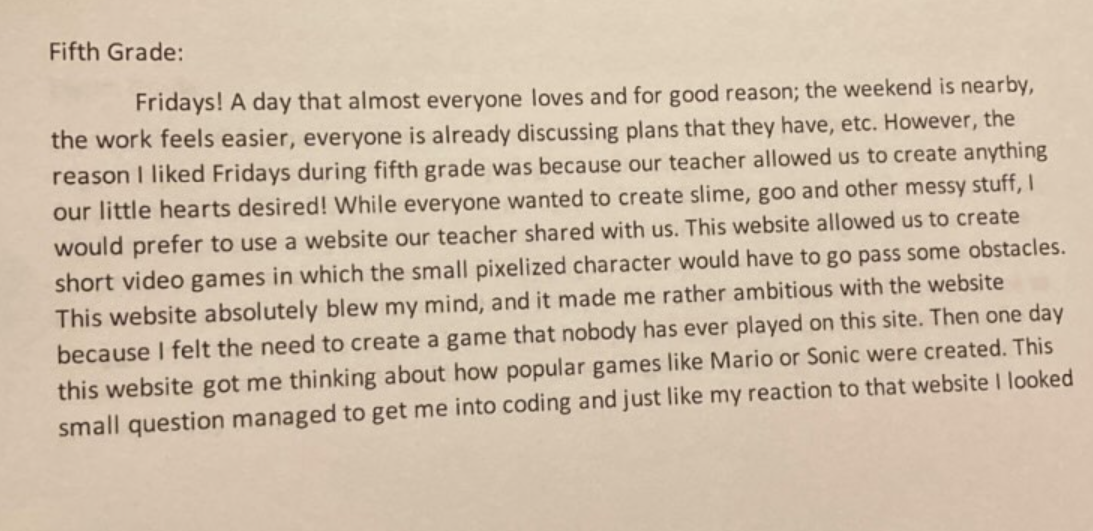
On one of my Socials, I posted a picture celebrating the number of years of service to my district (25!). A former parent saw it and commented. And yes, I have many former parents as mutuals on my Socials. I live in a small town and it’s not uncommon. She shared that her youngest, a former student of mine, was graduating this year and their plan is to study Computer Science in college and it was thanks to me. They are also graduating high school with a CSE sash. Which was all very nice to hear. THEN, she shared out a writing that the student did. I’m not sure what it was from but the focus was on an experience that the student had while in my class and the impact that experience had on their life.

Background:
For many years, the students participated in ‘Genius Hour‘. This is a time when students can explore their passion, learn something they are interested in, or explore subjects/concepts. There are rules and expectations that accompany this time. Part of the procedure has students reporting out to the class. Therefore, my students were giving weekly presentations. These presentations were then scored by the class. We focused on clarity, volume/eye contact, and overall presentation (did they slump, lean against things, stand tall, etc).

And for years, others side-eyed me and didn’t quite understand the power and impact this precious time held. From an outsider’s viewpoint, it looked like ‘free time’ or playing. To be fair, there was a good amount of slime and goo that was made through the years. I struggled with this for many years. I was hoping for more meaningful projects. Then, my good friend, Nancy Minicozzi, put it all in perspective for me. She said, “This is what they need and it’s okay. Let it go.” She was right. After all, there were many outstanding projects through the years. Techie Chicks were a group of girls who created a website of tech tools and tutorials. They even had their own Chrome Extension. There was another year, a group of girls got together to create a ‘business’. Well, it was more of a charity fundraiser. We had a student with health issues who was spending time in a Ronald McDonald house. This group created a website, sample products, and a Google Form all in an effort to raise money for the Ronald McDonald House. These 3rd-graders, raised around $300.

Back to the former student who will be studying CS. In an effort to help students explore subjects and projects they may have never thought of for themselves, I had some resources bookmarked for them to explore. The one resource that caught this student’s eye was Gamestar Mechanic. To say that the student was obsessed would be an understatement. This site allowed students to design their own video games. It was very basic pixelated images, but everyone enjoyed trying out the games this student created. The presentations grew more and more interesting as well. The student would invite another person up to play the newly created game while explaining how it was built and the skills needed to pass the level. It was so much fun watching this student dive into this newly found passion.

Fast forward 7 years. That student is now graduating and going on to study programming. Now, cue the waterworks. This was the reflection that was shared with me.

To this student and so many others, you are extremely gifted and, yes, here you are! You possess the drive and passion to build, create, solve problems, and make this world a better place. I can’t wait to see where you go and what you accomplish. I am so proud of you.

To educators and parents, allow students to explore new avenues. Allow them to spread their wings to try new things. Stand back and let them amaze you!

And yes, I’m tearing up again.

NOTE: I kept the pronouns neutral on purpose. It is nothing deeper than a habit to be neutral out of respect for others in the event they don’t want to be highlighted.

8 Mathematical Language Routines

I have been on a journey to educate myself on the 8 Mathematical Language Routines (MLRs). While they were designed with Multilanguage Learners in mind, I find that they are just good teaching. So what are they?

  • Stronger & clearer each time
  • Collect & display
  • Clarify, critique, and correct
  • Information Gap
  • Co-craft questions
  • 3 Reads
  • Compare & Connect
  • Discussion Supports

So what does each one entail? Well, rather than sit and explain, I’d rather give you a resource that does a far better job breaking it down. It’s also one of my favorite resources.

Part of my deep dive allowed me to align Math EduProtocols and these MLR’s. Doing this has my mind working on how to incorporate more MLR’s within Math EduProtocols.

With all this in mind, I have begun to curate some resources for teachers. I break down each MLR and give links to activities. It’s not a comprehensive list, so I will continue to add to it as I find more. If you have something that should be added to the document, let me know!

Inspirational Quotes

I have the honor to go into a 3rd-grade classroom in my district. Each time I am in there, the teacher has an inspirational quote posted. This isn’t your everyday quote. No, this teacher organically connects these quotes to social-emotional learning (SEL).

As you can see, the teacher is helping the students to have a healthy mindset about previously made choices. Not only does the teacher write these words, but demonstrates them to the students daily. The students are also reminded that mistakes are okay but in an authentic voice. It’s one thing to tell students, but it’s another thing to experience the compassion and encouragement to be gentle with oneself.

I have learned so much from this teacher. And hopefully, you learned a thing or two as well.