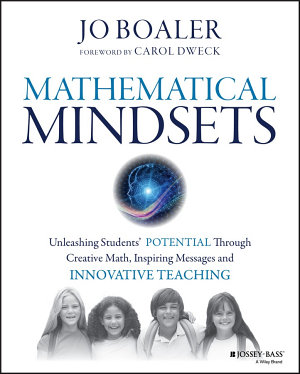
 This year, as a parting gift, my principal handed out this book to all returning and new staff members. We were invited to participate in a Summer Book Club. One in which we read, post thoughts, videos, questions, and ideas. This made me so happy! I had thought about buying the book earlier this year when my principal told me to hold off and that he was buying one for all of us. So for the last 2 weeks of school, I hounded him to let me take my copy. He wouldn’t give it to me until I signed out of my room. Tricky man! (NOTE: I NEVER ask to read a book. I have some reading disabilities that make ‘heavier’ readings difficult for me)
So a few of us have started the book and are making our notes/comments in the provided document; my principal created a shared doc in Google. I appreciate this way as I can read what others have written and get a general sense of what’s to come. The most recent chapter, Chapter 3, really caught my attention. In it, the author talks about how students view math vs. mathematicians view math. Students tend to view it as procedures, rules, and/or calculations. However, mathematicians tend to see it as creative, beautiful, and full of patterns. It was the sentiment that math is a study of patterns that made me take notice.
I have, for years, told my students that math was about patterns. That it was like a puzzle one needed to solve. I have always viewed math as a series of patterns and puzzles. I remember when I was in Kindergarten, a friend and I were talking. She was bragging how she could count to 100 while I could only count to 20. This irritated me. I wanted to count to 100 too. I remember going home and working this problem out in my room. Why I didn’t ask my mother is beyond me. But I was a stubborn kid (and for those of you who know me now, I’m still pretty stubborn). I remember looking at the numbers and ‘analyzing’ them. I thought, “If I can count to 20, then I can figure out how to count to 100.” And as I looked at the numbers, I saw a pattern. The numbers repeated. I began to realize that once the numbers in the one’s place (although I didn’t know place value at the time) were done, they started over again. And the numbers in the ten’s place began at 1, then went to 2 when all the numbers in the one’s place had been used. I had figured out the problem and went to school the next day bragging that I too, could count to 100.
Part of my success with math has come from A) a reading disability, so I gravitated towards math, and B) the fact that I was able to play and manipulate numbers on my own, okay and C) just being a plain old stubborn kid! We need to help students view math as patterns. We need to get over our own fear of math. We need to explore and allow conversations to happen in math. This is where the learning happens and a love of math will develop.
This is such a great book! Full of inspiration. I’m so glad we are reading it as a staff.
One final note: From grades 2 – 6 I was convinced I was going to grow up to be a mathematician. While that’s not my occupation, I’d say that I am one! We all are!
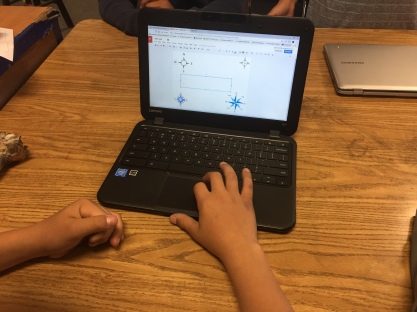 We had a bit of trouble coming up with a story so I had them creating some of the clues to the locks. They were RockStars creating the clues! They really thought out how to make the clues meaningful, with a bit of depth. One clue deals with the compass rose. We are still debating if we should have different ones on one page or split them up onto different pages and have them placed around the room. I think we will have to run the game with another class to work out some of the kinks.
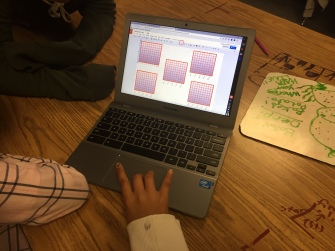 different approach in creating the coordinateplane. One group created a visually pleasing one with gradient coloring and took the time to draw each line. Meanwhile, another group struggled to create one; they needed four or five. The struggling group asked if the gradient colored group would mind sharing so they could copy their coordinate plane. And of course, the group was kind enough to share!
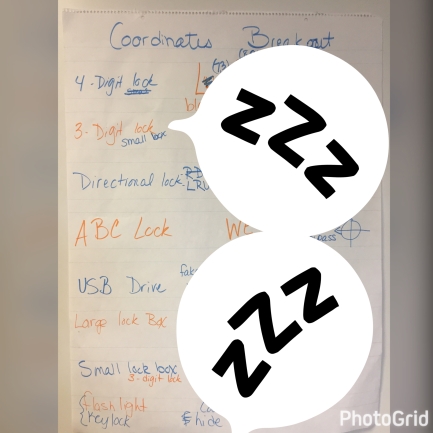 I posed the idea to the class and they went for it. We decided which locks and accessories to use, created codes, and clue outlines. They even designed a distractor that should be used. They had some great ideas! We’re not done yet, but we will definitely share when we are done. I will have them create the clues and the story. I’m pretty excited for what they will come up with.
 A few days ago I wrote about Google Classroom and Personal Accounts. I applied for early access and was granted it today! The nerd in me is super geeked.

 Nowa Techie