Customize Your MathReps in Snorkl Easily

This past summer, I’ve been sharing insights about the MathReps collection available in Snorkl. In my recent post, New MathReps Available in Snorkl Library, I provided a quick guide on how to easily navigate the platform to discover your favorite MathReps. Don’t miss the latest video that demonstrates how to seamlessly add these resources to your library and customize them to suit your specific needs.

Spice Up Your Math Lessons with the Nacho Problem EduProtocol!

Allow me to introduce you to an engaging and effective way to get your students thinking critically about math: Nacho Problem! If you’re looking for a structured-yet-flexible approach to problem-solving that promotes discussion, reasoning, and collaboration, then this EduProtocol is exactly what you need.

What is Nacho Problem?

Nacho Problem is a structured math discussion protocol that helps students develop their problem-solving and reasoning skills in a low-floor, high-ceiling way. Instead of just solving problems in isolation, students work through an incorrectly solved problem that leads to, explaining their thinking, and building deeper conceptual understanding.

It’s not just any problem—it’s “Nacho” Problem because it encourages students to engage with math differently!

How It Works

Nacho Problem follows a consistent routine that makes math discussions more meaningful and accessible for all learners. Here’s a breakdown of the process:

Launch the Problem:

  • Choose a problem that has been solved incorrectly. It can be a common misconception or a key concept.
  • Present the problem to the class and encourage students to think critically.

Think & Solve:

  • Students work independently or in pairs to solve the problem using their own methods.
  • They show their thinking through models, equations, or number lines.

Share & Compare:

  • Students explain how they solved it and compare their work with others.
  • Emphasize multiple strategies—there’s more than one way to solve a problem!

Debrief & Reflect:

  • Discuss which strategies were efficient, clear, or creative.
  • Make connections between representations and reinforce math vocabulary.

Why Use Nacho Problem?

🔹 Builds Math Confidence – Encourages all students to participate in math discussions.
🔹 Focuses Thinking – Students can critically analyze problems, looking for errors and correcting them.
🔹 Reinforces Multiple Strategies – Helps students see different ways to approach a problem.
🔹 Encourages Math Talk – Improves reasoning, justification, and communication skills.
🔹 Works with Any Grade Level – Can be adapted for K-12 by adjusting the complexity of the problem.

Hear About It In Under 2 Minutes

I recently created a video tutorial to show exactly how Nacho Problem works. Check it out here:

Try It in Your Classroom!

Want to give Nacho Problem a try? Here’s what you can do next:

Choose a problem that fits your students’ current math skills.
Use a template to help students structure their thinking.
Encourage collaboration by having students discuss and compare strategies.

You can find free templates and more math strategies at eduprotocolsplus.com and MathReps.com!

Final Thoughts

Nacho Problem is a fun, engaging, and powerful way to deepen students’ understanding of math. By making math conversations routine and structured, you’ll see more confidence, curiosity, and engagement in your classroom.

Measurement & Data Excite Me!

When you think about data, the first thoughts that come to mind might be how dull or uninspiring it can be. But what if there was a way to turn that perception around and make learning about data an exciting journey for elementary school students?

Enter the newest MathRep. This template is designed to engage students while teaching bar graphs and picture graphs to young learners.

In this blog, we will delve into how this new MathReps template is exciting elementary math students. It offers educators a fresh and dynamic method to ignite enthusiasm for data interpretation among their students. Get ready to explore the possibilities and discover how this MathRep can make a real difference in the classroom!

Picture This

This is an example that aligns to 3rd-grade standards: 3.MD.B.3 Draw a scaled picture graph and a scaled bar graph to represent a data set with several categories. Solve one- and two-step “how many more” and “how many less” problems using information presented in scaled bar graphs.

You’ll notice that the same information is used to complete each of the graphs. This leaves quadrant 4. It can have questions about how many more and how many less, but why not allow students to observe the data and make their own observations. Leaving it open-ended like this allows all students to be successful. In addition, you will have students making observations that go beyond how many more/less.

The Setup

When first introducing this MathRep activity, it is recommended to provide students with the information located in the center of the paper. Subsequently, they can proceed to create the graphs themselves. Once they have gained proficiency in graph creation, the teacher can fill in the graph and task the students with completing the remaining sections, including the center. For a more advanced approach, the teacher can fill in the ‘Mathematical Observations’ square (quadrant 4), leaving the rest to the students. This adaptable strategy can effectively challenge students at various proficiency levels, guiding them toward a deeper comprehension of the material.

What Will You Do?

The power of this MathRep lies in its ability to enable students to interact with data in multiple ways simultaneously. This allows students the opportunity to make connections between different representations of information, leading to a deeper understanding. Teaching skills in isolation should and has been discontinued according to the Common Core Math Clusters, as math is intertwined with all aspects of learning. This MathRep illustrates these connections, preparing students for future success.

Mastering Mathematical Language Routine 7: Compare and Connect

In the previous Mathematical Language Routine (MLR) discussions, we explored a variety of essential skills. MLR 1 focused on enhancing our understanding by revisiting and reinforcing key concepts, making our knowledge “Stronger and Clearer Each Time.” We then moved on to MLR 2, where we delved into the crucial skill of “Collecting and Displaying” data effectively. Building on this foundation, MLR 3 emphasized the importance of “Critiquing, Correcting, and Clarifying” our models and methodologies for optimal results. In MLR 4, we explored the “Information Gap” and how to use this strategy to be thoughtful of the information needed to solve problems. Continuing this journey, MLR 5 introduced the skill of “Co-Crafting Questions and Problems” collaboratively to foster innovative approaches and insights. Finally, in MLR 6, we explored the technique of “Three Reads,” emphasizing the significance of multiple reads in order to enhance student understanding. Let’s now embark on our next MLR discussion, MLR 7 Compare and Connect.

MLR 7: “Compare and Connect,” has the purpose of fostering students’ meta-awareness in their exploration of different mathematical approaches, representations, concepts, examples, and language. Through this MLR, students are encouraged to reflect on and verbally respond to these comparisons. This involves analyzing why certain mathematical actions or statements are done in a particular way, identifying and explaining connections between various mathematical representations or methods, and pondering how one idea relates to others in terms of both concepts and language. To support this learning process, teachers should model their thinking aloud when addressing these questions. This routine allows students to engage in rich mathematical conversations. We will explore two ways in which to accomplish this.

Which one doesn't belong

Getting students to engage in discussions about math, make connections, and consider different perspectives can be quite challenging. I often encounter students who simply say, “It was in my brain” or “My brain told me the answer.” However, by modeling and encouraging metacognitive awareness, students can begin to make connections on their own. One effective routine that focuses on linguistic skills is called ‘Which One Doesn’t Belong‘. This activity can be done in groups, in pairs, or as a whole class. Students are presented with four images, equations, numbers, graphs, or geometric shapes, and they are asked to identify a commonality among three of them and explain their reasoning. The interesting twist is that any combination of three out of the four options can be correct. For example, in the orange example, one could argue that the three triangles go together and the hexagon is the odd one out. Alternatively, one could justify grouping all the white-filled shapes while excluding the shaded shape. This activity is both enjoyable for students and provides the opportunity to hear and consider different viewpoints.

Another interesting activity that aligns well with this MLR is the Math EduProtocol Sous Chef from The EduProtocols Field Guide Math Edition (Chapter 9, page 56). In this activity, students are grouped together to solve a problem using different approaches and then present their work to the class. For instance, if students were given the task of solving 4 x 6 in third grade, one student might use equal groups, another could opt for repeated addition, a third student may create an array, while the last student represents the equation with the area model. Through this activity, students can establish connections with previously learned concepts and broaden their understanding. There are numerous ways to implement Sous Chef, but the central focus remains on fostering connections among ideas and encouraging students to share their thought processes orally.

In conclusion, incorporating this MLR into your math class will greatly benefit your students. It will help them enhance their meta-awareness, make connections between different concepts, and foster a deeper understanding of the subject. While we have explored two approaches to this MLR, there are numerous other equally powerful techniques available. In our next discussion, we will delve into MLR 8: Discussion Supports, which focuses on stimulating rich and meaningful conversations in the classroom.

Mastering Mathematical Language Routine 3: Critique, Correct, and Clarify

Welcome to the fourth installment of our series, where we delve into the fascinating realm of Mathematical Language Routines (MLRs). In our previous discussions on MLR 1: Stronger and Clearer Each Time and MLR 2: Collect and Display, we explored the crucial role they play in cultivating critical thinking skills and fostering a deep understanding of mathematical concepts. Let’s continue our journey toward mathematical success by exploring the next MLR in line.

MLR 3: Critique, Correct, and Clarify is a routine designed to enhance mathematical writing and discussions. The primary purpose of MLR 3 is to foster a culture of critique and improvement in mathematical conversations. By engaging in this routine, students are encouraged to actively evaluate, correct, and articulate mathematical concepts with clarity. Through collaborative groups or partner talks, students can refine their thinking as they work together. To introduce this routine, teachers can model it by providing a predetermined piece of writing for critique, ensuring that it includes common errors and vague language to encourage more precise language. This approach empowers students to identify and rectify mistakes while enhancing their ability to clarify their ideas effectively.

Beginning this routine can be tricky, especially since it involves critiquing and correcting another person’s work. However, there are strategies that can help create a safe space where students feel comfortable critiquing and correcting each other’s mathematical reasoning.

At the middle school and high school levels, it is a bit easier as students change classes, and using an example from another class can happen – with names removed.

For elementary-level students, making up a problem/solution that they can use to critique is advisable. It’s important to ensure that the problem/solution contains common errors related to the content being studied.

Once this routine is established, it will become easier for students to seek out peer feedback. Teachers play a crucial role in creating a safe environment where students feel encouraged to seek out one another for critiquing. By implementing these strategies, teachers can foster a supportive and collaborative atmosphere for students to improve their mathematical reasoning skills together.

One Math EduProtocol that works well with this MLR is Nacho Problem. This EduProtocol was developed by Ligia Ayala-Rodriguez with the intention of addressing common errors exhibited by students. The main concept behind Nacho Problem is to task students with identifying and explaining the errors they encounter. Let’s take a look at an example to better understand how it works:

Second-Grade Nacho Problem Example

Ms. Daines needs to drive to San Jose which is 109 miles away. Along the way she stopped in Salinas which is 48 miles away. When she began driving from Salinas, how far away was Ms. Daines from San Jose? The work was provided but no explanation was given. This allowed for students to critique and analyze the provided work, find the error, and clarify their reasoning. 

In this example, which was taken from an introductory lesson using Nacho Problem, the wording is kept basic and straightforward. However, as students progress with this EduProtocol, their written expression and complexity will naturally grow.

The beauty of Nacho Problem lies in its simplicity and effectiveness. By encouraging students to find errors and explain their reasoning, it promotes a deeper understanding of mathematical concepts. So, if you’re looking for an educational approach that fosters critical thinking and problem-solving skills, Nacho Problem is definitely worth considering, but not your only option. Sometimes, always, never is another good approach to this MLR.

Incorporating MLR 3 into your math class can greatly enhance your students’ understanding and written communication skills, which are vital for their success. This instructional approach can be implemented as early as kindergarten, allowing students to develop the valuable ability to analyze others’ work critically. This fosters a deeper comprehension of mathematical concepts and empowers them to ask more precise and insightful questions. In our next discussion, we will explore MLR 4: Information Gap, where students are encouraged to engage in critical thinking by identifying the necessary information to solve word problems.

Mastering Elementary Math: The Power of MathReps and Math EduProtocols Series Finale Pt. 10

MathReps and Math EduProtocols have been an incredible journey! We’ve delved into a plethora of aspects, ranging from understanding and implementation to assessing and monitoring, all while uncovering inspiring success stories. And guess what? The evidence is crystal clear – these strategies are absolute game-changers! Brace yourself for mind-blowing results in record time! Picture this: classes effortlessly grasping concepts and expanding their knowledge bank in the blink of an eye! Not to mention, students gaining solid confidence and forging natural connections left, right, and center! If you’re a fan of John Hattie and his work on Effect Size, get ready to be blown away because Deliberate Practice registers an awe-inspiring 0.79 Effect Size! And wait, there’s more: Rehearsal and memorization follow closely behind with an impressive 0.73 Effect Size! So, dear reader, don’t wait a second longer – dive into the world of MathReps and Math EduProtocols and revolutionize your classroom experience, starting today!

If you’re excited to explore more and take advantage of all the amazing resources available, you’re in for a treat! Dive deeper into the world of MathReps and Math EduProtocols by checking out the complete series starting with Pt. 1 or jump to getting started with MathReps in Pt. 4. For those who prefer a slower start with Math EduProtocols, be sure to jump into Pt. 7 of the series. But that’s not all! Visit mathreps.com for all templates and be sure to join our math-focused Facebook group to engage with a vibrant community of educators. Don’t forget to join the EduProtocols Community Facebook group too. You can also find us on various social media platforms like Instagram and TikTok, using the hashtags #MathReps and #EduProtocols. Excited for more? We’ve got you covered with a fantastic range of books to explore, including my personal favorite, The EduProtocols Field Guide Math Edition! The possibilities are limitless, so don’t miss out on this incredible opportunity to enhance your mathematical journey. Happy exploring!

Mastering Elementary Math: The Power of MathReps and Math Eduprotocols Success Stories Pt. 9

After creating MathReps in 2016, I quickly saw the benefits. One of the first ones I created dealt with 5th-grade multiplication and division. That year, I saw many students succeed in connecting the area model of multiplication to the traditional algorithm. In addition, there was a student who connected the partial quotient to the traditional algorithm in division. I can still see where the student was sitting and the conversation that we had.
Me: (pointing to the division problem done using the traditional algorithm) Can you tell me about this?
Student: Sure, I used the toolbox area to do some additional multiplication to help me.
Me: Did someone show you how to do this?
Student: No, I noticed that I could come close to the first two digits of the dividend if I multiplied the divisor. Then, I could subtract and do it all over again using the next two digits [the traditional remainder plus bringing down the next digit].
Me: 😲

Yeah, that was a mind-blowing moment. The student had made connections on their own based on repeated exposure and naturally made the leap to the traditional algorithm. I was blown away!

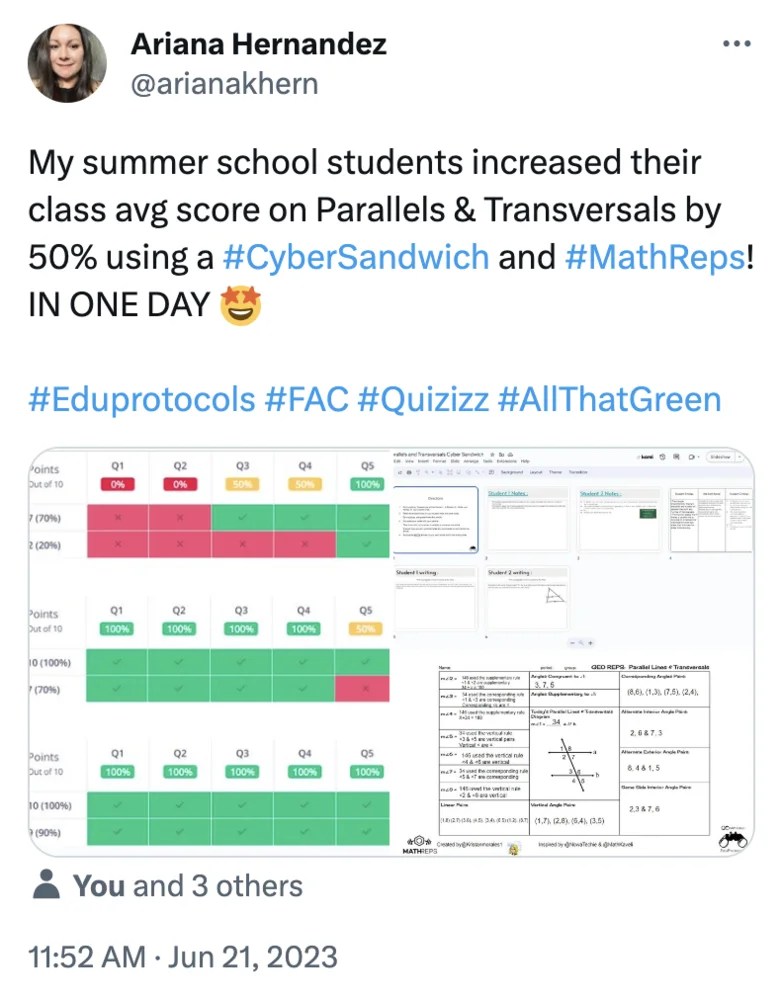
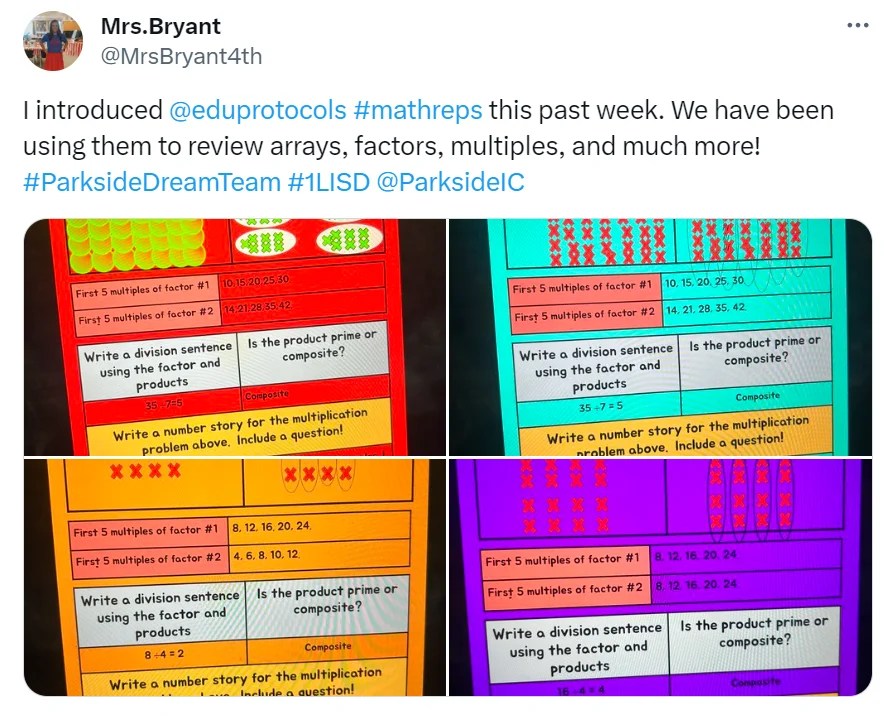
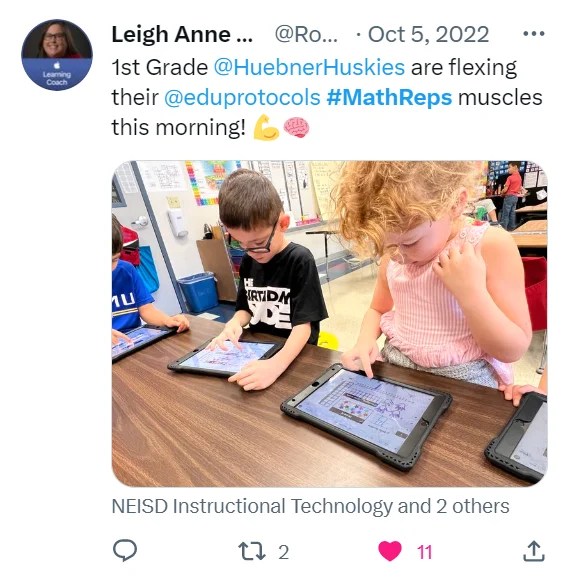
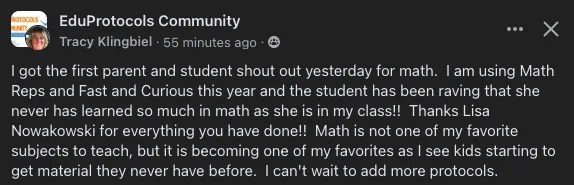
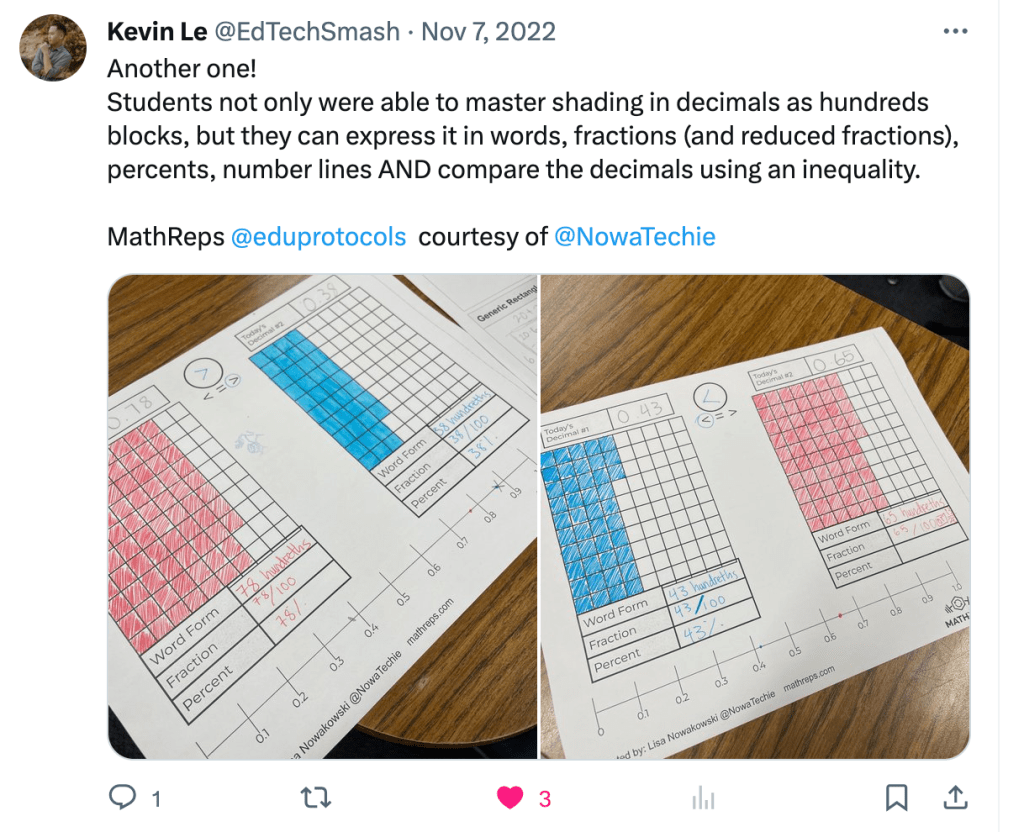
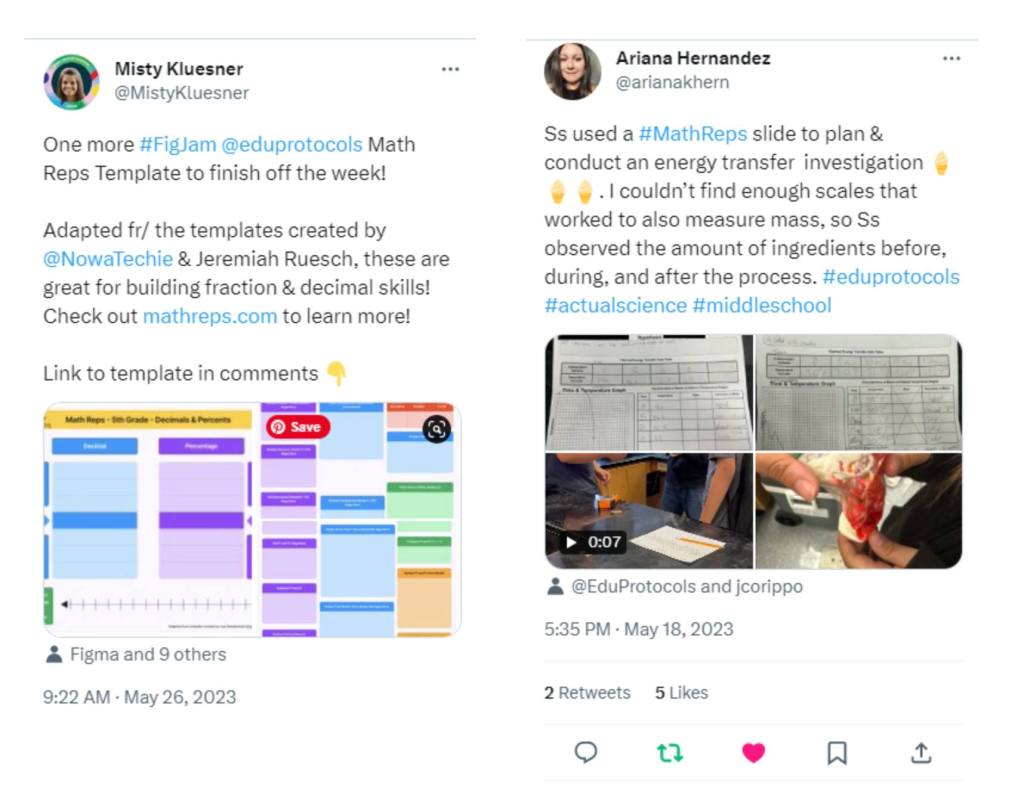
After that, I have been truly amazed by the countless teachers who have found great success using MathReps and Math EduProtocols in their classrooms. What started as a resource created solely for my own students has turned into something much bigger. I love to share, and it’s been incredible to see teachers from all over reaching out with their own success stories. One example that stands out is a 3rd-grade team who saw amazing results with MathReps. Join the growing community and discover the power of MathReps and Math EduProtocols for yourself!

I have compiled a few postings of what others have to say. If you’d like to see more, you can see them on this Wakelet.

Mastering Elementary Math: The Power of MathReps and Math Eduprotocols Assessing Progress Pt. 8

In today’s rapidly evolving educational landscape, tracking student progress is not only crucial but also an empowering tool for both teachers and students alike. In a previous post, we delved into the remarkable results achieved by a 3rd-grade team that implemented effective data tracking methods. However, we barely scratched the surface of the “how.” So, let’s take some time to explore the intricacies of tracking student data and discover how you can leverage these strategies in your own classroom. By examining the practices of the 3rd-grade team, who expertly utilized a combination of pre and post-tests, spreadsheets, and repetition, we’ll uncover the power of John Hattie’s work and the Achievement Teams framework pioneered by Steve Ventura. With a focus on MathReps and Math EduProtocols, these methodologies not only lower student anxiety but also provide invaluable insights to drive targeted instruction. Join us on this journey as we unravel the secrets of effective data tracking and witness the profound impact it can have on the learning process.

To effectively track data and student progress, we will discuss the first method utilized by the 3rd-grade team.

  1. Begin by selecting a MathReps or Math EduProtocol activity that aligns with the learning objective. Choose the most appropriate one that suits the needs of the students.
  2. To ensure that students feel more confident and less intimidated by the material, engage in some pre-teaching before conducting the pre-test. This will help familiarize them with the concepts and reduce anxiety.
  3. After administering the pre-test, log the data obtained from each student in a spreadsheet. This spreadsheet can help calculate a goal and later reassess their progress.
  4. After completing the MathReps or Math EduProtocol activity, encourage the teachers to post the group’s pre-test scores, along with a pie chart and percentage goal, in a visible location for the entire class to see. This allows students to be a partner in the learning and growing process.
  5. Once the pre-test data is collected, it is time to get in those reps! The cycle the teachers used in this case was roughly 10 days.

By following these clear steps, the data collected from the pre-test, as well as the subsequent activities, will help guide the teachers’ instruction and provide the students with a clear sense of purpose in their learning journey.

The guide below is a second method of tracking data and leveraging strategies:

  1. Select a MathRep or Math EduProtocol: Choose a suitable MathRep or Math EduProtocol that aligns with the learning objective.
  2. Introduce the Reflection Sheet: Provide students with a reflection sheet, either for daily or weekly use, to empower them in driving their own learning.
  3. Track Group Progress: Collect assessment data at the end of the week to monitor the progress of the entire group.
  4. Display Progress Openly: Create a visible display in the classroom to showcase the group’s progress based on the assessment data.
  5. Establish Goals: Collaborate with the class to define goals to strive for. These goals should include a specific percentage of proficiency and a target date for achieving them.

Using either of these methods can empower your students, unlock their full potential, and cultivate a strong sense of fulfillment in their own learning journey. With teachers equipped to personalize instruction and address individual needs, the path to student triumph becomes clear. Which approach will you take?

Mastering Elementary Math: The Power of MathReps and Math Eduprotocols Implementing Math EduProtocols Pt. 7

Implementing Math EduProtocols requires a unique approach compared to implementing MathReps or other EduProtocols. While with MathReps, we adopted a gradual approach and collaborated daily, and with traditional EduProtocols, it is advised to kickstart with a non-academic activity; neither of these methods aligns perfectly with Math EduProtocols. To ensure a smooth process, I recommend starting with a math skill that is slightly below the current grade level. This will allow students to fully engage in the new protocol without feeling overwhelmed by having to learn a new math concept. Another distinction from MathReps is that Math EduProtocols are not designed for daily use. Depending on the chosen Math EduProtocol, it may be implemented once a week to up to three times per week.

Implementing Math EduProtocols in the classroom can greatly enhance student engagement and creativity in math. Here are some important points to consider when introducing these protocols:

  1. Choose a New Math EduProtocol: Start by selecting one new Math EduProtocol to implement in your classroom. For example, you can begin with “Sous Chef” or “Curiosity Creator”.
  2. Start with Familiar Skills: It’s crucial to start with a math skill that is already known to the students, but perhaps below grade level. This will help them establish a foundation and build confidence in using the Math EduProtocols effectively.
  3. Master One Protocol at a Time: It’s essential to focus on mastering one Math EduProtocol before introducing a new one. Allow students ample time to practice and become comfortable with the chosen protocol. This approach ensures a solid understanding and implementation of each Math EduProtocol.
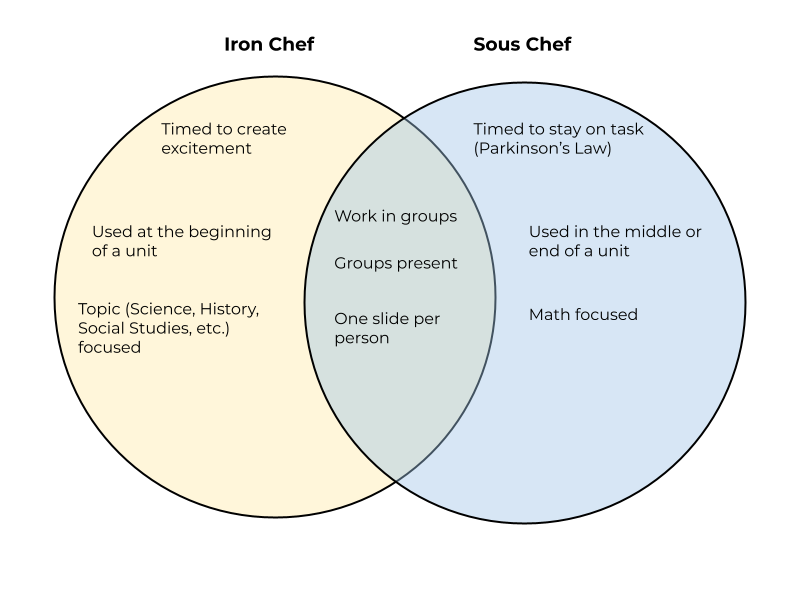
  4. Similarities to Non-Math EduProtocols: Note that some Math EduProtocols share similarities with non-math EduProtocols. For instance, “Sous Chef” is a math version of “Iron Chef.” Highlighting these connections can help students transfer their knowledge and skills from non-math subjects to the math classroom.

Remember, there are several Math EduProtocols to choose from, each providing a unique function in making math more engaging and creative. By following these guidelines, you can effectively implement Math EduProtocols and foster an environment conducive to active learning and mathematical exploration in the classroom.

To find out about more Math EduProtocols visit mathreps.com or purchase The EduProtocols Field Guide: Math Edition.

Mastering Elementary Math: The Power of MathReps and Math Eduprotocols The Benefits of Math Eduprotocols Pt. 6

Using Math EduProtocols in your math class offers numerous benefits. These protocols not only provide a consistent format but also foster collaboration, problem-solving, and critical thinking. By incorporating Math EduProtocols, you can engage your students in a systematic approach to problem-solving and encourage them to record their thoughts using Comic Strip Math. Furthermore, EduProtocols like Nacho Problem promote critical thinking by analyzing errors, while Sous Chef and Chatterbox encourage student collaboration. These protocols provide a refreshing and engaging alternative to traditional math lessons that often lack consistency and creativity. By using Math EduProtocols, you can transform your math class into an exciting and stimulating learning environment.