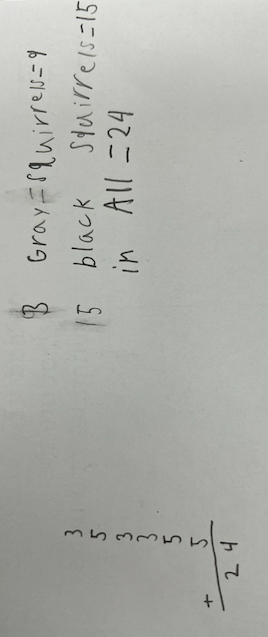
Nacho Problem

What’s a problem that’s not yours? Nacho Problem!

It’s that time of year, Test Prep time. Which makes me think about using EduProtocols for Test Prep. One great one that really promotes deeper thinking and understanding is Nacho Problem. This was created by Ligia Ayala-Rodriguez. It’s a fun way to do error analysis with your students. I have done this with students as young as 7.

One of the advantages is that you begin by telling the students the answer is wrong. This seemingly takes the pressure off. I like to have the students talk it out the first few times. I guide them along the way to help set the expectations. Just like in an ‘Analyze the Error’ on the test, students are expected to express their thoughts in writing. This can present an additional challenge if they haven’t exercised this skill. I’m not saying we should do this solely to prepare for the state test; the benefits of students being able to do this go far beyond that idea.

How to Get Started

As a class, they are presented with a Nacho Problem. We read and analyzed the problem together; starting with “What do you notice?” and “What do you wonder?” I explicitly tell them the answer is wrong and that we must find where I went wrong. I have found that looking at the question and working out the problem allows us to focus on the process (that the problem is asking us to solve) rather than the arduous task of finding a mistake. Once we work it out together, and later independently, students can then go back and compare their process with the original (wrong) process. It makes it more obvious where the original problem solver went wrong.

The written explanation can be the most difficult part. When I started doing problems like this, students would explain, in an addition problem, “I started in the ones and added 8+7. I left the 5 in the one’s place and regrouped the 1.” While technically that is true and we as teachers understand, that’s not showing an understanding. That is why practicing the structure of Claim, Evidence, and Reasoning (CER) is so important.

Claim: Ms. N. did not draw a quadrilateral.
Evidence: The student example with explanation.
Reasoning: Definition of a polygon and Ms. N’s error.

Finding Problems

One of the easiest ways to collect incorrect problems is from your class. Whether you use exit tickets or collect information from the day’s lesson, you have a plethora of options. When using student errors, it’s advisable to use a common mistake by many students. Done early, this can correct any misconceptions before they become habits. Ligia suggests using mathmistakes.org

Results

Teachers and students alike enjoy this math EduProtocol. Students find it ‘fun’ to find the mistakes. Teachers report that it takes little time to begin implementing in their classes. Doing this a few times a week can really improve understanding. Let’s face it, students LOVE to point out teachers’ mistakes.

If you use this, I would love to hear how it went. What changes did you make? How have your students improved with error analysis?

Free Bingo Cards

Recently I had a teacher ask me about some review games. Bingo is always a hit so I went on the search for a 3rd-grade Geometry Bingo game. Sadly, I couldn’t find what I wanted. Which then led to a search for Bingo card creators. I was not about to sit and recreate 25 Bingo cards. I like to use my time a bit more efficiently. And that’s when I found it! My Free Bingo Cards

This awesome sight creates simple Bingo Cards. They have several ready-to-go, broken down by categories. There is also the option to create your own. I opted to create my own. The process was simple. I plugged in all the words the students were to review. I then pressed one button for the program to create 30 unique Bingo cards. I did play around with it to see if I could insert images via copy/paste. No such luck. That was okay; I had a backup plan. The program also created a sheet for me to track which words were used and calling cards. I opted NOT to use the calling cards.

What did I use instead of the calling cards?

Instead of the calling cards I created a wheel on Wheel of Names. This was part of my backup plan: I used images. I could have also opted for the definitions, but I felt the images were more engaging and less repeating. This game was a big hit!

If you’re a 3rd-grade teacher and would like to play this here are the cards and here is the wheel.

If you’ve never used Wheel of Names before, you’re going to love it! There’s no need to guess where the spinner landed. The program tells you which one. Then you have the option to remove the selected item from the wheel to avoid mishaps.

Summer Presentations

This summer, I will be presenting at two academies for EduProtocols. My sessions will have a math emphasis; shocking, I know. So this past week when I was asked to come up with titles and descriptions, I struggled. I wasn’t feeling it. Luckily, a friend called before I could toil for too long. I relayed to her my lack of motivation at the time, and she came up with some catchy titles.

  • 🍸The Mixology of MathReps – MathReps
  • Wheel Of Word Problems – Word Problems with Random Emoji
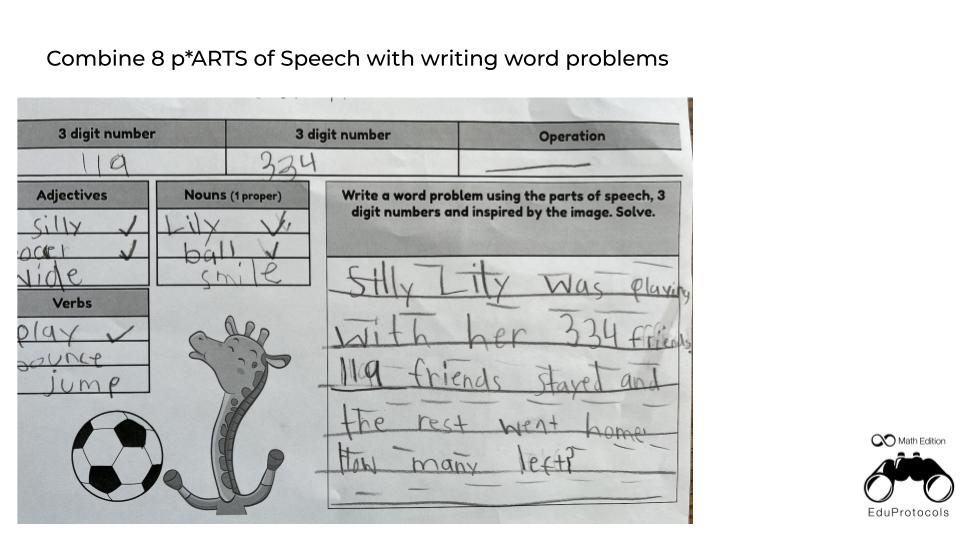
  • Playing with Parts – 8 p*ARTS meets word problems
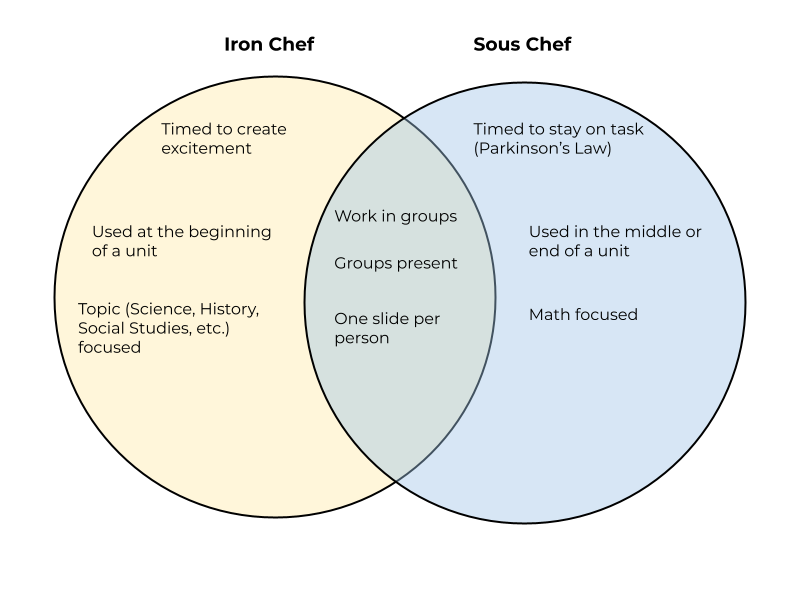
  • 🌶️🌶️ Spicey Solutions to a Bland Curriculum – Nacho Problem
  • 👩🏽‍🍳Chef’s Kiss – Sous Chef
  • Frayas for Ya Playas – Frayer and, honestly, my favorite title
  • 🦹🏻‍♂️Math is a Villain: Comic Strip Math

Then it was time to get started on the descriptions. This is where I got inspired. I doubled down on the titles and all descriptions fit that theme. I mean, check out this description for Comic Strip Math:

In a world full of villains, the fine citizens of Mathemagicalville are up against the most evil, vile, sinister one around. Master of Dark is relentless in the pursuit of conquering the city. It is up to you, the superhero, to prove Master of Dark wrong and find the errors that were made. You create the comic, find errors, explain processes, and become the hero the city needs.

Yes, Mathemagicalville is a mouthful, but the names I wanted were all taken, and so I had to become creative. When I was creating this description, I felt that I had to be very careful with my wording. The character ‘Master of Dark’ was created by my 5th-grade class at the time, around 2019. The character was created to be gender-neutral. However, in today’s political climate, with hundreds of anti-trans laws being introduced throughout the country, I want to be sensitive to this. In 2019, the intent was to NOT represent one group as ‘evil’ or ‘bad’ but to keep the focus on math while empowering ALL the students in my classroom. The empowerment came from not having the gender stereotypes that boys are better at math than girls, and by taking the gender out of character seemed like a good solution at the time. However, as I began writing the description, I tried avoiding any pronouns. I don’t want to put a negative focus on any group.

I may be overthinking all this, and I may not be. However, in cases like this, I would rather err on the side of caution. So what do you think? Am I overthinking this? Does this character need to be revisited? Do I simply avoid using any pronouns as it’s not critical to the purpose of thinking critically about math? I would love to hear from everyone, especially those in marginalized communities.

Okay, that took a serious turn. NOW if you’d like to join me in Laguna Beach or Notre Dame this summer, here’s more information. I can’t guarantee that all seven sessions will be presented at both, but I can say that MathReps and Comic Strip Math will be presented at both – if I have a say.

Google Lens FTW!

Google Lens may have saved the day after a series of unfortunate events. Or at least made a less-than-desirable day okay. Let me set the scene for you: it’s 4 am, all lights are off, and a sleepy teacher walks into her bathroom and steps on the ‘squishy’ rug. Said rug should NOT be squishy. This can only mean 1 of 2 things. Neither is good. Option 1: one of the dogs peed. Unlikely, as this is out of the norm for them, and it would have been A LOT of urine. Option 2: I have a leak. Alas, after opening the cupboard door under the sink, I was presented with Option 2. Oh, joy.

Fast forward to me calling the plumber after school today, he tells me that he may or may not be able to fix it depending on the problem. We agreed he would return tomorrow to fix it (or not). Side note: it was close to 6 pm and not an emergency. Fair enough, he’d been working all day. This led to a discussion on what to do if it can’t be fixed. Seeing as I like the faucet and it matches the others in the bathroom, I have little choice but to find another one. It’s a unique waterfall faucet. So a Google Search will take a while.
Enter Google Lens! What is Google Lens? It is an app that allows you to point your camera at something, like a waterfall faucet for a bathroom, and does a Google image search for that thing! So being the big brain thinker that I am, I used it to locate where it could be purchased. And Bingo! I now have the name and places where I can buy a replacement.

Google Lens can be found using your Google App (iPhone), and tap the camera icon in the search bar. On Android, open the camera app and tap the Lens icon (pictured above). There are several options, including translate, shopping, and search.

Next Level with MathReps

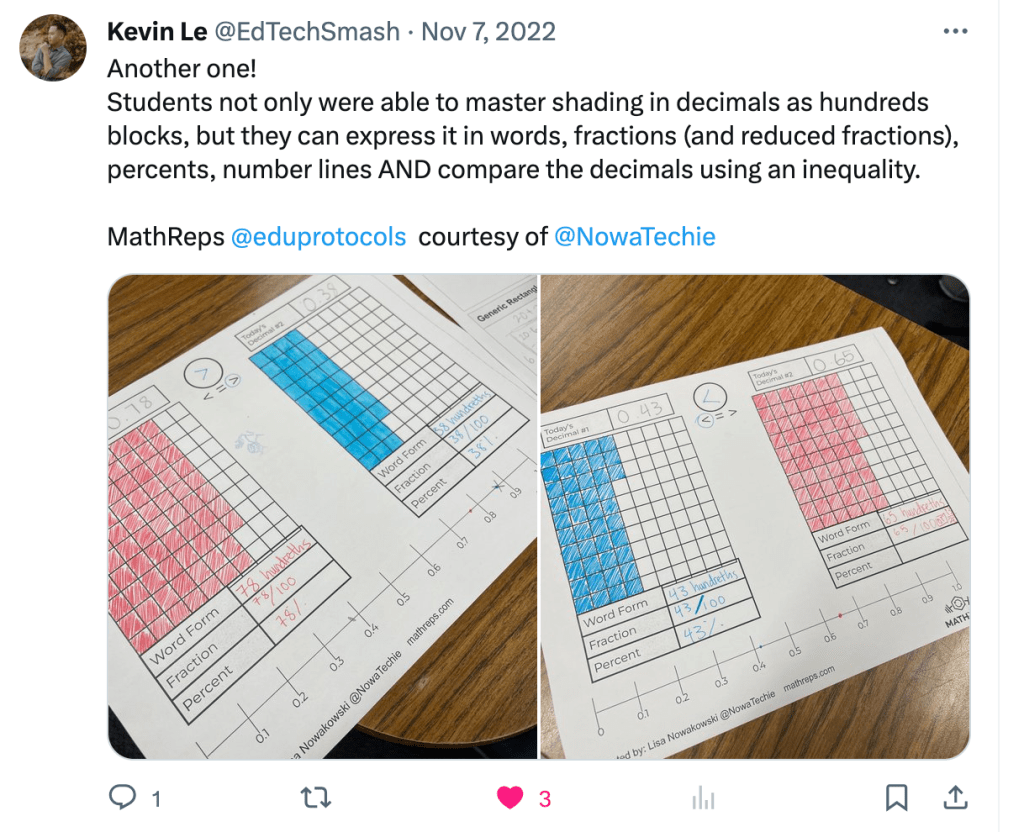
Recently I was in a 3rd-grade classroom doing a geometry MathRep. As I was walking around I noticed that one student wasn’t just writing the answer using just numbers, he was also putting it in word form. Needless to say, I thought this was great! Which then led to a discussion on different ways we could represent the answer. We talked about using tally marks, equations, and shapes.

I then went into another class and did the same lesson. Well, another student leveled it up yet again! I was having students state their answers out loud in complete sentences. As the students were being creative in reporting their answers on their paper, one girl wrote out the complete sentence! Yes! What a win. We celebrated her and her work.

Currently, I am a Tech TOSA (Teacher on Special Assignment) in my district. I love my job for so many reasons. One of which is the ability to go into classrooms and become inspired by the teachers I work with and their students.

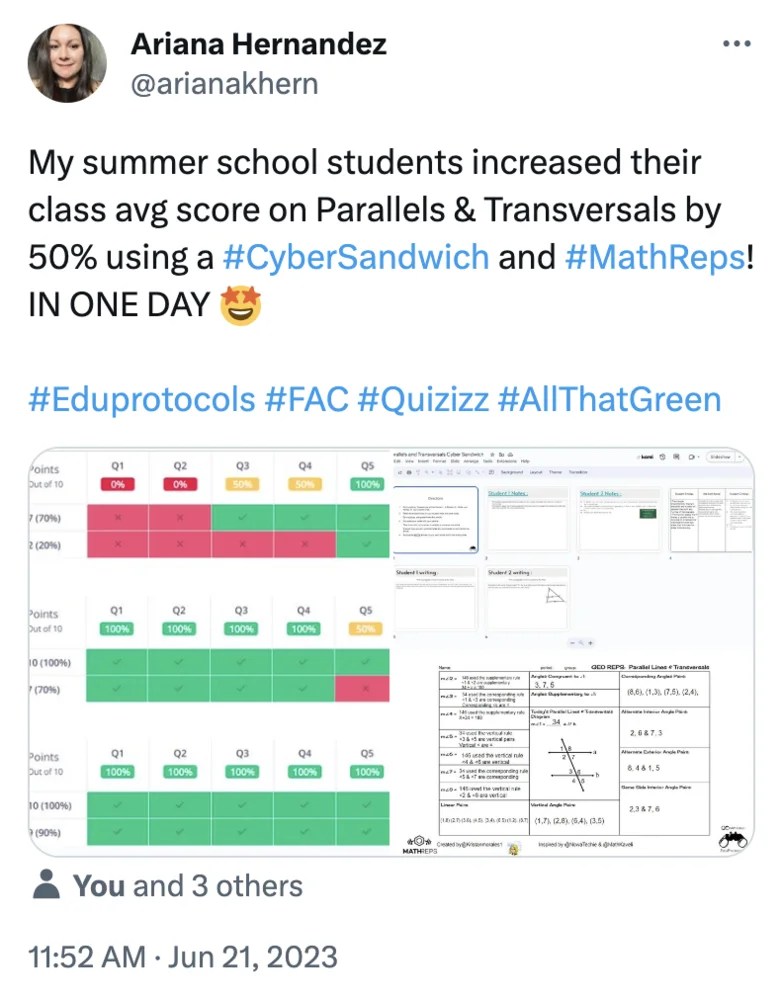
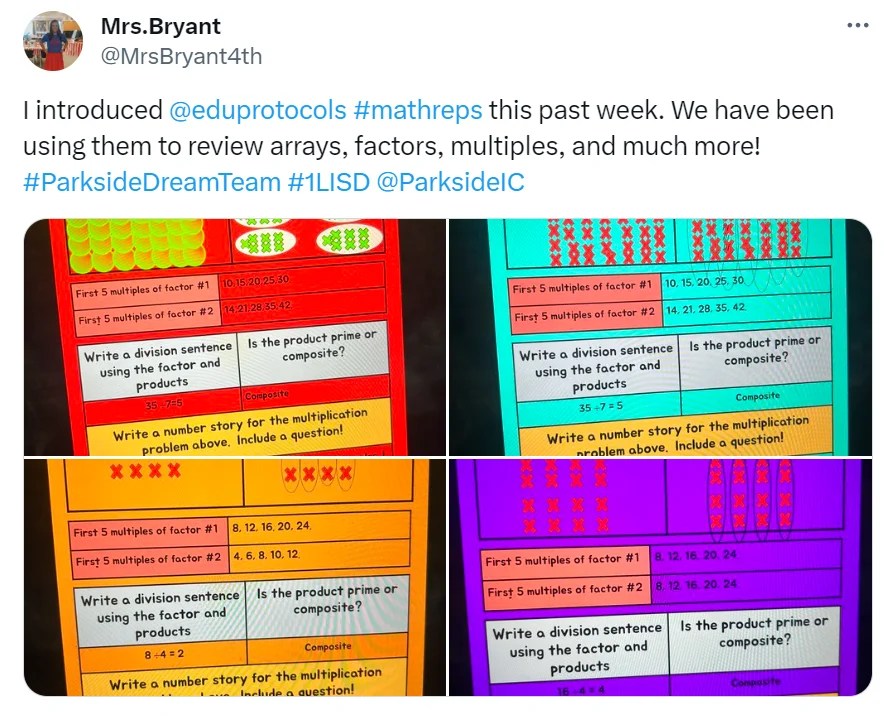
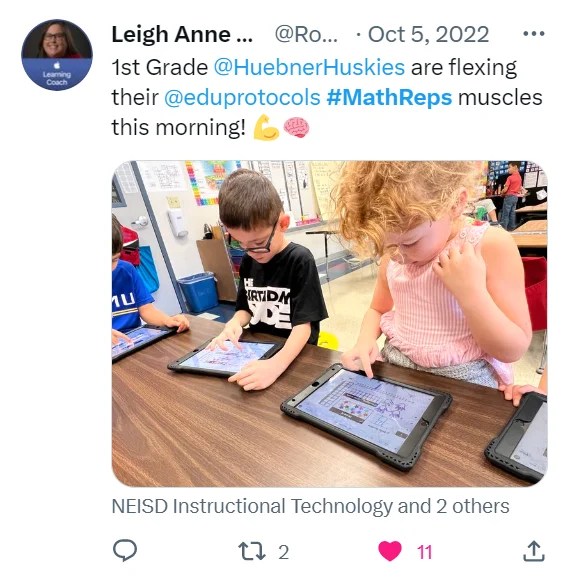
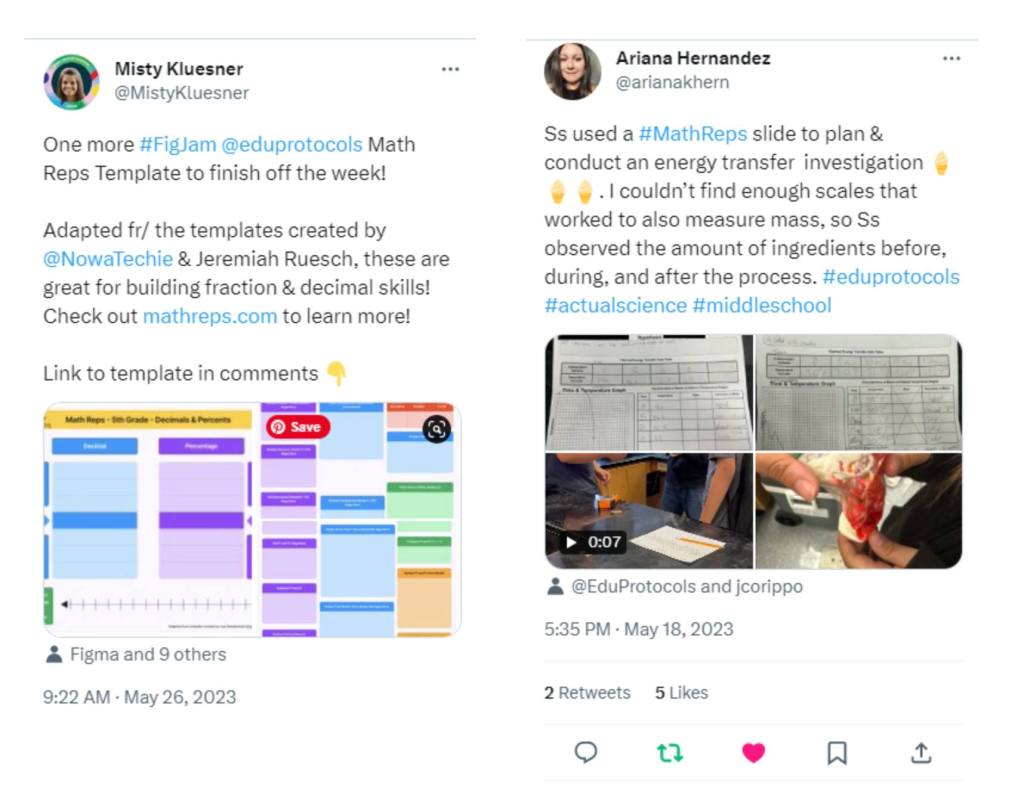
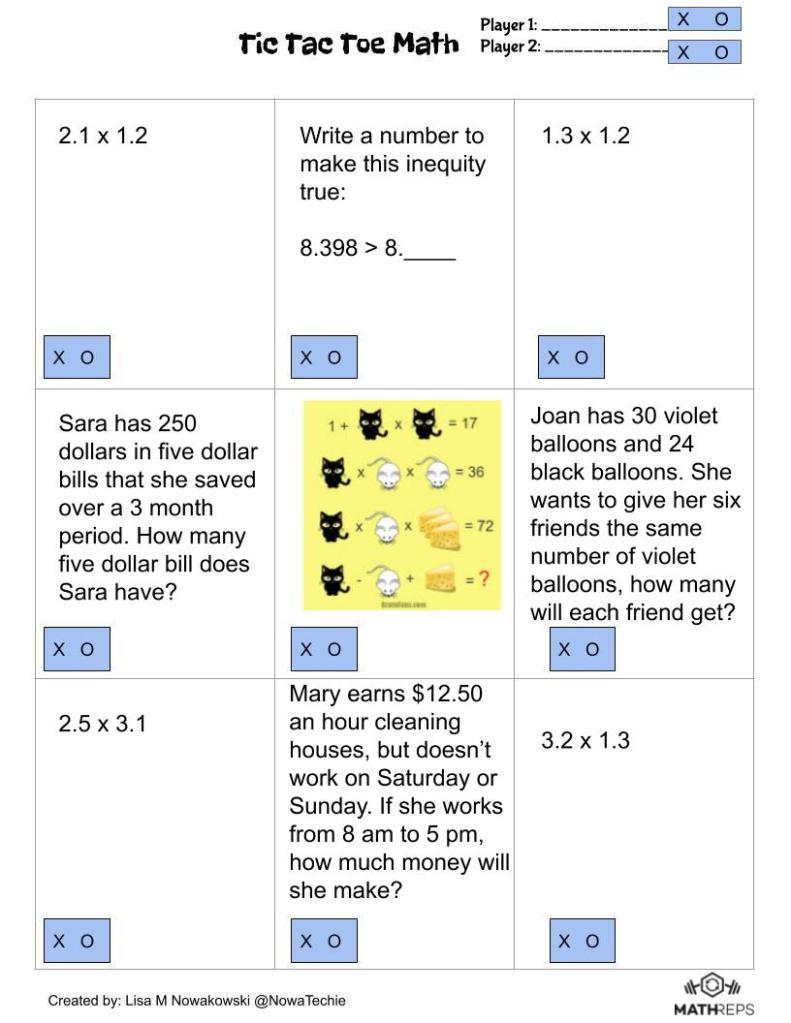
If you are interested in this MathRep or others that are available, please head over to MathReps.com to view them all. The best part, they are all FREE! We have kinder through high school.

MathReps Love at CUE

March 16-18 was Spring CUE, a California educator conference. There were many great sessions to choose from. In addition to all the great sessions, I was able to reconnect with friends. The night before the conference a few friends and I were able to have a fantastic dinner at our traditional ‘night before the conference starts’ restaurant. And it did NOT disappoint.

EduProtocols Math Edition available on Amazon

When I say that there was lots of love for MathReps, I’m not kidding. It felt like it was everywhere. I was not the only person presenting on it. It was in sessions, in the exhibit hall with the vendors, and people talking about them. It was everywhere! The vendor one was cool. As a friend and I were checking out the different booths, she stops me, points to an interactive whiteboard, and says, “Hey, that’s your stuff.” She was right. It was a 3rd-grade MathRep. I chatted with the vendor for a bit. I introduced myself to the person who displayed it. He commented on how he enjoys showing it on the boards because it’s so user-friendly

I was able to present MathReps and Comic Strip Math on the last day. There was lots of interest and lots of great questions. Several attendees wanted to know where they could purchase the book. Fortunately, on the book image, I had a link to Amazon.

So, all in all, it was a GOOD conference!

I’m Back!

Photo by Maksim Goncharenok on Pexels.com

Well, it’s been a hot 🔥 minute since I’ve written anything on here. I’m not exactly sure where to begin so I think I’ll just jump right in with what’s new. But before that let me reintroduce myself. I’m a lot of things but primarily a teacher, author (The EduProtocols Field Guide Math Edition), and creator of MathReps. More recently, I have started embroidery, bread making, and homemade vanilla extract.

In no particular order:

  • The MathReps Facebook Group continues to grow
  • I’ve been doing a lot of work creating new MathReps for various grades
  • EduProtocols Plus has launched and has included me in the fun!
  • Jeremiah Ruesch and I have launched our EP+ Math Show
  • I’ve been terrible about posting my resources after presenting. I will be better at that. I’ve already updated my presentation page to include Spring CUE. Go me!
  • I’ve created a course for EduProtocols Plus on implementing MathReps

I intended this one to be a quick reintroduction/catch-up post. I will write more soon about some of the amazing things that I experienced at Spring CUE 23! Quizizz was amazing and loving the new updates – that’ll be one post on its own. There was LOTS of LOVE ❤️ for MathReps during the conference. It felt like it was mentioned or highlighted everywhere from sessions to hallway discussions to the vendor hall.

I would like to thank Kyle Anderson for inspiring me to blog again. He too took a hiatus, although a shorter one than myself, and is now back at it!

#BookSnaps

If you’re not familiar with #BookSnaps, go to Tara M Martin’s site. In short, students connect with a reading with thoughts, graphics, and images. This year, our district has been virtual (we will be going back the week of April 12, 2021) and this has given us the opportunity to explore different ways of delivering instruction.

NOTE: It has been so nice getting away from curriculum and helping teachers find what works for them and their students. Hello EduProtocols, MathReps, BookSnaps. I hope this trend of giving teachers autonomy continues.

Well, as a TOSA I am often invited into classes to help develop lessons and model some of the new pedagogy. Which I totally love! On Friday, I went to a 1st-grade class to do a #BookSnap. The kiddos did awesome! First, we read a book about ladybugs 🐞 . Then, using Nearpod the students annotated and connected with the reading. I chose a page to upload the image for them. I gave them a few prompts they could answer. And this was the result!

I want you to think about this. How often have we said or heard that 1st-graders can’t do (fill in the blank). They are too young. If anything, this past year proves that students of all ages can do whatever. We need to stop underestimating them. I’d also like to point out, that these students ARE NOT BEHIND. They have acquired different skills than they have in past years. In many ways they are AHEAD.

One of THOSE Teachers

I am one of THOSE teachers.

I will always fight for my students.

I will speak out when I feel something is wrong.

I will point out issues.

I. Will. Speak. Out.

I will fight for equity, fairness, and what is right. While I am labeled as ‘one of those teachers’ and it’s meant to discredit my words. It’s meant to silence me. It’s meant to send a message to others.

So, yes, I am one of THOSE teachers. I can only hope that the right people, those that CAN make a difference, ignore the label and do the right thing.

Photo by Andrea Piacquadio on Pexels.com

NOTE: This is not about one thing in particular. I have been labeled this several times over the years and felt the need to express my frustration at this label which is meant to encourage others to ignore what I say.

2020: A Year in Review

I know most people feel that 2020 pretty much sucked. And to a certain extent, it did. However, for me it wasn’t so bad. Sure I missed my kiddos from March 13, 2020, on. Yes, I missed hanging out with friends and going to a music festival – it’s always around my birthday and a friend and I make a tradition of going. I absolutely missed going to see my family. It’s been over a year since I’ve been able to see my dad. I also missed going to conferences in person. And, I got fat! The sudden change in a routine did me no favors. Despite all this, I can say that 2020 wasn’t all that bad for me.

The Upside of 2020

Burying yourself in the sand is always fun!

The first few months were fine. Nothing extraordinary happened, personally. Sure there were concerns over the spread of Covid-19. Every time a student coughed another would shout out, “You’ve got Covid.” Clearly they didn’t understand the gravity of the situation – nor did we. As March progressed, things began to take a turn. March 13 was the last day I saw my class in its entirety. However, for me, it’s a bit more memorable than most. We had a field trip that day – to the beach. It may have been cold and overcast, but we still had fun. We were there learning about the environment with an organization (Save the Whales). Before we left, I got into a conversation with one of the volunteers. He was concerned about a shut down of schools. This was his only source of income and if schools shut down that would greatly impact his livelihood. I didn’t want to admit to him that I felt a shut down was inevitable. I felt for him. When we returned to school, I ran into another 5th-grade teacher. She asked if I had seen the email. I said, “No.” She proceeded to inform me that we would be out for a few weeks. Seeing as the following week was Spring Break it meant we would be out for approximately one week. Well, we all know how that turned out. As I had a bit of time before the end of the day, I was able to prepare my students. They had many questions for which I had no answers. Fast forward 10 months and we are still virtual. Our area has been hard hit.

Ah, my cheerleaders. Love these kiddos!

I know, that didn’t seem so positive. But think about it. The last day my students were together we were on a field trip. That’s pretty cool. Other positive things occurred this year. The EduProtocol Field Guide Book 3: Math Edition, of which I am a co-author, was completed and ready to release to the world in Spring 2021. When Covid lock down began, my dad insisted that we call each day. Before Covid, we spoke once every few weeks. We have a good relationship, just didn’t talk regularly. Then, my district saw the value in a new position (3 positions): Tech TOSA (aka Coach). TOSA stands for Teacher On Special Assignment. At any rate, this is a position I have been longing for over the past few years. It took a pandemic for my district to create this position. I have been able to work with so many teachers in our district. This is truly filling my bucket. I work from home. As an introvert, this has been awesome! My family stayed healthy, mostly, during 2020. Then my dad had to go and get pneumonia just before Christmas. That was anxiety on steroids for me (he has severe COPD). But, he went home! Then went back in on New Year’s – seriously, not doing anything for my anxiety. Good news is that he is doing well and slated to go back home soon.

None of this is not to detract from those who lost loved ones (350K deaths to date), those who lost jobs, homes, and/or other things. I realize I am one of the lucky ones and am thankful. I support local businesses as much as I can. When others talk about how crappy 2020 was, I stay quiet. Their experiences are valid and need to be heard.

So 2021

Well, here we are in the new year. I can only hope that things continue to trend in a positive direction. We now have 2 vaccines. While we still need to mask up and social distance, it is a step towards being together again. I look forward to going back home (Detroit), hopefully this summer, to see friends and family. I look forward to being in class with students – safely – and hopefully as a TOSA in the upcoming school year. I look forward to seeing all my EdTech friends at conferences IRL. I can’t wait to go to the annual music festival. As with the beginning of any new year, there is a lot of hope and optimism.

My Wish for You

May your 2021 be better and brighter than the past year. May all your hopes, desires, and dreams be fulfilled. May you be happy and healthy. Have a GREAT 2021!