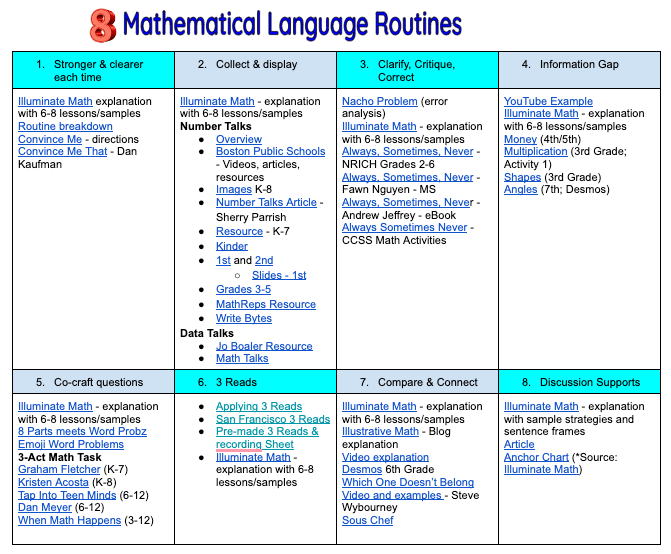
Looking back at the series of Mathematical Language Routines (MLRs) we have explored, we can see that their collective aim is to foster robust mathematical discussions and enhance language proficiency among students. These routines serve diverse purposes, such as refining ideas through structured conversation (Stronger and Clearer Each Time), stabilizing oral language as a reference (Collect and Display), refining written arguments through critique (Critique, Correct, and Clarify), promoting collaborative problem-solving through information sharing (Information Gap), empowering students to craft mathematical questions (Co-Craft Questions and Problems), facilitating comprehension and negotiation of math texts (Three Reads), and encouraging comparison and connection between various mathematical approaches and representations (Compare and Connect). Together, these MLRs not only elevate student participation and conversation but also cultivate meta-awareness of language, fostering a deeper understanding of mathematical concepts.
We conclude this series with Mathematical Language Routine 8: Discussion Supports. The goal is to foster inclusive discussions in math by combining multi-modal strategies that aid in understanding complex language, ideas, and classroom communication. These strategies encourage student participation, conversation, and awareness of language nuances. With continued modeling, the aim is for students to adopt these techniques independently, prompting deeper engagement among peers in discussions.
Having rich mathematical discussions can be challenging, especially when there are barriers that hinder effective communication. Recently, I encountered a situation where I was assisting a student with a math problem. The task was to determine the combination of rolls of coins needed to reach a specific amount. The problem provided information about the rolls of nickels and dimes, including the quantity each roll contained. However, during our discussion, it became evident that the student misunderstood the task. They believed they needed to determine the number of dimes or nickels in each roll, rather than finding the overall combination. To clarify this confusion, I decided to show them an image of a roll of coins and briefly discussed its concept, which helped them grasp the correct approach. This incident highlighted the importance of uncovering and addressing any gaps in background knowledge. It also underscored the significance of reflecting on the relevance of certain questions.


Having sentence frames is not only helpful to me but also to the students. The above image is one that I created based on Illuminate Math‘s suggestions. These sentence frames can guide the class towards deeper thinking and understanding. As mentioned before, the main objective of this routine is to encourage students to take the lead in these discussions. Additionally, it is important to note that this particular routine can be integrated into any of the other Mathematical Learning Routines (MLRs).
This concludes our multi-part series on the 8 Mathematical Routines. I highly encourage you to start implementing these routines in your day-to-day math class. To further support you on this journey, I have gathered a variety of helpful resources, which you can access here. If you have any additional resources to share, please don’t hesitate to reach out. I will gladly add them to the collection and give you proper credit.






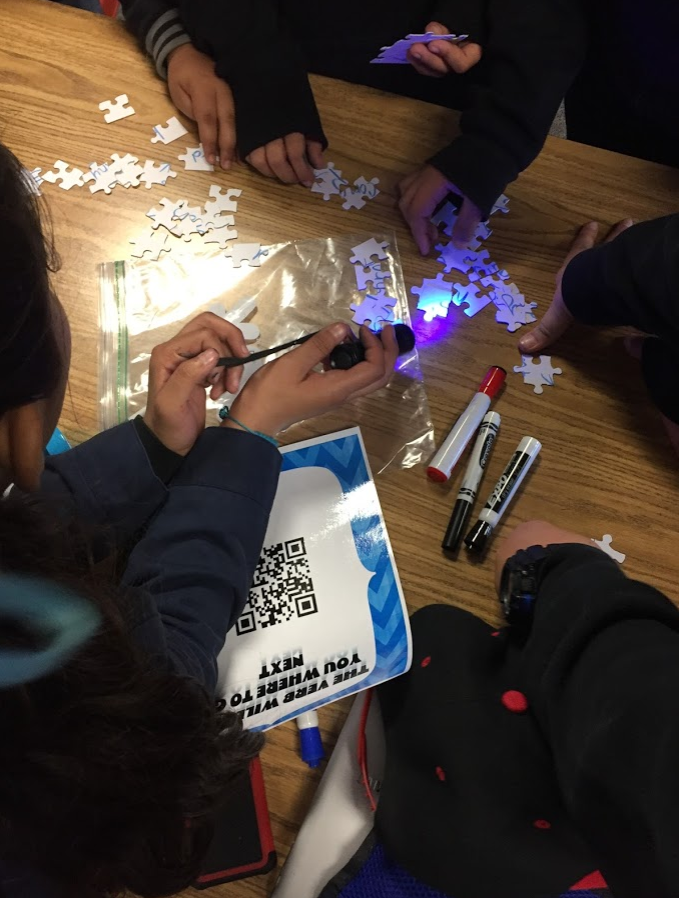 Holy Cow! It was a GREAT success. I mean, I knew it would be but it still blew my mind. A few weeks ago I sucked it up and purchased 4 more DIY kits. I had purchased one from the website a little over a year ago and was hesitant to buy more – I’m cheap! Anyhow, today I ran 5 simultaneous breakouts – Grammar Gurus.
 in the afternoon, I had another group of students in my classroom. They saw the locked boxes and asked what they were. I briefly explained what we did earlier and they asked when they were going to do one.
 Nowa Techie