Mastering Elementary Math: The Power of MathReps and Math Eduprotocols Pt. 2 Understanding MathReps

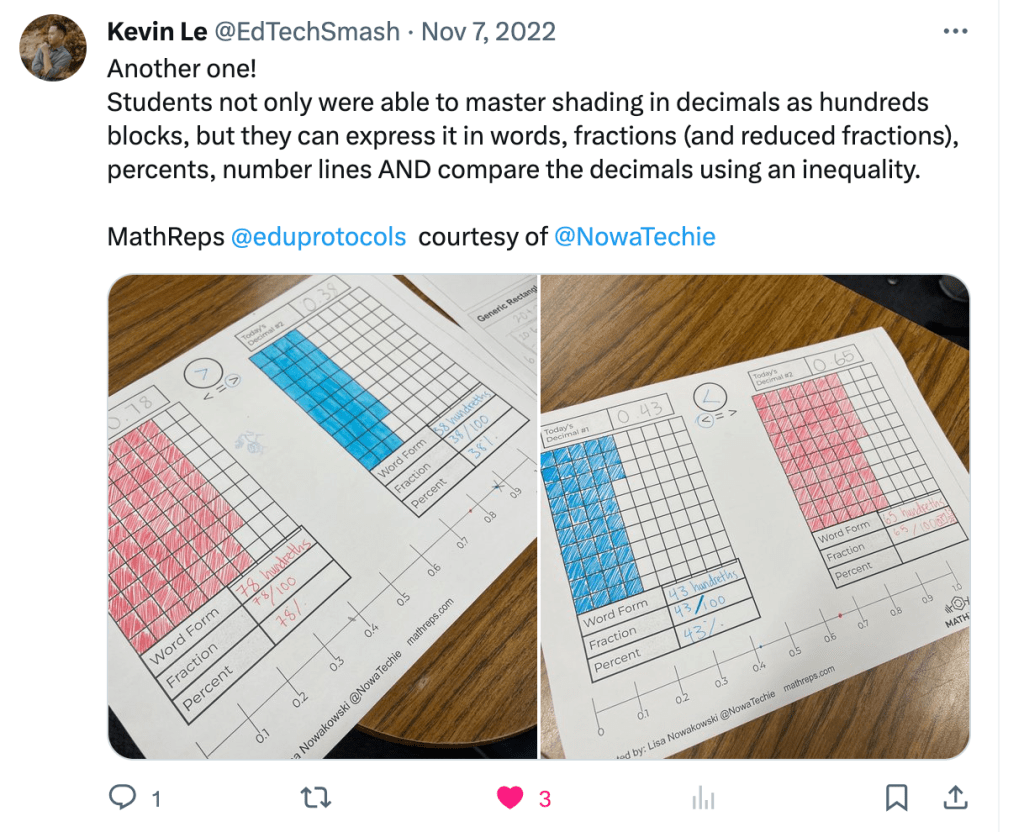
MathReps are thoughtfully designed templates teachers use for strategic and targeted math practices. These templates incorporate multiple related math skills and aim to help students make connections and bridge new concepts and strategies with previously learned ones. With MathReps, students can strengthen their understanding of mathematics in a structured and effective way.

MathReps is a powerful classroom tool that enhances learning. It offers ready-made templates, allowing teachers to focus on specific skills in order to gain mastery. One of the key benefits of MathReps is the immediate feedback it provides. In the classroom, teachers can give individual feedback as they move around, evaluate progress as a whole group, or employ a combination of both methods. Another advantage is the flexibility of MathReps, as it can be used with various platforms, ranging from simple paper and pencil or Wipebook to more advanced tools like Desmos, Nearpod, Pear Deck, or Figjam. It is recommended to use MathReps for at least three days a week to achieve the best results.

A Few Examples

Incorporating mathreps into a daily routine can be incredibly valuable for teachers. These short exercises provide repetitive practice and reinforcement for students, ensuring that concepts are deeply rooted in their minds. This approach helps to solidify connections between different mathematical concepts and builds fluency and flexibility in problem-solving.

Let’s take a closer look at the examples mentioned:

  • Second-grade counting money template: By using a template that incorporates word form and flexibility in handling money, students can develop a strong understanding of the concept of money in both dollars and cents. This repetitive practice allows them to become comfortable and confident in working with money.
  • Fifth-grade area model, partial products, and partial quotients: By combining these different techniques, students can see the connections between them and develop a more comprehensive understanding of the underlying mathematical principles. This approach encourages critical thinking and problem-solving skills.
  • Eighth-grade equations and expressions: Through repetitive practice, students can become proficient in solving various equations and working with different expressions. This builds their confidence and competence in tackling more complex mathematical problems.
  • High school trigonometry example: Running through several procedures in trigonometry enables students to make connections between different concepts and techniques. This helps them develop a deeper understanding of trigonometry and its applications.

Incorporating mathreps into the daily routine can ultimately enhance student learning by strengthening their mathematical foundation, connecting concepts, and fostering competence and confidence in problem-solving. It is an effective teaching strategy that greatly benefits teachers and students.

You can find the full collection at MathReps.com

What others are saying

Mastering Elementary Math: The Power of MathReps and Math Eduprotocols Pt. 1

According to (California) Mathematics Framework Chapter 3: Number Sense (2023), “To develop fluency, students need to have opportunities to explicitly connect their conceptual understanding with facts and procedures (including standard algorithms) in ways that make sense to them.” So what does all this mean?

To develop fluency, students need to have opportunities to explicitly connect their conceptual understanding with facts and procedures (including standard algorithms) in ways that make sense to them.

(California) Mathematics Framework Chapter 3: Number Sense (2023)

Building upon basic math concepts in early elementary is crucial for laying a strong foundation for future math concepts and overall academic success. By introducing and reinforcing fundamental mathematical skills, students develop essential problem-solving abilities, logical reasoning, critical thinking, and analytical skills.

When children acquire a strong understanding of basic math concepts, they are better equipped to tackle more complex mathematical ideas in later grades. By gradually introducing new concepts and building upon prior knowledge, students can gradually develop their mathematical proficiency. This progressive learning approach optimizes their chances of grasping and mastering higher-level math topics.

Moreover, the repeated practice of these basic math concepts is essential for long-term retention and automaticity. MathReps and Math EduProtocols provide valuable support in this process. Through systematic and repeated practice, students reinforce their understanding of basic math skills and improve their fluency.

Furthermore, the early development of strong math skills has a significant impact beyond the classroom. The critical thinking and problem-solving abilities fostered through the study of math are transferrable skills that have real-world applications. Proficiency in math opens doors to careers in various fields such as science, technology, engineering, finance, and even art, where mathematical reasoning plays a vital role.

In conclusion, building upon basic math concepts in early elementary is crucial for a child’s future academic success. By laying a strong foundation, students develop essential skills and pave the way for a deeper understanding of more complex mathematical concepts. MathReps and Math EduProtocols contribute to this process by providing systematic, repeated practice to reinforce these fundamental skills and promote mathematical fluency.

This captivating series explores the immense power of MathReps and Math EduProtocols, revealing their transformative impact on student success. Embark on a journey filled with insights, practical benefits, and step-by-step implementation strategies. Delve into inspiring examples and hear firsthand testimonials that will leave you motivated and ready to empower your students for a future of achievement. Don’t miss out, follow along and unlock your students’ true potential.

8 Mathematical Language Routines

I have been on a journey to educate myself on the 8 Mathematical Language Routines (MLRs). While they were designed with Multilanguage Learners in mind, I find that they are just good teaching. So what are they?

  • Stronger & clearer each time
  • Collect & display
  • Clarify, critique, and correct
  • Information Gap
  • Co-craft questions
  • 3 Reads
  • Compare & Connect
  • Discussion Supports

So what does each one entail? Well, rather than sit and explain, I’d rather give you a resource that does a far better job breaking it down. It’s also one of my favorite resources.

Part of my deep dive allowed me to align Math EduProtocols and these MLR’s. Doing this has my mind working on how to incorporate more MLR’s within Math EduProtocols.

With all this in mind, I have begun to curate some resources for teachers. I break down each MLR and give links to activities. It’s not a comprehensive list, so I will continue to add to it as I find more. If you have something that should be added to the document, let me know!

Nacho Problem

What’s a problem that’s not yours? Nacho Problem!

It’s that time of year, Test Prep time. Which makes me think about using EduProtocols for Test Prep. One great one that really promotes deeper thinking and understanding is Nacho Problem. This was created by Ligia Ayala-Rodriguez. It’s a fun way to do error analysis with your students. I have done this with students as young as 7.

One of the advantages is that you begin by telling the students the answer is wrong. This seemingly takes the pressure off. I like to have the students talk it out the first few times. I guide them along the way to help set the expectations. Just like in an ‘Analyze the Error’ on the test, students are expected to express their thoughts in writing. This can present an additional challenge if they haven’t exercised this skill. I’m not saying we should do this solely to prepare for the state test; the benefits of students being able to do this go far beyond that idea.

How to Get Started

As a class, they are presented with a Nacho Problem. We read and analyzed the problem together; starting with “What do you notice?” and “What do you wonder?” I explicitly tell them the answer is wrong and that we must find where I went wrong. I have found that looking at the question and working out the problem allows us to focus on the process (that the problem is asking us to solve) rather than the arduous task of finding a mistake. Once we work it out together, and later independently, students can then go back and compare their process with the original (wrong) process. It makes it more obvious where the original problem solver went wrong.

The written explanation can be the most difficult part. When I started doing problems like this, students would explain, in an addition problem, “I started in the ones and added 8+7. I left the 5 in the one’s place and regrouped the 1.” While technically that is true and we as teachers understand, that’s not showing an understanding. That is why practicing the structure of Claim, Evidence, and Reasoning (CER) is so important.

Claim: Ms. N. did not draw a quadrilateral.
Evidence: The student example with explanation.
Reasoning: Definition of a polygon and Ms. N’s error.

Finding Problems

One of the easiest ways to collect incorrect problems is from your class. Whether you use exit tickets or collect information from the day’s lesson, you have a plethora of options. When using student errors, it’s advisable to use a common mistake by many students. Done early, this can correct any misconceptions before they become habits. Ligia suggests using mathmistakes.org

Results

Teachers and students alike enjoy this math EduProtocol. Students find it ‘fun’ to find the mistakes. Teachers report that it takes little time to begin implementing in their classes. Doing this a few times a week can really improve understanding. Let’s face it, students LOVE to point out teachers’ mistakes.

If you use this, I would love to hear how it went. What changes did you make? How have your students improved with error analysis?