We’ve all been there. It’s your math block, and you’re asking students to run a Place Value MathRep. You need a number to work with. You could ask a student for a random number, and depending on your class, that could be dangerous. 6-7 anyone?
But what if we gave them a Menu instead?
The Number Menu is a simple, low-prep strategy to turn a standard MathRep into a high-interest, culturally relevant experience. By providing a curated list of 5–10 real-world numbers, you give students agency, choice, and a reason to care.
Why it Works
- Natural Differentiation: Include a “Mild, Medium, and Spicy” option. A teacher can put a 2-digit, 4-digit, and 7-digit number on the same menu, allowing students to self-select their challenge level.
- Connection: It bridges the gap between the classroom and the community.
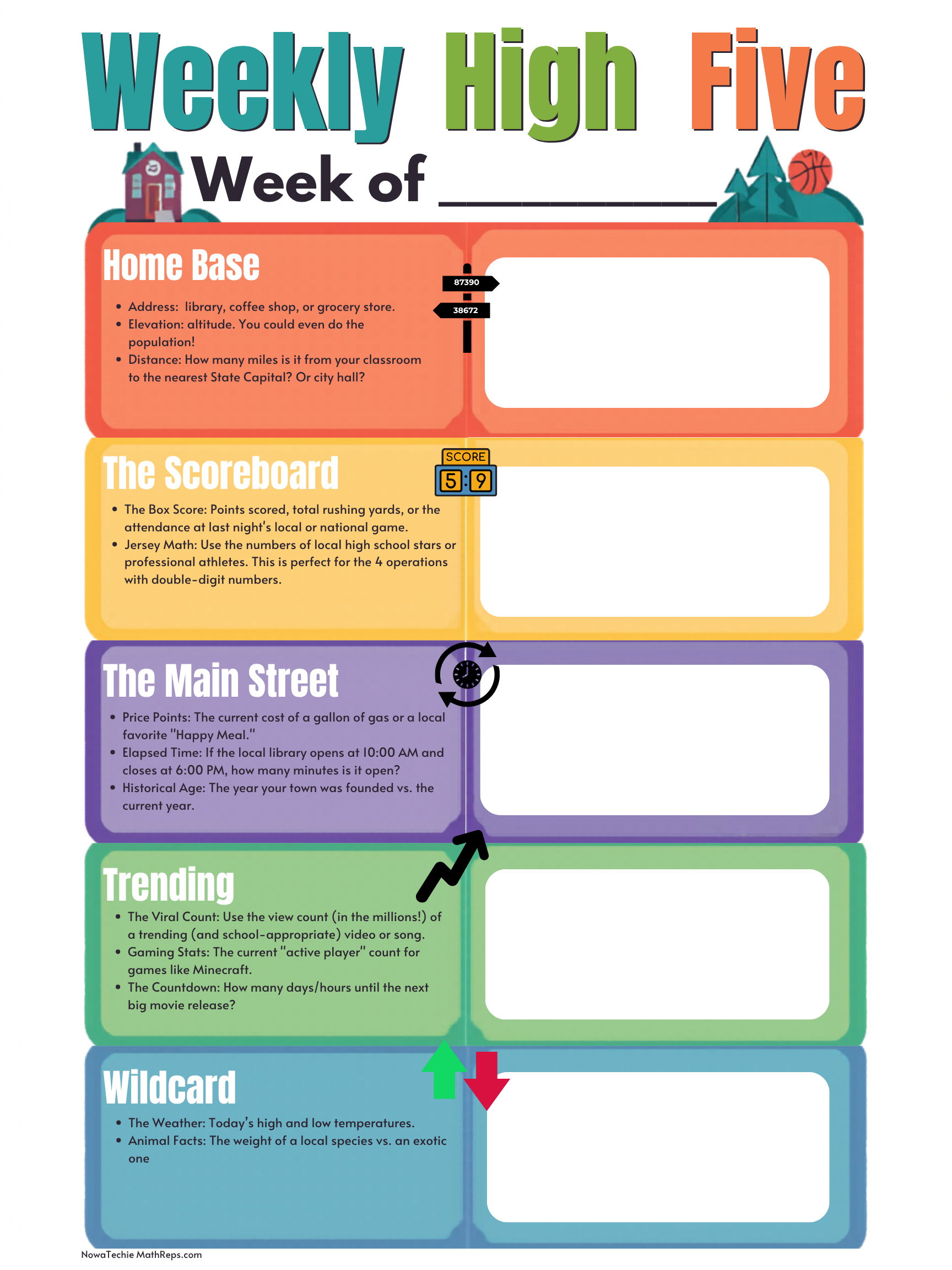
Build Your Menu: 5 Categories to Get Started
You don’t need to reinvent the wheel every day. Pick a few categories, update the numbers once a week, and post them in a dedicated corner of your whiteboard.
1. The “Home Base” (Local Landmarks)
Perfect for place value, rounding, and measurement.
- The School’s Address: Use the street number of your building or a famous local landmark (local library, coffee shop, or grocery store).
- Local Elevation: What is the altitude of your town? A nearby town? (Great for comparing numbers!) You could even do the population!
- The Distance: How many miles is it from your classroom to the nearest State Capital? Or city hall?
2. The “Scoreboard” (Sports Stats)
Sports are a universal language for engagement.
- The Box Score: Points scored, total rushing yards, or the attendance at last night’s local or national game.
- Jersey Math: Use the numbers of local high school stars or professional athletes. This is perfect for the 4 operations with double-digit numbers.
- Pro-Tip: Don’t be afraid to be a “homer”! Why not use at least one Detroit Lions stat on the menu? What a great way to engage in math! Not a Lions fan? (Why not? – don’t answer that), Use a favorite team of yours or your students.
3. The “Main Street” (Community Math)
Connecting math to the economy that students see every day.
- Price Points: The current cost of a gallon of gas or a local favorite “Happy Meal.”
- Elapsed Time: If the local library opens at 10:00 AM and closes at 6:00 PM, how many minutes is it open?
- Historical Age: The year your town was founded vs. the current year.
4. The “Trend” Report (Pop Culture & Digital)
Meeting students where they live—online.
- The Viral Count: Use the view count (in the millions!) of a trending (and school-appropriate) video or song.
- Gaming Stats: The current “active player” count for games like Minecraft.
- The Countdown: How many days/hours until the next big movie release? Or a local event like the Salinas Valley Fair?
5. The “Wildcard” (Nature & Science)
For the kids who love the “did you know” facts. I love this idea. So many random
- The Weather: Today’s high and low temperatures (perfect for introducing negative numbers).
- Animal Facts: The weight of a local species vs. an exotic one (e.g., a Black Bear vs. a Blue Whale).
Keep it Simple
The goal of MathReps is to keep the routine stable so the thinking can be deep. You don’t need a fancy tech integration for this. A simple “Weekly High Five” list on the board is all it takes to transform a routine repetition into a meaningful conversation.
When you bring the world into your MathReps, you aren’t just teaching place value—you’re showing students that math is happening all around them.
What numbers or topics are on your menu this week?


One thought on “The Power of the “Number Menu” in MathReps”