For years, I followed the “Trimester Trap.”
In Trimester 1, we did the heavy lifting: number sense, multiplication, and long division. By Trimester 2, we moved on to “All Things Fractions.” By Trimester 3, we were classifying polygons and plotting data, all while keeping one eye on the looming state test.
But then, the “April Epiphany” hit. When I circled back to prepare for testing, I realized my students didn’t own the math from Trimester 1. They had merely “rented” it for the unit test and returned it.
The math was gone.
I knew I had to stop teaching in silos. I needed a way to keep every Priority Standard “warm” year-round.
The Inspiration: From Grammar to Graphs
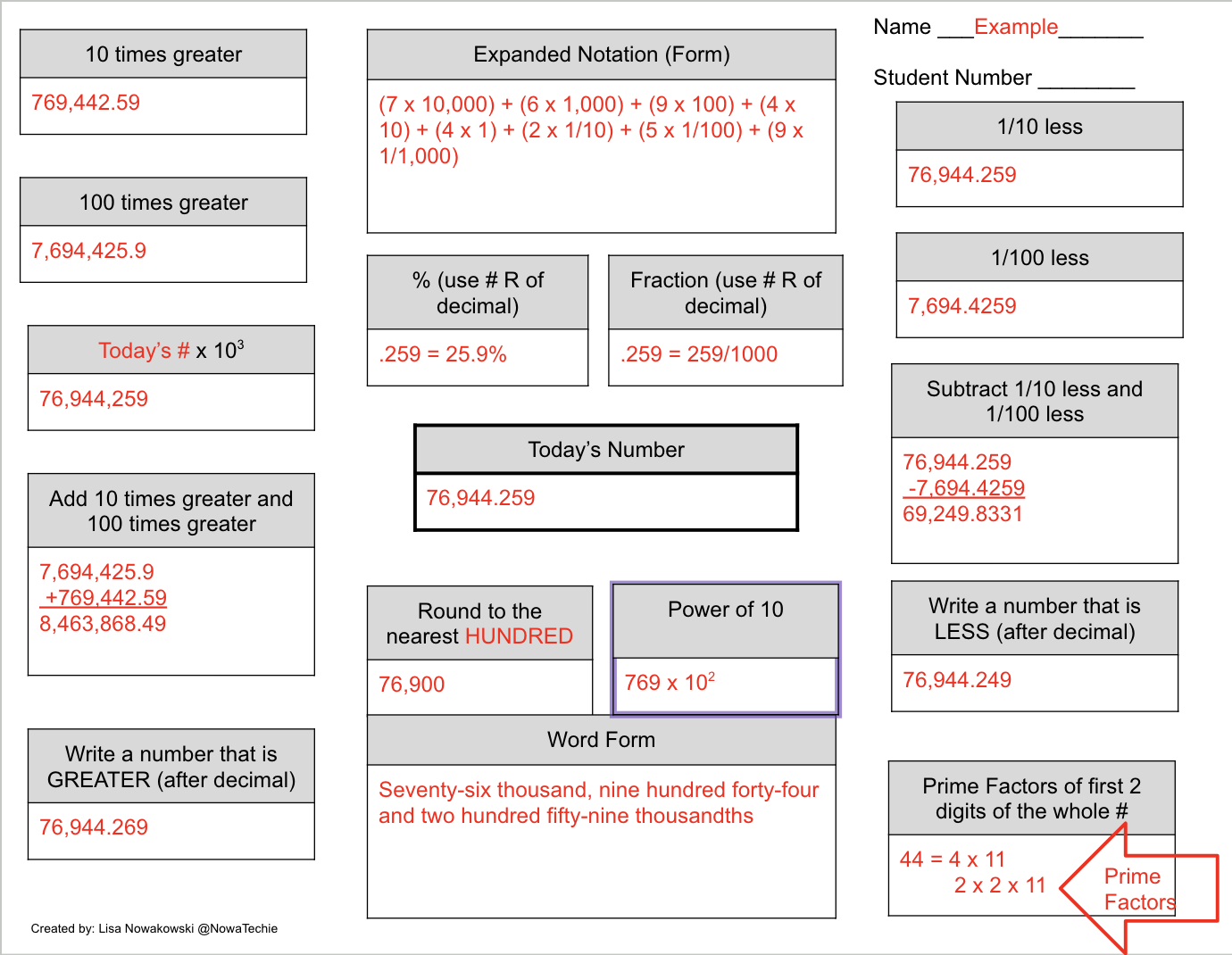
The spark came from Jon Corippo’s 8 p*ARTS of Speech. I saw how a simple, repeatable routine could solidify complex grammar, and I thought: Why aren’t we doing this with Math?
When I sat down to create the very first template back in 2016, I called it Place Value Basics. I’ll be honest: I explicitly wrote in that blog post that what I came up with “isn’t nearly as fun” as Jon’s version. But the core mechanism, squeezing 9 to 11 different standards onto a single page and hitting them daily, was there.
The results in my 5th-grade classroom weren’t just “better”, they were transformative. What started as a personal survival strategy quickly spiraled. A friend in 1st grade asked for a version. Then 3rd grade. Then Kinder. Suddenly, we weren’t just doing “reps”, we were building a movement.
Why Repetition Isn’t a Dirty Word
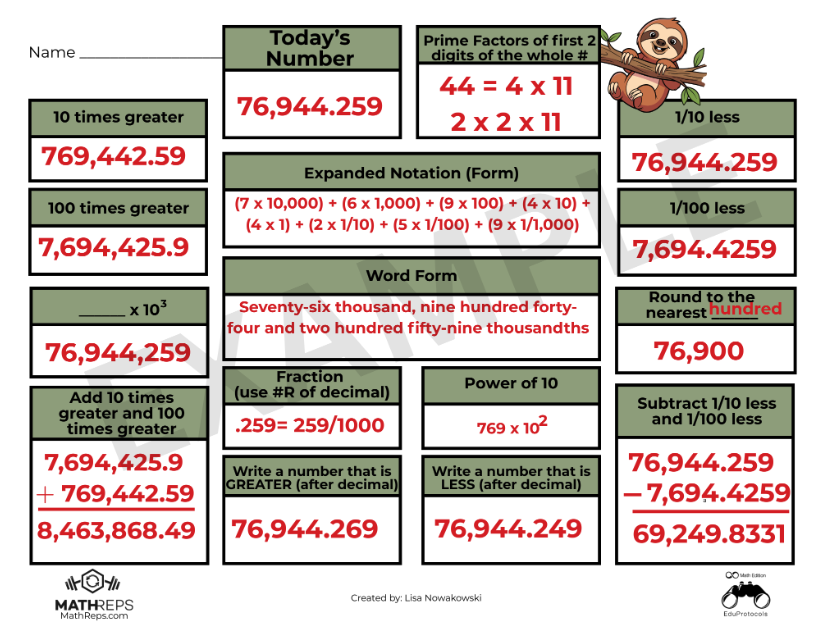
There is a common fear in modern education that any form of repetition is “drill and kill” – a soul-crushing exercise in flashcards that kills a student’s love for math.
But true MathReps are the exact opposite of a drill sheet.
- Drill and Kill is 50 problems of the exact same skill, practiced in a vacuum until the brain shuts off.
- MathReps is one number or set of numbers, run through 10 different connecting skills, practiced daily until the brain turns on.
We aren’t asking students to do the same thing over and over to get “fast.” We are giving them a predictable routine so their cognitive load is reduced. When they don’t have to worry about the format or “What do I do next?”, they finally have the mental space to notice patterns and ask “Why does this work?”
The Accidental Algorithm
I watched this play out beautifully with a 5th grader working on a MathRep that included the area model for division. In our conceptual progression, we weren’t teaching the traditional algorithm yet (that’s a 6th-grade standard); we were focusing on the “why” of place value blocks and area.
Day after day, this student engaged with the routine. Because he knew the structure inside and out, he stopped worrying about the instructions and started noticing patterns. One afternoon, he called me over, and I noticed his paper and inquired about his use of the algorithm.
“I saw that when I was doing it the other way, I could just figure out how many groups I needed from each place.”
Without a single direct instruction lesson, he had inherently figured out the traditional long division algorithm. He didn’t find it because he memorized an abstract chant or an acronym. He found it because the daily, low-stakes repetition of the area model allowed him to see the mathematical patterns so clearly that the traditional algorithm became the next logical step.
That is exactly how math is supposed to work: naturally, through curiosity and pattern-finding.
Rooted in the Classroom, Not a Boardroom
One thing that makes MathReps different is that it’s grassroots. This isn’t a framework developed by a textbook company or a corporate suite; it’s an educator-owned project born directly from the needs of real students in a real classroom. It’s built by teachers, for teachers, and refined by the feedback of the thousands of you who use it every day.
We now know the cognitive science backs this up. The 10-Minute Mastery Loop proves that daily mixed spaced retrieval beats the weekly review cycle every single time. If you only teach fractions in January and February, the brain flags that information as “temporary.” But if you touch a fraction every morning, the brain recognizes it as “essential.”
Where We Are Going Next
MathReps is no longer just a collection of legacy slides. As we look forward, our focus is on:
- Universal Access: Expanding the searchable directory so you can find the exact standard you need in seconds.
- Student Agency: Using the Number Menu to let kids bring their own real-world numbers into the math routine.
- Sustainability: Keeping the “low-prep, high-impact” promise that makes this routine actually doable on a rainy Tuesday in February.
The “Manifesto” is this: Every student deserves to feel like a “Math Person.” By giving them a consistent routine to practice the Priority Standards of their grade level, we move math from short-term memory to long-term mastery.
Join the Conversation
We’ve all seen the “Trimester Trap” in action.
Which specific standard or concept do your students always seem to “return to the rental shop” by the time spring testing rolls around? Drop it in the comments, and let’s look at which MathRep can help you keep it warm!


