Mastering Mathematical Language Routine 8: Discussion Supports

Looking back at the series of Mathematical Language Routines (MLRs) we have explored, we can see that their collective aim is to foster robust mathematical discussions and enhance language proficiency among students. These routines serve diverse purposes, such as refining ideas through structured conversation (Stronger and Clearer Each Time), stabilizing oral language as a reference (Collect and Display), refining written arguments through critique (Critique, Correct, and Clarify), promoting collaborative problem-solving through information sharing (Information Gap), empowering students to craft mathematical questions (Co-Craft Questions and Problems), facilitating comprehension and negotiation of math texts (Three Reads), and encouraging comparison and connection between various mathematical approaches and representations (Compare and Connect). Together, these MLRs not only elevate student participation and conversation but also cultivate meta-awareness of language, fostering a deeper understanding of mathematical concepts.

We conclude this series with Mathematical Language Routine 8: Discussion Supports. The goal is to foster inclusive discussions in math by combining multi-modal strategies that aid in understanding complex language, ideas, and classroom communication. These strategies encourage student participation, conversation, and awareness of language nuances. With continued modeling, the aim is for students to adopt these techniques independently, prompting deeper engagement among peers in discussions.

Having rich mathematical discussions can be challenging, especially when there are barriers that hinder effective communication. Recently, I encountered a situation where I was assisting a student with a math problem. The task was to determine the combination of rolls of coins needed to reach a specific amount. The problem provided information about the rolls of nickels and dimes, including the quantity each roll contained. However, during our discussion, it became evident that the student misunderstood the task. They believed they needed to determine the number of dimes or nickels in each roll, rather than finding the overall combination. To clarify this confusion, I decided to show them an image of a roll of coins and briefly discussed its concept, which helped them grasp the correct approach. This incident highlighted the importance of uncovering and addressing any gaps in background knowledge. It also underscored the significance of reflecting on the relevance of certain questions.

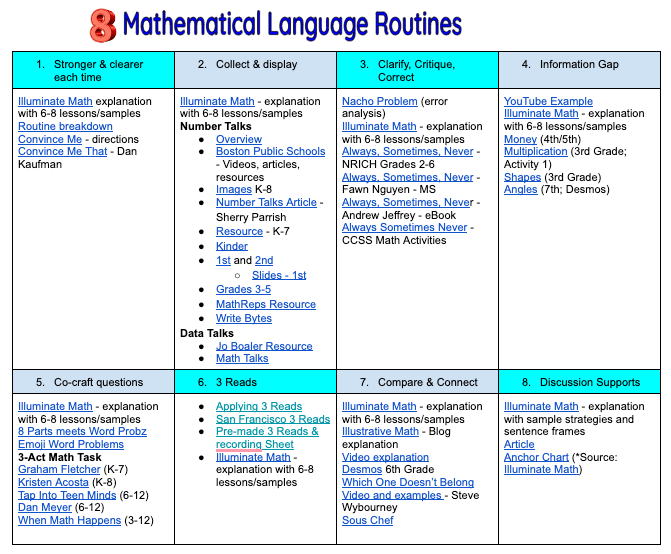
Having sentence frames is not only helpful to me but also to the students. The above image is one that I created based on Illuminate Math‘s suggestions. These sentence frames can guide the class towards deeper thinking and understanding. As mentioned before, the main objective of this routine is to encourage students to take the lead in these discussions. Additionally, it is important to note that this particular routine can be integrated into any of the other Mathematical Learning Routines (MLRs).

This concludes our multi-part series on the 8 Mathematical Routines. I highly encourage you to start implementing these routines in your day-to-day math class. To further support you on this journey, I have gathered a variety of helpful resources, which you can access here. If you have any additional resources to share, please don’t hesitate to reach out. I will gladly add them to the collection and give you proper credit.
Mastering Mathematical Language Routine 7: Compare and Connect

In the previous Mathematical Language Routine (MLR) discussions, we explored a variety of essential skills. MLR 1 focused on enhancing our understanding by revisiting and reinforcing key concepts, making our knowledge “Stronger and Clearer Each Time.” We then moved on to MLR 2, where we delved into the crucial skill of “Collecting and Displaying” data effectively. Building on this foundation, MLR 3 emphasized the importance of “Critiquing, Correcting, and Clarifying” our models and methodologies for optimal results. In MLR 4, we explored the “Information Gap” and how to use this strategy to be thoughtful of the information needed to solve problems. Continuing this journey, MLR 5 introduced the skill of “Co-Crafting Questions and Problems” collaboratively to foster innovative approaches and insights. Finally, in MLR 6, we explored the technique of “Three Reads,” emphasizing the significance of multiple reads in order to enhance student understanding. Let’s now embark on our next MLR discussion, MLR 7 Compare and Connect.

MLR 7: “Compare and Connect,” has the purpose of fostering students’ meta-awareness in their exploration of different mathematical approaches, representations, concepts, examples, and language. Through this MLR, students are encouraged to reflect on and verbally respond to these comparisons. This involves analyzing why certain mathematical actions or statements are done in a particular way, identifying and explaining connections between various mathematical representations or methods, and pondering how one idea relates to others in terms of both concepts and language. To support this learning process, teachers should model their thinking aloud when addressing these questions. This routine allows students to engage in rich mathematical conversations. We will explore two ways in which to accomplish this.

Which one doesn't belong

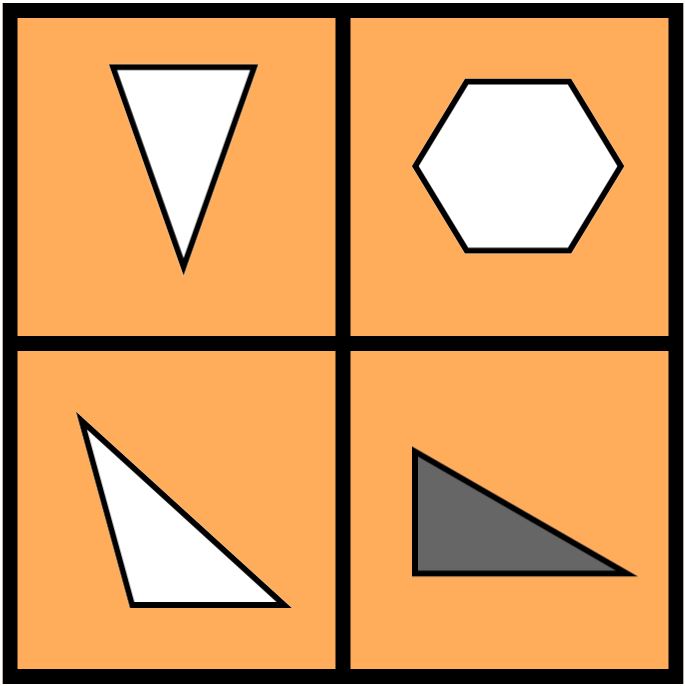
Getting students to engage in discussions about math, make connections, and consider different perspectives can be quite challenging. I often encounter students who simply say, “It was in my brain” or “My brain told me the answer.” However, by modeling and encouraging metacognitive awareness, students can begin to make connections on their own. One effective routine that focuses on linguistic skills is called ‘Which One Doesn’t Belong‘. This activity can be done in groups, in pairs, or as a whole class. Students are presented with four images, equations, numbers, graphs, or geometric shapes, and they are asked to identify a commonality among three of them and explain their reasoning. The interesting twist is that any combination of three out of the four options can be correct. For example, in the orange example, one could argue that the three triangles go together and the hexagon is the odd one out. Alternatively, one could justify grouping all the white-filled shapes while excluding the shaded shape. This activity is both enjoyable for students and provides the opportunity to hear and consider different viewpoints.

Another interesting activity that aligns well with this MLR is the Math EduProtocol Sous Chef from The EduProtocols Field Guide Math Edition (Chapter 9, page 56). In this activity, students are grouped together to solve a problem using different approaches and then present their work to the class. For instance, if students were given the task of solving 4 x 6 in third grade, one student might use equal groups, another could opt for repeated addition, a third student may create an array, while the last student represents the equation with the area model. Through this activity, students can establish connections with previously learned concepts and broaden their understanding. There are numerous ways to implement Sous Chef, but the central focus remains on fostering connections among ideas and encouraging students to share their thought processes orally.

In conclusion, incorporating this MLR into your math class will greatly benefit your students. It will help them enhance their meta-awareness, make connections between different concepts, and foster a deeper understanding of the subject. While we have explored two approaches to this MLR, there are numerous other equally powerful techniques available. In our next discussion, we will delve into MLR 8: Discussion Supports, which focuses on stimulating rich and meaningful conversations in the classroom.

Mastering Mathematical Language Routine 6: Three Reads

In our recent posts, we have explored various Mathematical Language Routines (MLRs) that aim to foster language development in the math classroom. We have covered MLR 1: “Stronger and Clearer Each Time,” MLR 2: “Collect and Display,” MLR 3: “Critique, Correct, Clarify,” MLR 4: “Information Gap,” and MLR 5: “Co-Craft Questions and Problems.” Each of these MLRs has offered valuable insights into different aspects of language acquisition in mathematics, be it written and oral expression, oral language proficiency, or the comprehension of tasks and word problems.

MLR 6: Three Reads

Building upon these discussions, let’s now delve into our next MLR, MLR 6: “Three Reads.” This routine plays a crucial role in enhancing reading comprehension and developing meta-awareness of mathematical language. By engaging in this exercise, students get the opportunity to practice navigating the intricacies of math-related questions, which often pose challenges for them. Through multiple readings, they can better understand the unique ways in which math concepts are presented and effectively plan their strategies for problem-solving. MLR 6: “Three Reads” serves as an important tool for supporting students’ grasp of mathematical language and equips them with the skills needed to tackle word problems with confidence.

The Three Reads protocol is a powerful tool designed to enhance students’ understanding of mathematical word problems. Its main purpose is to break down complex problems into manageable steps that students can comprehend, analyze, and solve successfully. This protocol is particularly beneficial for multilanguage learners and students with academic disabilities who often struggle with comprehending mathematical texts.

The Three Reads protocol begins by encouraging students to focus on the meaning of the problem. Instead of rushing to perform calculations, students are prompted to truly understand the context and situation described in the word problem. This initial step allows students to connect with the story or situation presented and reflect on its implications.

After gaining a solid understanding of the problem’s context, students move on to the second read. Here, they concentrate on identifying the units and quantities involved in the problem. By focusing on these key components, students can make sense of the mathematical concepts and relationships embedded within the word problem.

Finally, during the third read, students shift their attention to the specific tasks or questions asked in the problem. By this stage, students have already engaged deeply with the problem’s meaning and mathematical content. They are now able to formulate a plan of action and approach the problem in a strategic manner.

The Three Reads protocol supports not only reading comprehension but also sense-making and meaningful conversations around mathematical texts. By emphasizing understanding and meaning before diving into calculations, students are given the opportunity to reflect on different presentation styles, negotiate interpretations, and explore multiple solution strategies.

Let’s explore an example that demonstrates how to implement the protocol of co-crafting questions with students. In this example, Mateo’s M&Ms, the quantities are initially hidden to allow students to focus on comprehending the story. Once they grasp the concept that Mateo has a bag of M&Ms with different colors, the quantities are revealed. At this point, students can create a T chart to organize the quantities and their corresponding units. Although the units are the same in this particular example, it’s important to note that it may not always be the case in every word problem. Utilizing the T chart helps students effectively organize the information. Moving on, the final phase of this example involves students creating their own questions, reminiscent of MLR 5. By allowing students to differentiate and choose their own questions, they are encouraged to tackle more challenging problems rather than opting for the easy way out. This approach also fosters open-ended questions that lead to a variety of possible solutions. It’s a wonderful way to introduce this routine. Additionally, another teacher in my district, Nicole Garcia, and I have developed a recording sheet to assist students in organizing their thoughts and work. It’s worth noting that it’s also practical to address problems that already come with pre-established questions. In these cases, steps 1 and 2 of the protocol remain the same. However, in step 3, students formulate a plan to answer the provided question. Once again, reading the story multiple times allows students the necessary time to grasp and organize the given information.

In summary, the Three Reads protocol encourages students to engage actively with mathematical questions, reflect on presentation styles, and negotiate meaning. By following this routine, students can develop a deeper comprehension of word problems, improve their mathematical reasoning skills, and ultimately enhance their overall problem-solving abilities.

Mastering Mathematical Language Routine 5: Co-Craft Questions and Problems

In this ongoing blog series on Mathematical Language Routines (MLRs), we have covered four essential routines so far. Let’s recap their key ideas: MLR 1: “Stronger and Clearer Each Time,” MLR 2: “Collect and Display,” MLR 3: “Critique, Correct, Clarify,” and MLR 4: “Information Gap.” These routines are designed to enhance oral and written communication skills in mathematics. Now, let’s turn our attention to MLR 5: “Co-Craft Questions and Problems,” which offers a unique approach. It encourages students to actively participate in the question and problem-solving process, enabling them to explore mathematical contexts before seeking answers.

In MLR 5, students are given the opportunity to dive deeper into problem-solving by creating, analyzing, and enhancing mathematical questions, problems, and situations. The purpose of this routine is to provide students with a space where they can generate, analyze, and improve their understanding of mathematical concepts, specifically word problems. Through engaging in conversations, students refine their ability to formulate, select, and refine questions, allowing them to develop stronger critical thinking skills. This routine fosters students’ ability to use conversation skills effectively in the process of formulating, selecting, and refining their mathematical questions and problems. By actively participating in these conversations, students take ownership of their learning and become more proficient problem solvers. Curiosity Creator, found in The EduProtocols Field Guide Math Edition, Chapter 18, is one way to practice this routine.

Another excellent routine that can be seamlessly integrated into MLR 5 is the 3-Act Math Task, originally developed by Dan Meyer. This ingenious task involves providing students with minimal information, serving as a catalyst to foster curiosity and encourage them to generate questions that they can later answer with additional information provided in subsequent acts.


The first act, known as Act 1, is designed to stimulate students’ observation skills and curiosity. During this phase, students are encouraged to ponder upon what they notice and wonder about the given scenario. They also formulate questions that they will eventually solve. Act 1 is an opportune moment for students to engage in conversations regarding their observations, estimations ( too high, too low, or actual), a specific focus question, and the type of information they need to answer their own question.


In Act 2, students are provided with the necessary information to solve the problem or question they crafted in Act 1. Armed with this newfound knowledge, they embark upon the solving process.
Finally, Act 3 allows students to review the actual answer and assess whether their initial predictions were correct.

This routine is highly engaging for students across all levels, offering a perfect balance between accessibility and challenge. It also offers a wide range of ready-made, standards-aligned tasks suitable for students from Kindergarten through high school. By incorporating the 3-Act Math Task routine into the classroom, instructors can empower students to actively participate in problem-solving, develop critical thinking skills, and cultivate a deep understanding of the importance of co-constructing problems and questions.

Mastering Mathematical Language Routine 4: Information Gap

Recap of the previous MLR discussions: We have reached the halfway point in the series of Mathematical Language Routines (MLRs). So far, we have explored MLR 1: “Stronger and Clearer Each Time,” where the focus was on enhancing understanding and communication skills through the use of the “Convince Me That” technique. This was followed by MLR 2: “Collect and Display,” which aimed at expanding students’ academic vocabulary. MLR 3: “Critique, Correct, Clarify” was centered around improving both oral and written skills, utilizing the EduProtocol Nacho Problem. Now, let’s introduce MLR 4: “Information Gap,” a personal favorite, which promotes collaborative work and helps students identify critical information necessary for solving word problems. This routine plays a vital role in fostering meaningful interactions and communication in the realm of mathematics.

One of the biggest issues in math classrooms is the challenge of word problems, also known as story problems. These problems require students to go through multiple steps, including reading comprehension, deciphering the question, creating a plan, and solving the problem. However, students often struggle with knowing how to use the given information and which details are relevant to the solution.

To address this problem, Information Gap tasks have been developed to help students navigate this challenge. In these tasks, students are divided into two groups: one group has the data card, while the other group has the problem card.

The group with the problem card reads the problem silently and asks the group with the data card for the information necessary to solve the problem. It’s important that neither group shows their cards to the other. Before sharing the information, the group with the data card asks the problem group why they need that specific information. This process encourages the problem group to justify their reasoning and ensures that they have thoroughly thought out the solution process.

This collaborative process continues until all the required information is obtained. Once both groups have shared their cards, they can work together to solve the problem. The goal of this approach is to create a need for students to communicate and collaborate, as this type of task cannot be accomplished alone.

When starting this process, it is beneficial to demonstrate it to the class. Initially, I present the problem card to the entire class while holding the data card myself. I then instruct students to work in pairs and determine what information they need. They are encouraged to formulate questions to obtain the necessary information and provide a rationale for why they need it. I repeat this process several times until the entire class understands their roles. Gradually, I reduce the group size over time until they are working in pairs to complete this task. This routine helps students to slow down and approach their thinking more deliberately.

In summary, Information Gap tasks are designed to promote collaboration and problem-solving skills among students. By requiring them to share different pieces of information both orally and visually, these tasks facilitate effective communication and enhance their ability to work together towards a solution.

In the upcoming post, we will delve into MLR 5: Co-craft questions, where we explore how 8 P*Arts meets Word Problems, 3-Act Math Task, and Emoji Word Probz perfectly align with this approach. Join us in the next installment of the series to discover exciting examples and techniques that will surely ignite your interest and leave you eager to come back for more. Stay tuned!

Mastering Mathematical Language Routine 2: Collect and Display

In the previous post, we delved into the significance of the Mathematical Language Routine 1 (MLR 1) “Stronger and Clearer Each Time.” MLR 1 focuses on nurturing a deeper understanding of mathematics by encouraging students to thoughtfully articulate their thinking process, either individually or in groups. Through explanation and attentive listening, students refine their writing skills and strive to explain concepts at a more profound level, akin to mathematicians.

Mathematical Language Routine 2: Collect and Display

Now, let’s turn our attention to MLR 2, known as “Collect and Display.” The primary objective of MLR 2 is to capture the oral language utilized by students during discussions, creating a valuable reference for later use. This capturing process encompasses various forms, including words, diagrams, and images. By collecting and displaying this language-rich content, MLR 2 aids students in establishing connections between different mathematical concepts, as well as facilitating the integration of academic language into their understanding and expression. Additionally, MLR 2 provides immediate feedback, an essential element in student learning, and offers a structured framework for self-reflection and language usage. Join along as we explore MLR 2 further in this post.

The focus of this routine is to collect students’ thoughts using verbal, pictorial, and diagrammatic representations. Although visuals play a role, they are not the main focus. The purpose is to explain the importance of using visual aids to collect and showcase student ideas in mathematics.

This routine aims to stabilize the ever-changing language used by students so that their own output can serve as a reference in developing their mathematical language. The teacher actively listens and records the language employed by students during discussions, whether it’s in pairs, small groups, or the entire class. This includes capturing written words, diagrams, and pictures.

The collected output can be organized, restated, or connected to other language in a display that all students can refer to, build upon, and make connections with during future discussions or writing activities. Throughout the unit, teachers can use the displayed language as a model, update and revise the display as student language evolves, and create connections between student language and new disciplinary language.

This routine provides valuable feedback to students, enhancing their understanding while simultaneously fostering their awareness of language.

When it comes to collecting data during student discussions in math class, there are effective strategies to encourage students to represent their mathematical thinking visually. One popular approach is incorporating Number Talks, a practice already utilized by many teachers. During Number Talks, teachers can record their methods and thoughts, which not only helps them make connections but also allows for discussions about the most efficient approaches. However, it’s important to note that sometimes students may overcomplicate their solutions to showcase the flexibility of their thinking. To address this, scribing these methods can help students realize the value of efficiency. Apart from Number Talks, there are other strategies to encourage visual representation of mathematical thinking. Teachers can introduce visual organizers like graphic organizers or mind maps, which help students organize and illustrate their ideas. Additionally, utilizing tools such as virtual or physical whiteboards or digital sketching apps can enable students to visually capture their thought processes. Activities like creating diagrams or pictures also enhance the collection of student ideas in a visual format, providing teachers with valuable insights into student understanding and promoting deeper mathematical thinking.

The method of collecting student data can vary depending on the teacher’s preference. Some teachers may opt for traditional methods like chart paper, prominently displayed in the classroom. Others may choose digital tools like Padlet. Regardless of the chosen method, the collected data will be easily accessible to students whenever they need it. It is encouraged for students to utilize these records when expressing their thoughts, whether orally or in writing. As a teacher, it is important to highlight this resource for students and demonstrate how to effectively utilize it.

In conclusion, we have explored the significance of MLR 2: “Collect and Display” in fostering effective language students use to communicate their mathematical thinking. This routine has proven to be a valuable tool for students, as it allows them to actively engage with mathematical concepts and communicate their ideas effectively. By collecting and displaying their thinking, students can enhance their understanding and learn from their peers. Moving forward, we will delve into MLR 3: “Critique, Correct, and Clarify” in our next blog post. Stay tuned as we continue to explore the power of Mathematical Language Routines in promoting mathematical discourse and deepening conceptual understanding.

Mastering Mathematical Language Routine 1: Stronger and Clearer Each Time

Mathematical Language Routines (MLRs) play a crucial role in enhancing students’ comprehension and communication skills in mathematics. Developed to meet the diverse language needs of learners, these frameworks have become an invaluable tool in promoting a deeper understanding of mathematical concepts. In this series, we will explore each MLR in detail, starting with MLR 1: “Stronger and Clearer Each Time.”

Mathematical Language Routine 1: Stronger and Clearer Each Time

MLR 1: “Stronger and Clearer Each Time” focuses on refining students’ ideas and communication through various activities. By incorporating writing, listening, explaining, and integrating new language, students are encouraged to continually improve their understanding of mathematical concepts. This routine, often conducted in pairs, provides students with the opportunity to collaborate and build upon each other’s ideas, fostering a culture of shared learning and growth.

Throughout this series, we will delve into the different structures and strategies that can be employed within MLR 1, unveiling how this routine nurtures students’ confidence and fluency in mathematics. Join us as we explore the remarkable impact of MLR 1 and its profound influence on students’ language development and mathematical achievements.

The purpose of this routine is to foster the refinement of students’ verbal and written output through structured conversation and revision. By engaging in this process, students can enhance both their thinking and their expression of it.

In this routine, students initially work individually or in groups, gradually progressing towards partner work. This approach allows students to acclimate to the task and build their confidence. For those who may be less familiar with writing, explaining, and refining their thoughts, supportive strategies can be implemented to ensure their success.

Once the structures are in place, it is crucial for students to recognize the ultimate goal, which is either a deep understanding of the concept or the ability to articulate it like an expert. The listener’s role becomes significant as they ask clarifying questions, enabling a comprehensive understanding of the speaker’s thoughts. Simultaneously, the speaker benefits from this exchange, refining their thinking more clearly.

To encourage thorough responses, it is valuable to have students switch partners multiple times during the routine. By engaging in back-and-forth conversation, with equal emphasis on speaking and listening, students not only refine their thoughts but also strengthen their language and reasoning skills. The iterative nature of this process reinforces the importance of pressing for details and encourages the continual refinement of ideas.

Convince Me That, by Daniel Kaufmann, is a highly effective protocol that teachers can implement in their math lessons to foster deeper understanding and engagement among students. To successfully introduce and implement this routine, educators can follow these step-by-step guidelines:

  1. Introduce the Problem: Begin by presenting a math problem along with its solution to the students. For instance, students can be asked to explain why 3 x 4 equals 12.
  2. Form Partners or Small Groups: Divide the students into pairs or small groups to facilitate collaborative learning. This structure encourages peer interaction and promotes the sharing of ideas.
  3. Restrict Algorithmic Thinking: Emphasize that students should focus on concrete or pictorial methods rather than relying on algorithms. This restriction encourages students to think deeply about the problem and explore alternative approaches.
  4. Initiate Individual Thinking: Give students time to think individually about the problem and develop their own explanations for the solution. This step helps to build independence and promotes critical thinking skills.
  5. Structured Pairing: After individual thinking, partners or group members should share their explanations with each other. This process enables students to refine their understanding through constructive discussions and peer feedback.
  6. Revise Written Responses: Encourage students to revise and improve their written explanations based on the feedback received during the structured pairing phase. This step promotes self-reflection and reinforces learning.

To facilitate the refinement process and prompt students effectively, here are some examples suitable for Math Learning Routine (MLR) 1:

  • “Convince your partner why the sum of any two even numbers is always even.”
  • “Explain to your group why dividing by zero is undefined and cannot result in a finite number.”
  • “Justify why the product of any number and zero is always zero.”

These prompts stimulate students to think critically, apply their knowledge, and refine their explanations. By implementing the Convince Me That routine with these strategies and prompts, educators can foster deeper conversations, encourage active learning, and enable students to demonstrate a more profound understanding of mathematical concepts.

For a more detailed explanation and implementation guidelines, you can refer to Chapter 19 of The EduProtocols Field Guide Math Edition. This invaluable resource offers comprehensive insights and practical tips for effectively utilizing the Convince Me That routine in math classrooms.

In conclusion, the implementation of MLR 1 has proven to be highly beneficial for students. It provides them with a structured platform to refine their thinking, improve their communication skills, and deepen their understanding of the subject matter. By engaging in the collaborative and iterative process of MLR 1, students are empowered to develop clearer and more coherent responses.

We invite you to stay engaged with our series and continue exploring the world of Mathematical Language Routines. The second routine in our series, MLR2: “Collect and Display”, has a specific purpose. It aims to capture students’ oral words and phrases and transform them into a stable, collective reference. The main goal is to preserve the language that students use and use it as a reference point for developing their mathematical language.

Enhancing Math Discourse: Introducing the ‘Mastering Mathematical Language Routines’ Series

Unleash the Power of Mathematical Language: Introducing the Game-Changing 8 Routines

Calling all educators! Prepare to embark on a transformative educational journey unlike any other. I am thrilled to bring you a powerful series on Mathematical Language Routines – the game-changers that will revolutionize your math classroom. Crafted by the brilliant minds at Stanford University and wholeheartedly adopted by the esteemed CA Department of Education in the newly adopted 2023 Math Frameworks, these routines are set to redefine the way we teach and learn mathematics.

But what exactly are these Mathematical Language Routines? There are eight carefully designed techniques that provide a powerful framework for enhancing language acquisition in the context of mathematical learning. These routines have proven to be instrumental in bridging the gap between mathematics and language, ensuring that students develop a deep understanding of both. Throughout this captivating series, we will delve into each routine, unpacking their unique benefits and offering practical guidance on how to implement them effectively in your classroom.

In this series, we will delve into 8 Mathematical Language Routines (MLRs) that can effortlessly enhance your math classroom experience, no matter the age group you teach. Let’s start with

MLR 1: Stronger and Clearer Each Time – In this routine, students write and share their responses to math problems verbally. They eagerly listen to valuable feedback, which further enriches and refines their responses.

MLR 2: Collect and Display – As students explain their thoughts and processes, the teacher captures the language they use. This serves as a helpful tool for further clarification.

MLR 3: Critique, Correct, and Clarify – Think of this as an in-depth analysis of errors to enhance learning.

MLR 4: Information Gap – Students form two groups, each with partial information, and must collaborate to solve a problem by obtaining the missing pieces of information.

MLR 5: Co-Craft Questions and Problems – Here, students generate questions and problems based on real-life scenarios, akin to the engaging nature of 3-Act Math Tasks.

MLR 6: Three Reads – This routine involves reading a problem three times, each time with a specific purpose. It is particularly effective for dissecting story or word problems.

MLR 7: Compare and Connect – Students compare, discuss, and connect their understandings with those of their peers.

MLR 8: Discussion Supports – Supportive sentence frames, thoughtfully organized into categories, can enhance students’ participation in discussions.

Get ready to embark on an exciting journey that will revolutionize your teaching practice. Together, we will explore the immense potential of these MLRs, empowering you to unleash the true capabilities of your students in mathematics and beyond. Over the past two years, I have gathered a wealth of knowledge in this area, and I can’t wait to share it with you. Join me as we dive into this exhilarating series, equipping you with the tools and skills to excel, ensuring your students’ success. Come back for more captivating insights that will leave you inspired and eager for the next installment.

Number Paths: The How Pt. 3

Discover the enchantment of number paths, where the elegance of simplicity meets the practicality of organization. Often, these paths showcase numbers encased within colored boxes, thoughtfully grouped in sets of five. Visualize orange encompassing numbers 1 to 5, while red houses 6 to 10. This delightful arrangement resonates harmoniously with the familiar 5-frame and 10-frame charts that our young learners explore. To enhance convenience and ease, a palette of subdued grays has also been created, ensuring ease for copying purposes. Allow yourself to be captivated by this delightful approach to number path aesthetics.

To effectively utilize these materials with students, it is advisable to laminate them for the purpose of writing. There are various activities that can be done using individual number paths. For instance, students can demonstrate numbers, and perform addition and subtraction. When students are asked to locate numbers on the number path, it is crucial for them to not only encircle the specified number (e.g. 4), but also the entire set of numbers that surround it. They should be encouraged to encircle numbers 1, 2, 3, and 4 as a group. For more detailed insights, The Recovering Traditionalist has an excellent blog post on this topic. This approach helps students develop an understanding of how numbers are organized and represented as a series of objects, and it supports their journey toward comparing numbers.

To ignite the excitement of young learners in primary classrooms, it can be incredibly inspiring for teachers to create a captivating number path either on the classroom floor or in an outdoor play area. A fantastic strategy to kickstart their journey is to encourage students to use colorful unifix cubes to represent each number along the path. Once students gain confidence in their number sense, a wonderful way to keep the momentum going is to challenge them further. Here’s a fun idea: have students cover up the numbers on the number path, then roll a dice or spin a spinner (depending on the numbers involved) and uncover the corresponding numbers. If you want to wow your students with an amazing interactive experience, check out Toy Theater, which offers an engaging number path simulation that you can seamlessly use in whole group activities. These concrete examples will surely empower primary teachers to embark on their number path journey with enthusiasm and immediate action.

No matter where you embark on your journey with number paths – whether it’s through simulations, utilizing large paths on the floor, or implementing individual paths – your primary students will undoubtedly develop a profound comprehension of numbers and enhance their overall number sense. Moreover, by incorporating number paths early on, students will be equipped with the necessary foundation to thrive in 2nd grade and seamlessly transition to working with number lines. Embrace the power of number paths, and empower your students on their mathematical voyage!

Number Path

What are Number Paths?

Introducing Number Paths: A Fun Tool to Fuel Young Minds’ Numeracy Skills!

Are you ready to embark on an exciting journey into the world of numeracy? Buckle up and get ready to explore a helpful tool that will make learning numbers a breeze for primary students (TK-1). Prepare to say farewell to conventional number lines and welcome the fascinating concept of Number Paths!

Picture this: instead of the usual tick marks, imagine boxes beckoning young learners to count their way to numerical mastery. But what makes Number Paths so special? It’s no secret that young students have an innate desire to count objects, and Number Paths perfectly align with their natural talents.

Number Path examples 1-10 and 1-20

Now, you might wonder why it is recommended to veer away from traditional number lines until 2nd grade. That’s because Number Paths, unlike their linear counterparts, emphasize an essential concept: one-to-one correspondence. While number lines relate to length and space, Number Paths establish a magical connection between numbers and counting objects, fostering a solid foundation for numerical comprehension.

If you haven’t yet experienced the wonders of Number Paths, or are looking for more tools and resources, get ready for an exciting journey! In the upcoming three posts, we’ll not only uncover the incredible benefits of these tools but also share simple strategies to seamlessly integrate them into your TK-1 classroom. With valuable resources at your disposal, mastering numeracy has never been easier. So, buckle up and join us on this daily exploration of Number Paths that promises to expand your knowledge and transform your teaching methods. Stay tuned for tomorrow’s captivating installment!