Summer Presentations

This summer, I will be presenting at two academies for EduProtocols. My sessions will have a math emphasis; shocking, I know. So this past week when I was asked to come up with titles and descriptions, I struggled. I wasn’t feeling it. Luckily, a friend called before I could toil for too long. I relayed to her my lack of motivation at the time, and she came up with some catchy titles.

  • 🍸The Mixology of MathReps – MathReps
  • Wheel Of Word Problems – Word Problems with Random Emoji
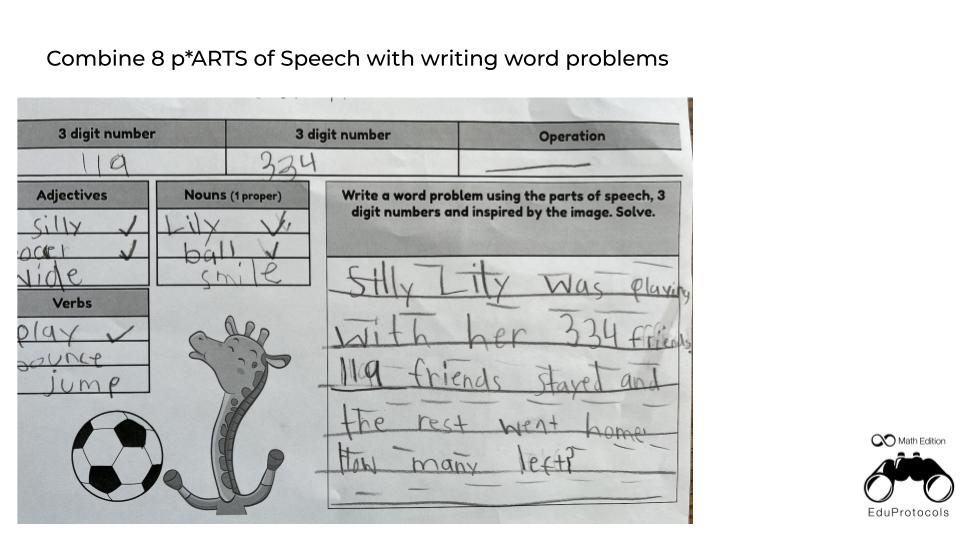
  • Playing with Parts – 8 p*ARTS meets word problems
  • 🌶️🌶️ Spicey Solutions to a Bland Curriculum – Nacho Problem
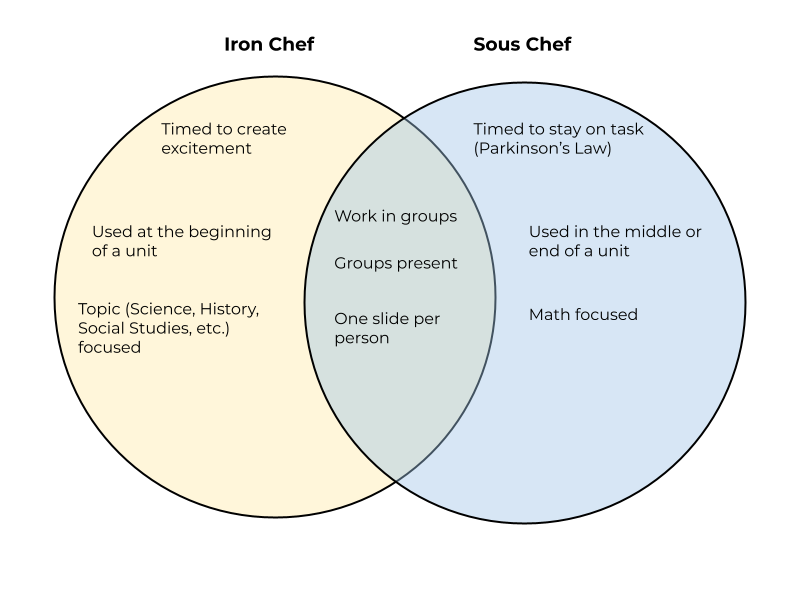
  • 👩🏽‍🍳Chef’s Kiss – Sous Chef
  • Frayas for Ya Playas – Frayer and, honestly, my favorite title
  • 🦹🏻‍♂️Math is a Villain: Comic Strip Math

Then it was time to get started on the descriptions. This is where I got inspired. I doubled down on the titles and all descriptions fit that theme. I mean, check out this description for Comic Strip Math:

In a world full of villains, the fine citizens of Mathemagicalville are up against the most evil, vile, sinister one around. Master of Dark is relentless in the pursuit of conquering the city. It is up to you, the superhero, to prove Master of Dark wrong and find the errors that were made. You create the comic, find errors, explain processes, and become the hero the city needs.

Yes, Mathemagicalville is a mouthful, but the names I wanted were all taken, and so I had to become creative. When I was creating this description, I felt that I had to be very careful with my wording. The character ‘Master of Dark’ was created by my 5th-grade class at the time, around 2019. The character was created to be gender-neutral. However, in today’s political climate, with hundreds of anti-trans laws being introduced throughout the country, I want to be sensitive to this. In 2019, the intent was to NOT represent one group as ‘evil’ or ‘bad’ but to keep the focus on math while empowering ALL the students in my classroom. The empowerment came from not having the gender stereotypes that boys are better at math than girls, and by taking the gender out of character seemed like a good solution at the time. However, as I began writing the description, I tried avoiding any pronouns. I don’t want to put a negative focus on any group.

I may be overthinking all this, and I may not be. However, in cases like this, I would rather err on the side of caution. So what do you think? Am I overthinking this? Does this character need to be revisited? Do I simply avoid using any pronouns as it’s not critical to the purpose of thinking critically about math? I would love to hear from everyone, especially those in marginalized communities.

Okay, that took a serious turn. NOW if you’d like to join me in Laguna Beach or Notre Dame this summer, here’s more information. I can’t guarantee that all seven sessions will be presented at both, but I can say that MathReps and Comic Strip Math will be presented at both – if I have a say.

Next Level with MathReps

Recently I was in a 3rd-grade classroom doing a geometry MathRep. As I was walking around I noticed that one student wasn’t just writing the answer using just numbers, he was also putting it in word form. Needless to say, I thought this was great! Which then led to a discussion on different ways we could represent the answer. We talked about using tally marks, equations, and shapes.

I then went into another class and did the same lesson. Well, another student leveled it up yet again! I was having students state their answers out loud in complete sentences. As the students were being creative in reporting their answers on their paper, one girl wrote out the complete sentence! Yes! What a win. We celebrated her and her work.

Currently, I am a Tech TOSA (Teacher on Special Assignment) in my district. I love my job for so many reasons. One of which is the ability to go into classrooms and become inspired by the teachers I work with and their students.

If you are interested in this MathRep or others that are available, please head over to MathReps.com to view them all. The best part, they are all FREE! We have kinder through high school.

MathReps Love at CUE

March 16-18 was Spring CUE, a California educator conference. There were many great sessions to choose from. In addition to all the great sessions, I was able to reconnect with friends. The night before the conference a few friends and I were able to have a fantastic dinner at our traditional ‘night before the conference starts’ restaurant. And it did NOT disappoint.

EduProtocols Math Edition available on Amazon

When I say that there was lots of love for MathReps, I’m not kidding. It felt like it was everywhere. I was not the only person presenting on it. It was in sessions, in the exhibit hall with the vendors, and people talking about them. It was everywhere! The vendor one was cool. As a friend and I were checking out the different booths, she stops me, points to an interactive whiteboard, and says, “Hey, that’s your stuff.” She was right. It was a 3rd-grade MathRep. I chatted with the vendor for a bit. I introduced myself to the person who displayed it. He commented on how he enjoys showing it on the boards because it’s so user-friendly

I was able to present MathReps and Comic Strip Math on the last day. There was lots of interest and lots of great questions. Several attendees wanted to know where they could purchase the book. Fortunately, on the book image, I had a link to Amazon.

So, all in all, it was a GOOD conference!

I’m Back!

Photo by Maksim Goncharenok on Pexels.com

Well, it’s been a hot 🔥 minute since I’ve written anything on here. I’m not exactly sure where to begin so I think I’ll just jump right in with what’s new. But before that let me reintroduce myself. I’m a lot of things but primarily a teacher, author (The EduProtocols Field Guide Math Edition), and creator of MathReps. More recently, I have started embroidery, bread making, and homemade vanilla extract.

In no particular order:

  • The MathReps Facebook Group continues to grow
  • I’ve been doing a lot of work creating new MathReps for various grades
  • EduProtocols Plus has launched and has included me in the fun!
  • Jeremiah Ruesch and I have launched our EP+ Math Show
  • I’ve been terrible about posting my resources after presenting. I will be better at that. I’ve already updated my presentation page to include Spring CUE. Go me!
  • I’ve created a course for EduProtocols Plus on implementing MathReps

I intended this one to be a quick reintroduction/catch-up post. I will write more soon about some of the amazing things that I experienced at Spring CUE 23! Quizizz was amazing and loving the new updates – that’ll be one post on its own. There was LOTS of LOVE ❤️ for MathReps during the conference. It felt like it was mentioned or highlighted everywhere from sessions to hallway discussions to the vendor hall.

I would like to thank Kyle Anderson for inspiring me to blog again. He too took a hiatus, although a shorter one than myself, and is now back at it!

MathReps on Jamboard

It’s no secret my new love is Jamboard. I began exploring it a little over a year ago. I liked some of the features: ease of writing, collaboration, and simplicity. I did NOT love some of the features: no revision history, inability to lock background, and some other annoyances. Yet, it became one of my favorite Google Tools.

Within the last four months, Google has been quietly updating Jamboard. First came the text and shapes features. Then came the ability for creators to lock a background. Recently, I discovered that a keyboard shortcut allows you to view the revision history. PC – Alt Ctrl Shift H; Mac – ALT Command Shift H

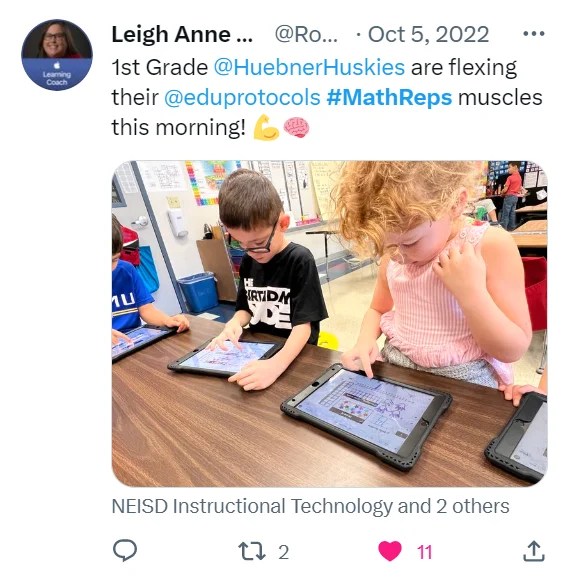
With all these updates, teachers are using Jamboard more and more. Last week I was able to work in a 1st-grade classroom and introduce Jamboard and MathReps to the students and teacher. We used a MathReps that the students could feel success. This way, if the tool was too much for them, they could at least follow along. Well, the tool was NOT too much for them. It does help that our students have touchscreen Chromebooks to use during distance learning (and yes, when we eventually resume in class instruction). The students had fun, the teacher learned about a few new tools, and everyone left feeling successful. Some students started pressing buttons (this is a good thing) and discovered the shapes tool!

Check out their work:

Extra Practice

This year I began using ‘Classroom Economy’. The students have jobs, earn money, and rent or buy their desks. Students have several opportunities to earn extra money. This is important because their monthly paychecks are less than their rent ($1000).

One way they can earn extra money is to solve math problems. I post two problems for anyone in the class to solve. I will only take the first correct answer. One is generally more difficult than the other thus allowing students to challenge themselves. The harder problem will earn them $50 while the easier one will earn them $20.

I was able to snap this photo of a student, who NEVER passes up the opportunity to make extra money, practicing the skills that she has learned. Added bonus, we leave the process a student takes on the board for all to see and learn from.

Math Practice


92%, Say What?

92%So what’s the big deal with 92%? A lot when it comes to having 3 weeks off and the likelihood that none of my students practiced their multiplication facts.

Monday was our first day back after winter break. As we do every day, we practiced our math facts using the Fast & Curious Eduprotocol. I had an anticipated drop from our usual 96% – 98%. I predicted, to myself,  it would drop to around 89%.  I wasn’t too concerned as I knew that they could easily get it back up to our normal within a week.

Well, to my surprise, my class scored 92%. Seriously, I was happily surprised that they really didn’t lose as much as I had feared. YES! The continuous rep practice has worked. The facts are sticking.

I was so giddy, I needed to write this quick post to celebrate the success my class is finding. I was sold before, but now I’m a believer for life!

Tic Tac Toe Math

I have been on a creative streak lately. I LOVE #EduProtocols by Marlena Hebern and Jon Corippo. I LOVE #MathReps which were inspired by Jon Corippo’s 8 p*ARTS of Speech (read the full story). As a result, I have been working on Math EduProtocols. My latest one, that is ready to share with the world and receive feedback, is Tic Tac Toe Math.

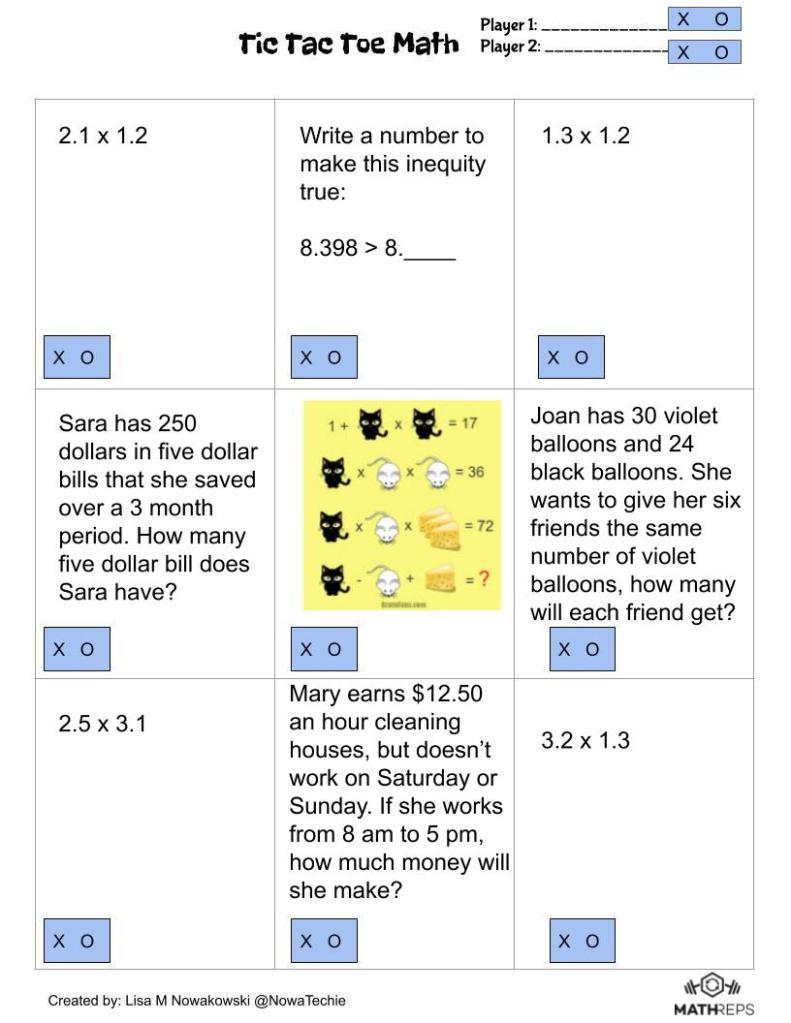
Tic Tac Toe Math (1) This is a sample I created for my class. My intent was to review some basic math concepts while having fun. The rules are simple:

Each player writes their name and chooses either X or O.

  1. Player 1 chooses a square to complete. BOTH Player 1 and Player 2 independently work out the problem in the chosen square.  If Player 1 is correct, Player 1 gets the square and circles their symbol (X or O)
  2. IF Player 1 is incorrect, Player 2 has a chance to ‘steal’ the square. Player 2 MUST complete the problem correctly AND explain where Player 1 was incorrect.
  3. Player 2 chooses a square, even if they stole Player 1’s square. BOTH players must work independently to solve the problem. If Player 2 is correct, Player 2 gets the square. If Player 2 is incorrect, Player 1 has a chance to ‘steal’ the square. Player 1 MUST complete the problem correctly AND explain where Player 2 was incorrect.
  4. This continues until someone wins or all squares have been completed.

I tested it out on my students. They liked it and had some good feedback. Some wanted ALL algorithms. Some wanted harder problems. This was a fair statement as I purposefully chose easier problems. I wanted to hook them before going all in. Two students worked on the middle square together and decided that they both claimed it; that worked for me. Overall, it was something that they all enjoyed.

The set up of the problems was purposeful. The four corners are meant to be easier problems (DOK 1). This allows all students success. Those that are between the four corners are meant to be a bit harder. Finally, the center square is to be the hardest. A challenge problem. A player can still win without choosing the challenge problem. I did like the modification my students came up with for that middle square. It takes the pressure off one particular player and allows for collaboration, problem-solving, and communication between players in a friendly manner.

I have created a template with directions and the above sample. Feel free to copy and create your own. I would love to hear how you are using it and how your students feel about it. What modifications have you made? Please share!

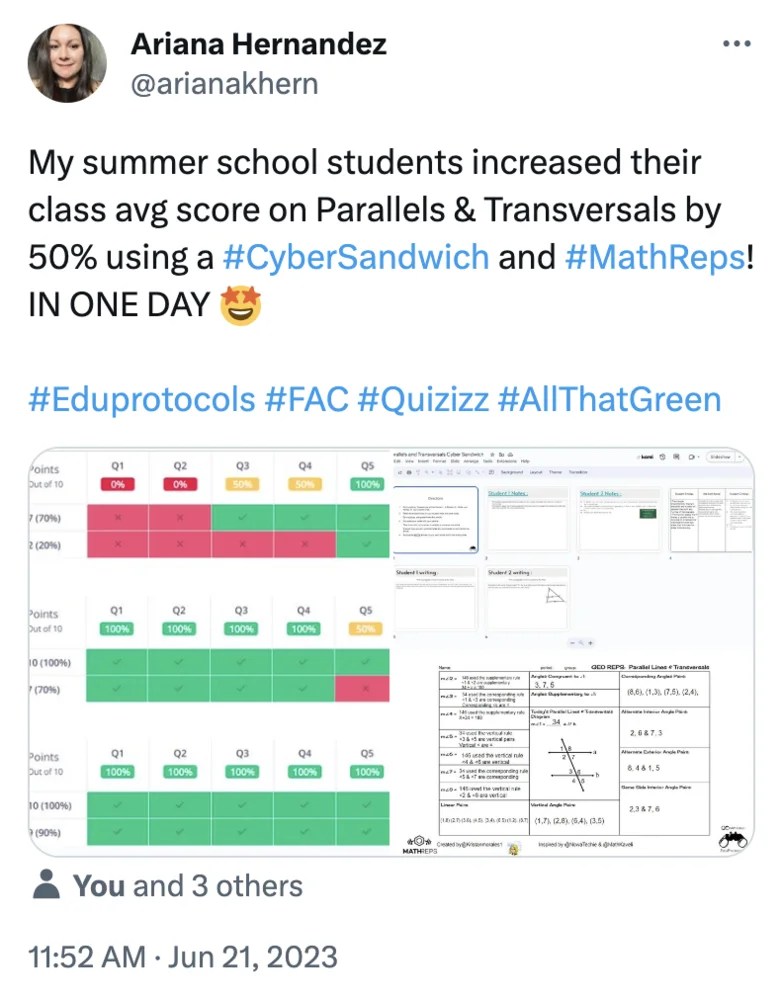
#MathReps Work!

Several years ago I created #MathReps (EduProtocols for math) for my classroom. The original idea was based on Jon Corippo‘s 8 p*ARTS of Speech. When I first designed it I was excited and blogged about it. Since then, the idea, and resources have grown. And being who I am, I constantly doubt myself and my creations. I constantly question whether I’m doing good or harm.

MathReps Logo

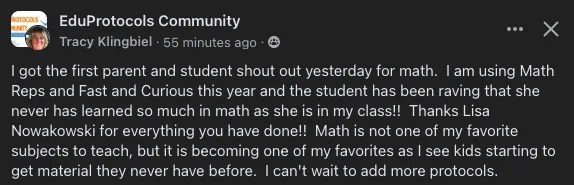
Yesterday, some of my doubts were cast aside and my creation was validated. Recently, I was talking to another 5th-grade teacher at my site. We were talking about some tasks that we have students do. She follows the curriculum to a T; I, however, do not. This is in NO way a slight towards her (she’s new and is doing as she is instructed). She shared that she pulled out a concept the students hadn’t seen in a few months (our curriculum doesn’t spiral. I have much more to say about it, but won’t do it here.). It was adding/subtracting with decimals. I thought THAT was a great idea, so I did the same. She reported her students having difficulty remembering to line up the decimals doing the task. As I gave my students a similar task, I observed that they instinctively lined up the decimals. I found this not only interesting but satisfying. My students had been exposed daily to almost 5 months of this concept on various #MathReps. Needless to say, I was elated and felt somewhat justified in doing what I do.

After completing the task I had a frank discussion with my class. I asked, even though I already knew the answer if they had any trouble adding the decimals. I asked about lining up the decimals. They all looked at me like I was crazy. Of course, they knew to line up the decimals….duh! I then shared WHY! I also shared that a class that doesn’t use #MathReps had trouble remembering that important piece of information. And that it was because we practiced these concepts DAILY that they had no trouble with that part. (They had trouble with the task but weren’t confused about how to perform the actual skill of adding decimals.) Because of the culture of our class, they focused on the fact that #MathReps actually do help them and not on the class that had trouble. It was so awesome to bring to light to them, and me, that this protocol really works. One student even remarked that while they may not like doing them it does help them to learn.

Just like with anything, if we don’t use newly acquired knowledge we lose it. In addition, John Hattie puts repetition at a 0.73 on the Hattie Check Scale. I would caution that there are different types of repetition and we need to make sure that our reps are meaningful.

I did share this with the other teacher. I assured her it was no slight on her, and she understood, rather it was a slight on the adopted curriculum.

#MathReps

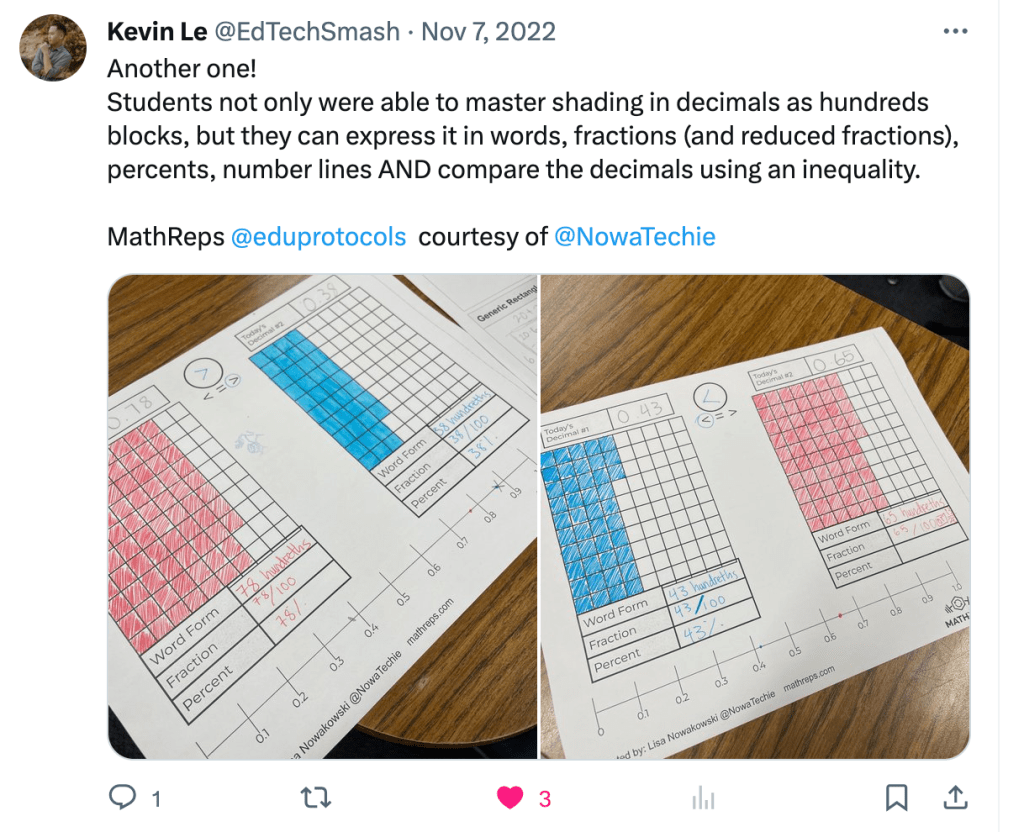
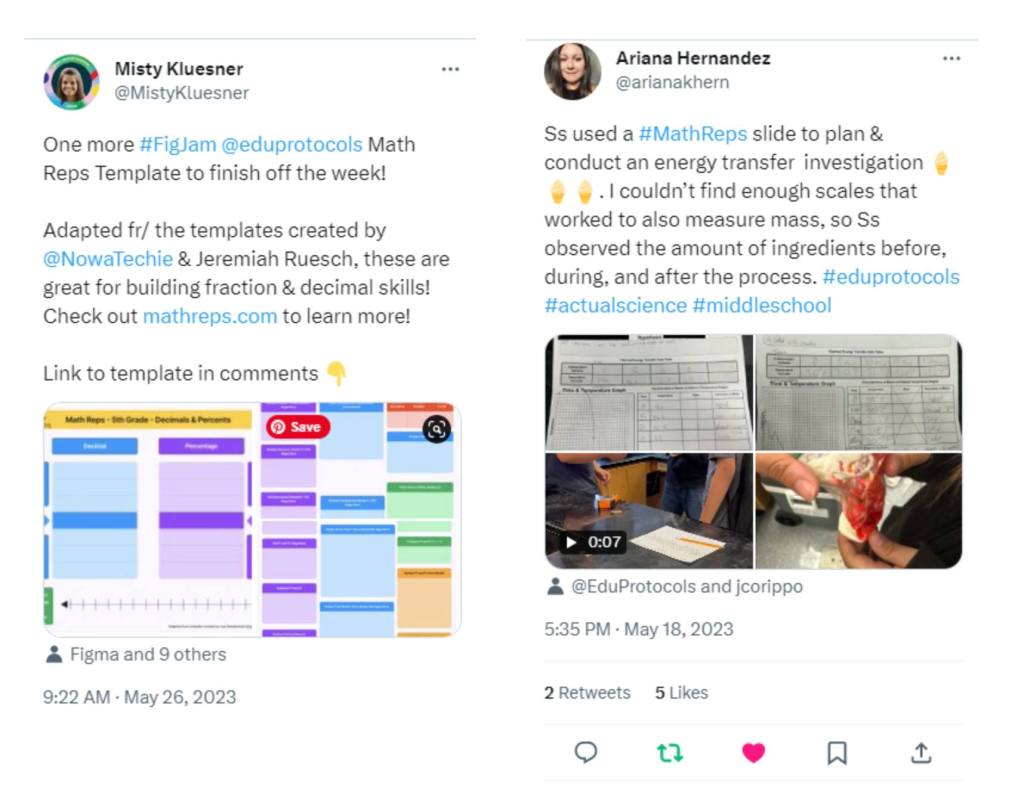
About a year and a half ago I began imagining how Jon Corippo‘s 8 p*ARTS of Speech might look in a math classroom. That’s when I started on my journey of #MathReps. It was small, and originally just for me. I had no problem sharing it and did so freely. Since then, I have been encouraged to expand to other grades. Working with other teachers, I have begun creating and collecting #MathReps for grades K – 8. It is an ongoing process.

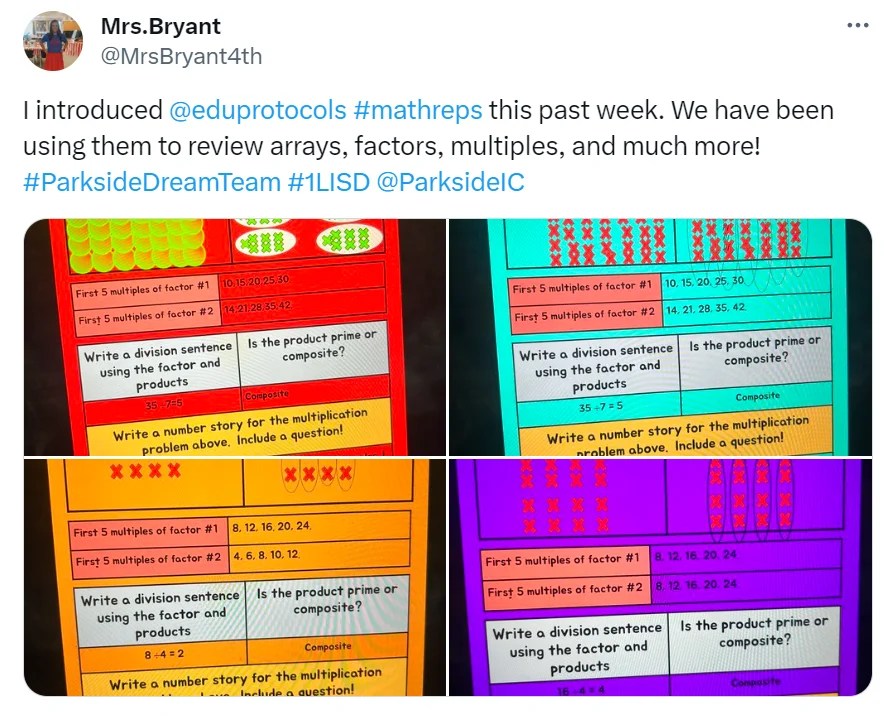
#MathReps Example

Feel free to share with others. All credits are given to those that helped. And to them, I thank you!