In the previous Mathematical Language Routine (MLR) discussions, we explored a variety of essential skills. MLR 1 focused on enhancing our understanding by revisiting and reinforcing key concepts, making our knowledge “Stronger and Clearer Each Time.” We then moved on to MLR 2, where we delved into the crucial skill of “Collecting and Displaying” data effectively. Building on this foundation, MLR 3 emphasized the importance of “Critiquing, Correcting, and Clarifying” our models and methodologies for optimal results. In MLR 4, we explored the “Information Gap” and how to use this strategy to be thoughtful of the information needed to solve problems. Continuing this journey, MLR 5 introduced the skill of “Co-Crafting Questions and Problems” collaboratively to foster innovative approaches and insights. Finally, in MLR 6, we explored the technique of “Three Reads,” emphasizing the significance of multiple reads in order to enhance student understanding. Let’s now embark on our next MLR discussion, MLR 7 Compare and Connect.

MLR 7: “Compare and Connect,” has the purpose of fostering students’ meta-awareness in their exploration of different mathematical approaches, representations, concepts, examples, and language. Through this MLR, students are encouraged to reflect on and verbally respond to these comparisons. This involves analyzing why certain mathematical actions or statements are done in a particular way, identifying and explaining connections between various mathematical representations or methods, and pondering how one idea relates to others in terms of both concepts and language. To support this learning process, teachers should model their thinking aloud when addressing these questions. This routine allows students to engage in rich mathematical conversations. We will explore two ways in which to accomplish this.
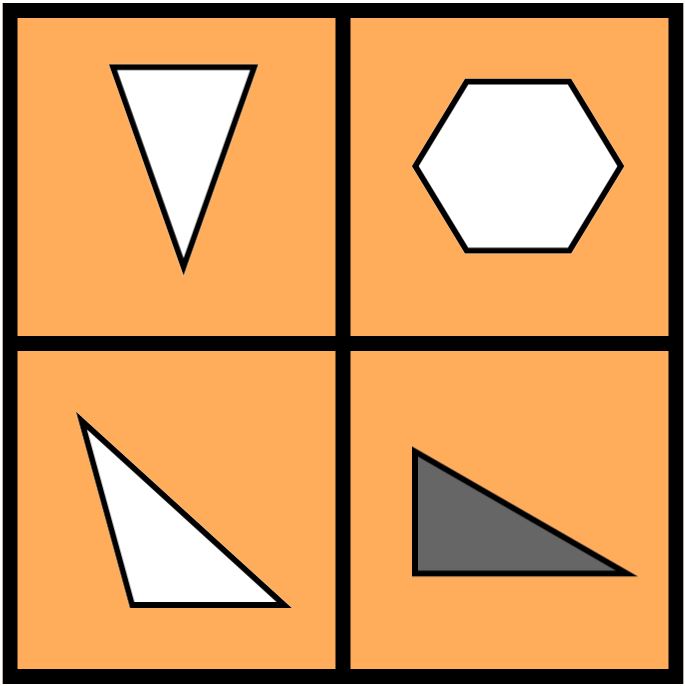
Getting students to engage in discussions about math, make connections, and consider different perspectives can be quite challenging. I often encounter students who simply say, “It was in my brain” or “My brain told me the answer.” However, by modeling and encouraging metacognitive awareness, students can begin to make connections on their own. One effective routine that focuses on linguistic skills is called ‘Which One Doesn’t Belong‘. This activity can be done in groups, in pairs, or as a whole class. Students are presented with four images, equations, numbers, graphs, or geometric shapes, and they are asked to identify a commonality among three of them and explain their reasoning. The interesting twist is that any combination of three out of the four options can be correct. For example, in the orange example, one could argue that the three triangles go together and the hexagon is the odd one out. Alternatively, one could justify grouping all the white-filled shapes while excluding the shaded shape. This activity is both enjoyable for students and provides the opportunity to hear and consider different viewpoints.
Another interesting activity that aligns well with this MLR is the Math EduProtocol Sous Chef from The EduProtocols Field Guide Math Edition (Chapter 9, page 56). In this activity, students are grouped together to solve a problem using different approaches and then present their work to the class. For instance, if students were given the task of solving 4 x 6 in third grade, one student might use equal groups, another could opt for repeated addition, a third student may create an array, while the last student represents the equation with the area model. Through this activity, students can establish connections with previously learned concepts and broaden their understanding. There are numerous ways to implement Sous Chef, but the central focus remains on fostering connections among ideas and encouraging students to share their thought processes orally.
In conclusion, incorporating this MLR into your math class will greatly benefit your students. It will help them enhance their meta-awareness, make connections between different concepts, and foster a deeper understanding of the subject. While we have explored two approaches to this MLR, there are numerous other equally powerful techniques available. In our next discussion, we will delve into MLR 8: Discussion Supports, which focuses on stimulating rich and meaningful conversations in the classroom.

 Nowa Techie