The “3 Reads Protocols” is a highly effective technique among the 8 Mathematical Language Routines. This strategy encourages a comprehensive understanding of word problems through a structured approach. In this activity, the problem is read three times, but it entails more than simple repetition. During the first read, the focus lies on comprehending the problem’s narrative. To aid in this process, teachers often conceal quantities and questions, enabling students to concentrate on comprehension rather than immediately diving into mathematical calculations. In the second read, teachers reveal the hidden quantities, redirecting students’ attention towards analyzing these values and their associated units, consequently deepening their grasp of the problem’s context. The final read diverges into two possible paths. If a question is provided, it is read aloud, and students formulate a strategic plan to tackle it. Alternatively, if no question is given, students are prompted to generate a list of inquiries themselves. Personally, I advocate for the latter approach, as it not only boosts student engagement but also fosters natural differentiation. In this scenario, students select a question from the generated list to solve. Remarkably, I have seldom witnessed students opting for an easy way out; rather, they frequently rise to the challenge by choosing appropriately challenging questions for themselves.
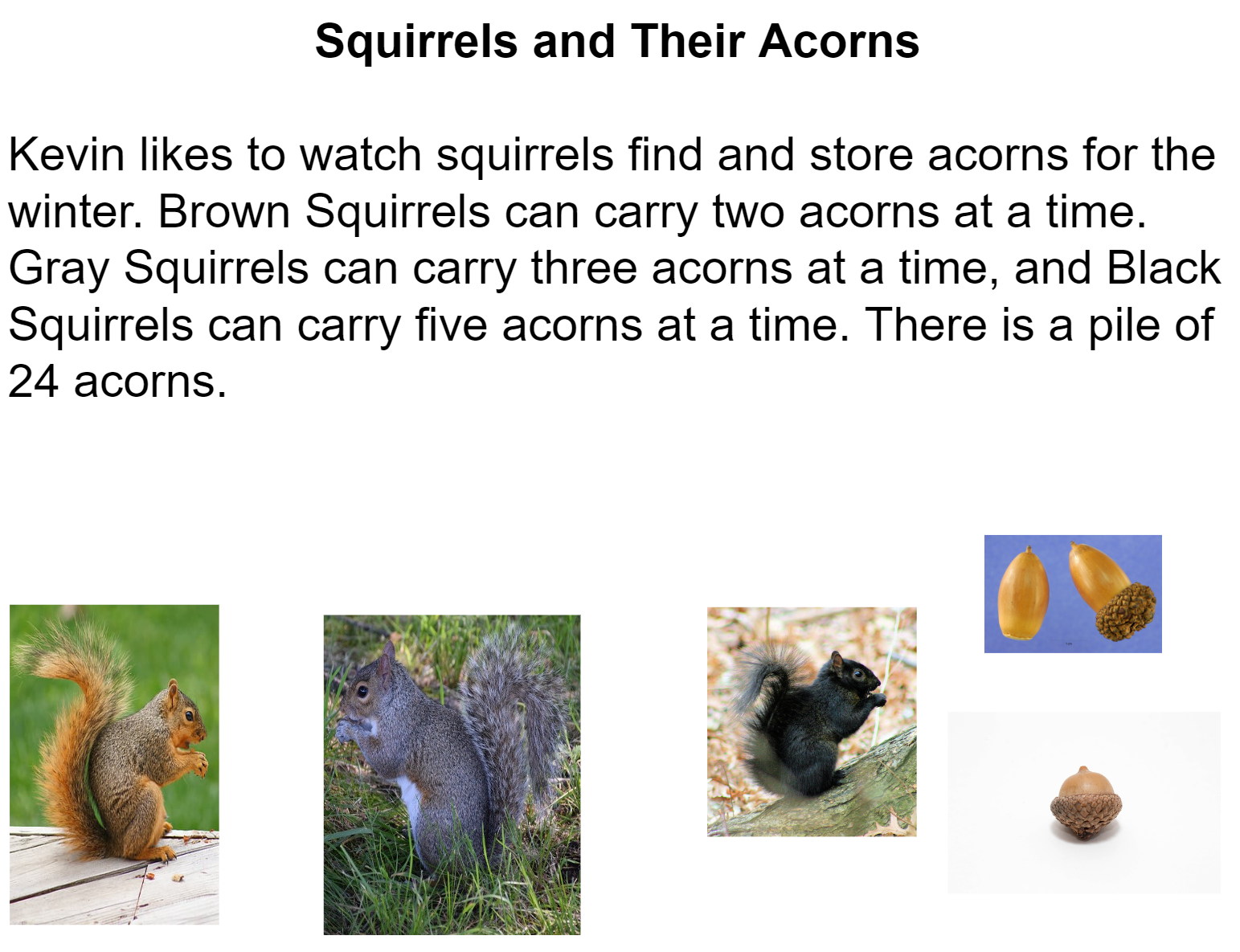
Today I was able to visit a 3rd-grade classroom in which the teacher was practicing this routine with their students. The teacher began by accessing the students’ prior knowledge about squirrels. The teacher then read the story (minus quantities) to the students. With partners, they discussed what the story was about. This can be hard for some students in the beginning. They know it’s math and naturally start looking for problems to solve. The students went through the steps and enjoyed themselves. After generating a list of questions, the group decided to answer the same question: How many acorns did each squirrel carry to get the pile of 24 acorns?
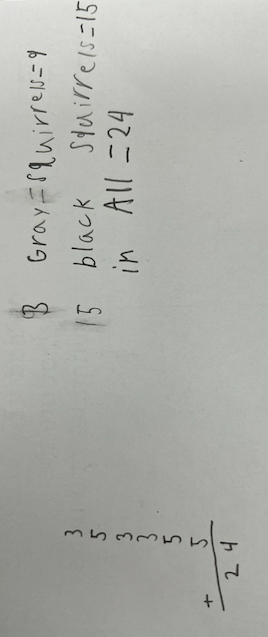
The struggle began as the teacher and I observed the students grappling with the task. We decided to give them some time to develop their own strategies before intervening. Many of them struggled to find a clear direction. Some counted the number of acorns squirrels can carry, reaching a total of 10. However, they seemed unsure about what to do next. Sensing the need for guidance, we asked the students to explain their thinking process. It was at that moment when a student appeared to have a promising approach. We asked him to elaborate on his reasoning. With a little clarification, he successfully explained that the black squirrel carried 15 acorns, while the gray squirrel carried 9 acorns. Surprisingly, the student didn’t mention the brown squirrel; technically, it carried 0 acorns. Another student followed suit and broke it down in a slightly different manner:
| Brown | Black | Gray |
| 2 | 5 | 3 |
| 2 | 5 | 3 |
| 1 | 2 | 1 |
Doing it this way, the student was able to organize their thoughts and solve the problem in smaller chunks. At this point, we stopped the class to celebrate some early successes. With permission from the students, we shared each strategy pointing out how they are different yet correctly answered the question. By having the students explain their thoughts and showcasing some strategies this allowed struggling students to begin making sense of how to begin to tackle solving the problem. While some students still struggled others found similar strategies and were able to begin solving the problem.
The students agreed that this task was difficult, but fun. From our perspective, the students were engaged. As this was not the first time that students had experienced this, we can see small gains being made in the area of word problems. This is a protocol that the teacher plans to continue to use throughout the year.

 Nowa Techie