I often find myself going down unexpected rabbit holes, and today was no exception. While on a quest to create a more engaging quadrilateral hierarchy for a 3rd-grade team, I found myself pondering the age-old question: Is a parallelogram a trapezoid? As it turns out, the answer is both yes and no!
I know. You’re wondering how it can be a trapezoid and yet not a trapezoid simultaneously. The answer lies in the definition of a trapezoid. The Oxford Dictionary defines a trapezoid as “a quadrilateral with only one pair of parallel sides.” So, according to this definition, the answer is no, which makes our math ‘program’ give incorrect information (that is a whole other post). However, many define it as a quadrilateral with at least one pair of parallel sides, which makes a parallelogram a trapezoid and our math ‘program’ correct.
In my math mind, a parallelogram is separate from a trapezoid. According to the hierarchy, the broad spectrum is quadrilateral. Below that there are either two or three main categories of quadrilaterals: kite, trapezoid, and sometimes parallelogram. Then, the parallelogram can be further broken down into rectangle and rhombus. Those can both be broken down into a square.
For the purposes of our district, I followed the current ‘curriculum’ where a parallelogram is a trapezoid. Below are the two variations of the poster.
So, what are your thoughts? Is a parallelogram a trapezoid or not?
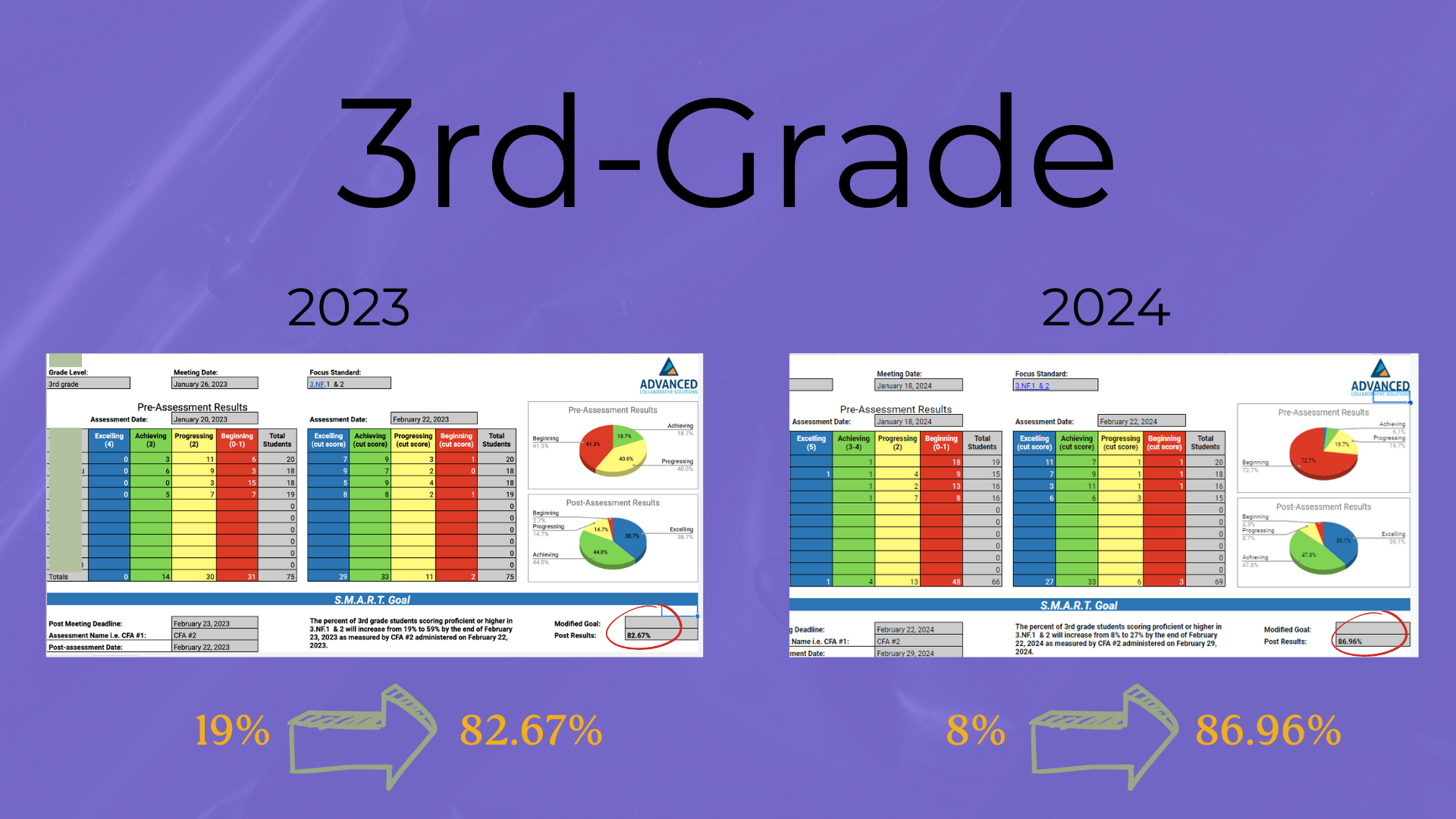
For years, I’ve questioned the effectiveness of MathReps and pondered whether the skills transferred to everyday math tasks. Known for overthinking and constantly questioning things, I’ve been intrigued by recent data from teachers showcasing the positive impact of MathReps on their students.
There are numerous reasons to celebrate these results. Firstly, this is a multi-year comparison illustrating a significant improvement. The 2024 year initially showed a much lower proficiency level than the 2023 year. However, it is important to note that their overall gains were greater in 2024. Secondly, the teaching staff remained consistent over these two years; there were no departures or new additions. Remarkably, one particular class saw an astounding increase from 5% to 90% proficiency in just 4 weeks. It’s worth noting that this exceptional progress happened after the teacher conducted the final assessment earlier than planned due to external circumstances. Subsequently, the same group of students took the SBAC IAB for Fractions, which resulted in 14% below the standard and 86% at or above it. This is particularly noteworthy as the class had only been 5% proficient with fractions a few weeks earlier. While the teacher deserves full credit, she acknowledged that regular completion of MathReps played a role in this achievement. Furthermore, the IAB takes the students’ knowledge of the subject matter and requires them to use that knowledge in context. This further supports knowledge transfer is happening. This is just one example of the success that can be achieved through the use of MathReps.
Why do I bring this up? Students are struggling, and teachers are noticing. Too often students come without the basic skills necessary to succeed with the expected standards. I witnessed this many years ago (pre-pandemic) and created the first MathRep. I noticed that my 5th-graders could master the expected skills during the first trimester. Then, the skill expectations shifted to fractions in the second trimester. This is where many of my students lost the skills they acquired in the first trimester. So by the time the third trimester rolled around, all was forgotten from the beginning of the year. Needless to say, this is less than ideal, especially when state testing is right around the corner. So MathReps were born!
So, after several years and an ever-growing library of MathReps I have started hearing from countless teachers from across the county witnessing the same success I am seeing with teachers in my district. I love that they also share stories about their students and how they have gained confidence through MathReps. All this is to say, if you haven’t tried them, you should!
What are MathReps?
MathReps are carefully crafted templates that incorporate interconnecting skills/standards. MathReps allows students to make connections between skills and concepts seamlessly. They are customizable and versatile. The repetition allows students to master the skills without the cognitive load of navigating a new ‘review page’ each day. The format remains the same. The teacher changes the number each day, allowing students to work through a series of skills. The teacher provides immediate feedback by walking around the classroom or checking the work as a whole, leaving zero paperwork for the teacher to deal with at the end of the day.
MathReps explanation video
Where to Start
With this data, it’s a no-brainer. MathReps work. If you’re looking to get started, head on over to MathReps.com and find a template that’s right for you! No need to worry about the cost, it’s FREE! The templates are all teacher-generated. That’s right, made by teachers just like you for students just like yours.


 Nowa Techie